Guest post: ‘an adventure beyond words’

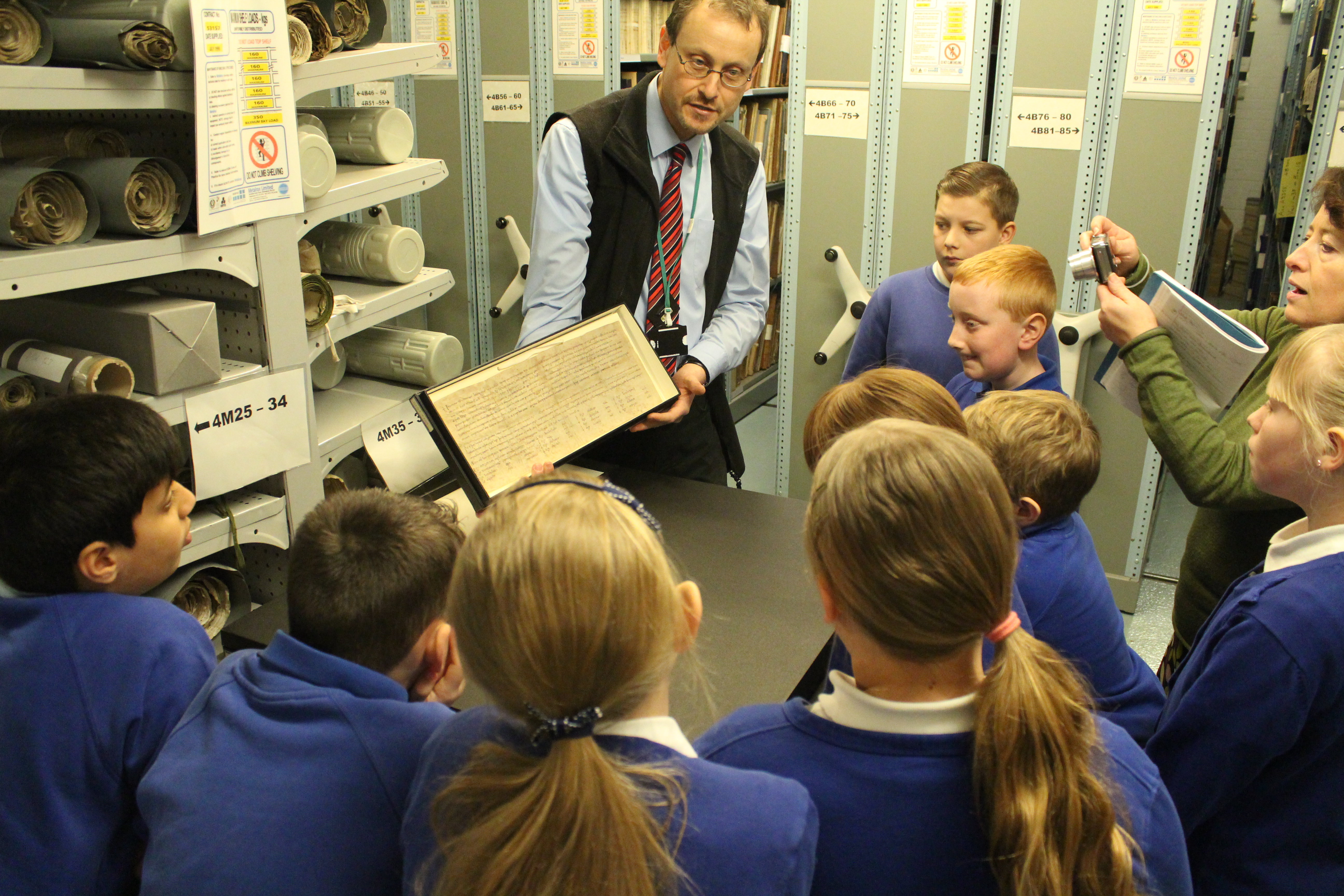
This guest post is written by Ben, Grace, Evie, Akmal, Toby, Ben, Grace, Lucas and Bella who are all in year 5 at Broomfield Primary School. They were shown around the ERO by Neil Wiffen, Public Service Team Manager, and Hannah Salisbury, Access and Participation Officer. If you would like to arrange a visit for an educational group, please get in touch with us on ero.events@essex.gov.uk 

My teacher and a small group of pupils were invited to The Essex Record Office. Not the CD, track kind of record: the letter, diary, document kind of record. We were not just fascinated to find out some amazing facts, we were amazed to see some facts that gave us a link to things from hundreds of years ago. On our journey through time we filled our brains with lots of information and fun facts.

Why does the Essex Record Office (ERO) exist? Some people have interesting artefacts in their home but it’s no good having it all there! The ERO provide the capability of looking at all the information you need in one place.  You do not have to make appointments in different buildings, the ERO has everything you need, but they have certain rules. These include not taking any bags (at all!) into the Searchroom.  This is because some naughty people try and steal the information. The other rule was to use pencil only, as they don’t want to ruin any documents or information. The ERO is for people of all ages – there is no limit. You cannot only just have fun and find out information, you can understand and communicate with the past.

When the ERO was opened in 2000, there was a model made of a flower designed by pupils [ed.: the sculpture which runs alongside the public stairs up to the Searchroom]. The roots were to represent that History is in the past, the stem shows that were are the present.  The flower and the seeds (which were binary 1 and 0s) represented the information travelling out in the future.

When we walked into the Searchroom Mr Wiffen explained about the organization of the documents. We thought it sounded quite complicated but actually it turned out to be a lot easier than we thought. IMG_5792 They have this website called Seax (a Seax is an Anglo Saxon stabbing sword and on the Essex County Council logo, the swords are Seaxes).  The website called Seax helps you to find documents VERY quickly and efficiently.  We searched for ‘Maps of Broomfield’ and it came up with 113 results.  The earliest was made in 1591 and the latest was made in 2007. To search, you type in the key words, and then it shows you all the search results with the key words in date order.

Hannah then informed us about a pie chart that someone made from the information in a book called a Parish Register which had a list of Births, Deaths or Marriages.  Somebody looked at details telling us about deaths in the 1830s.  We were shocked to hear that over half the people died under the age of 10!!

We definitely realised that Seax was helpful, especially for people who live overseas and love historical documents, because anyone around the world can ask for things to be put on there.  It is much cheaper than travelling to the ERO, but it was more fun to go there for our visit.

After we observed the picture-perfect painting of James I [ed.: on display in the Searchroom], Hannah told us that when monarchs wanted portraits of themselves, they would have chosen props that represented them. For example, Elizabeth I chose a globe to show she has invaded different nations. We should look for clues in paintings, not just at the person who has been painted. IMG_5800 Next Mr Wiffen pulled a draw out full of envelopes and picked up a microfiche, which is miniscule pictures of wills and newspapers.  The reason why the newspapers are made smaller is because you can keep lots of information on a small sheet of film and the big news paper takes up a lot of room, is very thin and will disintegrate. You have to place the microfiche in a machine, so that when you look through, it will magnify and illuminate it big enough for people to read it. IMG_5807 Mr Wiffen showed us a couple of unique maps of Broomfield in the past. The first one we looked at was from 1846. It was an enormous map and Broomfield looked empty and lonely, with fewer houses and more greenery.  We found that our school and houses had not been built yet. We put our fingers on our invisible houses. Bromfield Hospital was not there yet either, but the area where it would be built was called Puddings Wood. IMG_5832 Then we looked at the earliest map of Broomfield which was made in 1591 by John Walker.We could see the beautiful colours to show the roads, houses and landmarks.  It was made for Widow Wealde and showed all of her land. D-DVk 1 watermarked The next map we looked at was created and drawn by hand in 1771 of Broomfield, it is 244 years old. It showed a field called Drakes Fut, which is near our school.  It is now called Dragon Foot Field. We talked about a legend from 1,00 years ago.  Every day workers would build a bit of Broomfield Church and use strange red bricks and tiles that they found in the field.  But in the night, when they were sleeping, a dragon would take all the bricks and bury them back in the field. Imagine how the builders felt when the dragon took their building materials! They must have felt frustrated and scared. Nowadays, we know the bricks and tiles were made by Romans and there was a villa in that field. Bricks and tiles from the villa can be seen in the walls of Broomfield Church.

Shortly after, we were showed a map from 1919 in Broomfield. There were 2 coffee shops and here is a photograph to prove that it really did exist.  We were surprised that people used to go out for a coffee, just like we do today.  Coffee shops were there to stop people from spending all of their money in the pubs. But even 100 years ago there were no roads, just mud. The road outside Broomfield Primary School was just mud too – and it looked VERY muddy.

D-F-269-1-3176

One of Broomfield’s two coffee shops (from the Fred Spalding Collection)

D-F-269-1-3170

Broomfield School and a very muddy unmade road (from the Fred Spalding Collection)

There is a pub called The Saracens Head on the High Street in Chelmsford.  We saw a photograph if it showing the American soldiers who used to go there to interact and relax. Back in the Second World War, Mr Wiffen’s dad (who lived in Broomfield) had heard planes fighting overhead when he was a boy.  Would you like it if bullet cases were falling on your shed?  That’s what he could hear, but he was probably in his Anderson Shelter.  Forty years later, he found a spent bullet case (probably from those fights) in his back garden.

Broomfield has lots of things in the ground from different periods of history.  How would you feel to be standing on history, or to never find artefacts that could be worth millions! We had an amazing time looking at the spectacular maps.

After that we carefully opened a box that was in another box with another padded cover.  Inside was a special bible that Charles I had before his gruesome and terrifying beheading happened. Somehow, Charles’s librarian Patrick Young, got his hands on it and gave it to his granddaughter Sarah who gave it to the Broomfield Church. IMG_5880 IMG_5883 When the Church was being renovated, apparently the builders dropped it by accident!  They decided to give the responsibility to the ERO to protect the Bible forever. The Bible has an amazing silver outline with a glorious red velvet cover, decorated with a lion, a unicorn, a crest of arms and initials. IT MUST’VE COST MILLIONS!!!!!  The lion was very detailed with tiny silver stitches – the mane swerving in different directions and the ribs and claws very clearly seen.  He has two beady bead eyes.

The ERO looks after Log Books from different schools, and here is a page from Broomfield Primary School in 1912.  The book sat on a special pillow to protect the spine and showed the beginning of the school summer holidays.  the school was closed so that the children could go and help with pea picking for the harvest.  Food was important – everyone needed to help collect enough food to get through the next winter.  That is why we have six weeks off in the summer.   Luckily we don’t actually have to pick peas any more!

Eventually, we reached the storage room after a long walk from the library. The storage room keeps all of the documents and old books safe. The humidity and temperature was cool enough to preserve them for even longer than usual. To access the room, Mr. Wiffen had to scan his staff card in a laser. We had to be quick going in because the door shut after 30 seconds!

As soon as we got in we felt a lot cooler and looked at huge rolls and lots of shelves and books. First of all, he showed us the stacks. These have codes on them to help staff find the right document quickly. They are moveable so they can fit more of them in. There are 8 miles of shelves altogether. He also told us that the red pipes let out a special gas during a fire to prevent the special files from burning.  Water would damage the documents, and so would foam, so gas is safer for the documents.  However, if the fire alarm goes off you have only 45 seconds to escape!

Next, Mr. Wiffen showed some precious packages, one of which was an Anglo Saxon document from 962 AD, written on parchment (Animal skin). They were deeds from Devon, part of Lord Petre’s collection. This is the oldest item in the collection.

IMG_5913

Looking at the ERO’s oldest document, an Anglo-Saxon charter from 962 (D/DP T209)

He then showed us a huge, hand drawn and hand coloured old map of Chelmsford from 1591, by John Walker. Even though it was old, the colours were bright and beautiful.  On the edge of Chelmsford, were two little lines to show the town gallows.  Who would have thought they would build grizzly gallows in such a beautiful town? And right behind the town centre was a field called the Back Sides, where John Lewis will be built!

John Walker's map of Chelmsford, 1591

John Walker’s map of Chelmsford, 1591 (D/DM P1)

Lastly, we scurried out past the timed doors and saw a strange thing.  It did look peculiar, but it was one of the camera’s dust covers: a chicken tea cosy! If you live in Australia and want a photograph of a document, they will use the really good camera to take an image and then send it to you.

Then we continued our journey to the Conservation Room. The Conservation Room is a room where they carefully fix and clean documents, maps and letters. A lady called Diane showed us all the things that she needed, and some things that she couldn’t fix. For instance a letter, which was folded up into a bundle and tied up, had been burnt by fire and had got very brown.  It felt harder than metal – however it would be very, very easy to break if anyone tried to unroll the document.  Nobody would ever know what was written on it.  On the other hand, some Americans have now invented a machine, which mysteriously x-rays the bundle and scans the letters by looking at the ink inside, and makes a reconstruction that shows you what it had on it before it went in the fire. Maybe one day somebody will be able to put this document in and see what it is all about.  Right now, all we know is a date of 1917, which we found when we examined it. IMG_5955 Next Diane showed us a paper document that had lots of mould on it. She said it would never come off, so if you at home have very special letter or something else, make sure it’s not in your loft where mould will develop. The only writing on this was ‘{Be is re……..day of……year of the reign of our……. of Great Britain, Franc…….and fo forth.’  The rest of the paper had disintegrated. As well as that, we were allowed to hold a real piece of parchment.  It is animal skin and is very strong.  It lasts much better than paper so we could touch it. There also was large a circular thing made of wax. It looked a giant coin because it had Queen Victoria on her throne. On the other side, it was a picture of her on a horse.  A quarter of it had been smashed on the floor. Most of words were in Latin, however most of it we could read. These big seals were attached to important documents to show that the King or Queen agreed with what was written inside it.

IMG_5966 Last of all, Diane showed us scientific equipment such as a measuring container that could make sure that when she fixed using different liquids, she had the right amount of it. For example if she needed a litre of water, she could make sure there’s not too much and not too little.  There were other scientific instruments to make sure the temperature and humidity were exactly right in the room all the time.  It was interesting to see how Science and History were used together in one job.

We had a mind-blowing time at the ERO, our brains were stretched. It was an experience of a life time and an adventure beyond words. We had no idea it would be so interesting and would like to say thank you to the ERO for giving us an amazing tour, we learnt lots! It’s a brilliant place to find out many things. The people who work there are very kind and friendly.  They were experts and shared all their knowledge and information with us from generations ago. We were mad at Mrs McIntyre (our teacher) for making us leave, and were desperate to stay to find out more about our own pasts and where we lived. We hope to be back soon…

By Ben, Grace, Evie, Akmal, Toby, Ben, Grace, Lucas and Bella, Broomfield Primary School
ERO is stronger with Friends: purchase of the Saulez collection

The Friends of Historic Essex are a charity which supports the ERO. Throughout the centenary of the First World War, the Friends and ERO are working together on the Essex Great War Archive Project, which aims to preserve documentary evidence of the period for educational study, family history research and community histories. The project includes looking out for documents relating to Essex people and places during the War, and where possible acquiring them for our collection.

If you would like to help, would you consider making a donation or becoming a member of the Friends? Details are available on the Friends’ website.

Here, Archive Assistant Sarah Ensor shares details of the most significant purchase made as part of the project to date – the Saulez family collection. (A version of this article first appeared the Autumn 2014 edition of the Essex Journal.)

The Friends of Historic Essex have recently acquired a family collection which has since been deposited at the Essex Record Office (Accession A14026).

This slideshow requires JavaScript.

DP-511-28-1 Robert Travers Saulez crop

Rev. Robert Travers Saulez (D/P 511/28/1)

A large part of the collection consists of letters and telegrams from and relating to the sons of the Reverend Robert Travers Saulez (right). Robert was born in India in 1849 where his father, George Alfred Frederick Saulez, was an assistant chaplain at Nainee Tal. After gaining his degree from Trinity College Cambridge Robert served as curate in Lancashire, Hampshire and London before moving to Essex in 1886. According to Crockford’s Clerical Directory he was vicar of Belchamp St. Paul from 1886 to 1901 and rural dean of Yeldham from 1899 to 1901, vicar of St. John, Moulsham from 1901 to 1906 and rector of Willingale Doe with Shellow Bowels from 1906 to 1927. He retired to Twinstead where he died in 1933.

Robert and his wife Margaret Jane had three sons and a daughter between 1882 and 1887. Their sons, Robert George Rendall, Arthur Travers and Alfred Gordon were all educated at Felsted School and later served in the army. The letters deposited appear to date from towards the end of the Boer War through the Great War and beyond.

Robert George Rendall Saulez answered the call to serve in the South African Constabulary from 1902 to 1904 so is likely to be the author of the earliest letters in the collection. He volunteered soon after the outbreak of the Great War and served with the Army Service Corps in Egypt and Palestine. He was a good horseman and was recognised during the war for his share in providing an efficient transport service by ‘Horse, Camel or Motor’. After the war he served in the Supply and Transport Corps in the Indian Army until about 1922 after which it is believed he settled in the country.

IMG_4287 edit

Bundles of letters fill the boxes

On leaving school Arthur Travers Saulez attended the Royal Military Academy before joining the Royal Garrison Artillery. He was posted to India in 1907 but returned to England prior to 1914 and was sent to France in May 1915. He achieved the rank of Major and having survived the Battle of the Somme was killed on 22 April 1917. The pencil in his diary which is amongst the collection is lodged in the page of the week of his death. A window was erected in the church at Willingale Doe in memory of Arthur Travers Saulez by the officers, NCOs and men of his battery.

IMG_4296 edit

The diary of Arthur Travers Saulez, with the pencil still marking the spot where he made his last diary entry before being killed in April 1917


Hart’s Annual Army List for 1908 shows that the youngest of the brothers, Alfred Gordon Saulez, had joined the Army Service Corps in 1906 and when war broke out he was sent to France as part of the British Expeditionary Force in 1914. Like his brother Arthur he rose to the rank of Major but unlike his brother he survived the war; however nothing is known of his service throughout the conflict so hopefully some of his letters are in the family collection and will reveal more. Following the Armistice he was posted to Mesopotamia where he died in 1921 apparently as a result of the ‘excessive heat’; he left a wife and two children.

IMG_4307 edit

One of the more unusual items within the collection – a remedy for poisonous gas

Robert and Margaret’s daughter Margaret Hilda embraced the opportunity that the Great War gave women to be involved. She served with the Scottish Churches Huts which, like the YMCA, provided support behind the lines in France. Following the war she married Wilberforce Onslow Times at St. Christopher’s in Willingale Doe with her father conducting the service.

D-P 388-1-11 image 95

Marriage of Margaret Hilda Saulez, with her father as minister (D/P 338/1/11, image 95)

Until this collection of over 300 letters and other items can be sorted and catalogued the full story of this family’s experiences serving their country remains untold. It is hoped that funding can be raised to expedite the cataloguing and storage of the collection and the provision of an educational resource for students and people of all ages. If you as an individual, group or institution are interested in helping fund this project then please contact the Friends of Historic Essex by e-mail or by writing to them care of Essex Record Office, Wharf Road, Chelmsford, CM2 6YT.

You can also help to support the Essex Great War Archive Project by coming to a fundraising quiz organised by the Friends on Friday 17 April 2015 at Galleywood Heritage Centre – full details, including how to book, can be found here.

An Essex nurse on the Western Front: Sister Katherine Evelyn Luard (1872-1962)

On International Women’s Day 2015, we thought we would highlight the story of one extraordinary Essex woman, Sister Kate Luard. A version of this post first appeared in Essex Life magazine.

Katherine Evelyn Luard was born in Aveley in 1872, the tenth of 13 children, the daughter of a vicar. She grew up at Aveley Vicarage, and then Birch Rectory near Colchester.

Kate Luard Birch Rectory

Sister Kate Luard in her Queen Alexandra Imperial Military Nursing Service Reserve uniform in the doorway of her family home, Birch Rectory. Reproduced courtesy of Caroline Stevens.

Kate, known as Evelyn or Evie to her family, was aged 42 when the First World War broke out, but she headed straight to France, arriving there on 20th August 1914, just 16 days after war was declared. She had previously served as a nurse in the Boer War in South Africa in 1900-1902, and joined the Queen Alexandra Imperial Military Nursing Reserve as a Sister. She worked as a nurse on the Western Front until December 1918, in field hospitals, casualty clearing stations, and on ambulance trains. She was awarded a Royal Red Cross and bar for exceptional service in military nursing.

Photograph of one of the hospitals Kate worked in on the Western Front (D/DLu 55/10/5)

Photograph of one of the hospitals Kate worked in on the Western Front (D/DLu 55/10/5)

Kate and her family exchanged hundreds of letters during the War, many of which are held at the ERO, and she also kept a diary, which was published anonymously in 1916 as Diary of a Nursing Sister on the Western Front, 1914-15; a copy is available in the ERO library. A collection of her letters was also published in 1930 as Unknown Warriors: the Letters of Kate Luard, RRC and Bar, Nursing Sister in France 1914-1918. A new edition of Unknown Warriors was published in 2014 – you can find out more about it here (again, a copy is available in the ERO library).

Just a few of the many letters the Luard famiy exchanged during the War

Just a few of the many letters the Luard famiy exchanged during the War

Kate’s letters home are a mixture of descriptions of her nursing work and requests for her family to send her food and other home comforts. In one letter written from the Hospital Ship Carisbrook Castle at St Nazaire she describes a night transferring sick and wounded soldiers from the hospital train she was then stationed with:

When you stand off for a few hours from the gruesome details & pathetic streams of broken, dirty, ragged bandaged cripples that one is occupied with all day it gets more & more unfathomable & heartbreaking. 1500 were disembarked from the trains yesterday & they are still streaming in. One train of bad cases yesterday took 8 hours to unload.

Kate Luard letter

First page of a letter from Kate Luard to her family written from the Hospital Ship Carisbrook Castle (D/DLu 55/13/4)

In another letter written from Rouen Kate asked her family to send her a tin of bullseyes, a tin of oatmeal biscuits, tea, Slade’s toffee, chocolate almonds, a large homemade spice cake, a tin of honey (if such a thing existed), and nut-milk chocolate. She also asked for an aluminium camp candlestick, a probe and a comfortable cushion to use on the uncomfortable hospital train.

Kate worked on the Western Front throughout the war, and returned home in 1918 to care for her sick father. She later worked as matron of a house at a boys private school, and in the last years of her life she lived in Wickham Bishops with two of her sisters.

If you would like to discover more about Kate, have a look at the published versions of her diary and letters in our Searchroom library, or you can order up the documents we look after that relate to her for yourself. If you would like to find out more about our county during the War, keep an eye out for our First World War displays and events throughout 2015.

Document of the Month, March 2015: Freehand plan of George Street, Old Moulsham, Chelmsford as it was c.1948

By Jane Bedford, Archivist

Freehand plan of George Street, Old Moulsham, Chelmsford as it was c.1948 (Accession A13903)

This month’s document is the product of a remarkable feat of memory. It was drawn by Ms. Joan E. Atkins, more than half a century after almost all of the buildings in George Street were demolished in the 1950s. The area is now a car park and only two of the forty-three dwellings which once existed there have survived.

A13903 Moulsham

Ms. Atkins’s drawing of George Streeet, Moulsham, as it was c.1948. Click for a larger version.

Ms. Atkins lived in George Street as a child, during and after the Second World War, until 1948, when her family moved. In April 2014, having searched unsuccessfully for photographs or images of the Street prior to the demolition, she decided to make her own sketch of it as it once was, because she felt it was ‘a great pity that nothing exists to give future generations an idea of George Street’s origins’. She drew on her childhood memories to produce the freehand sketch plan, and especially on her observations of the layout of the houses when accompanying her mother on weekly door-to-door collections for the Red Cross during the war years. She includes carefully-drawn frontal elevations of the buildings, which are reminiscent of those depicted on the maps of Chelmsford and Moulsham made by the pioneering map-maker John Walker in 1591.

A truly impressive achievement!

The sketch will be on display in the Searchroom throughout March 2015.

We Will Remember Them: North Primary School Roll of Honour

This guest post is written by Laura Davison, project officer for We Will Remember Them. This HLF-funded school project has used documents stored at ERO and included a visit to ERO for the pupils involved.

Year 5 pupils at North Primary School in Colchester are working on the year-long project We Will Remember Them, researching the lives of the 50 former pupils who volunteered or were conscripted for action in the First World War. This innovative project explores how the discovery of locally relevant histories can engage and inspire pupils in responding to moments in the history of the First Word War.

The project was initially inspired by entries in the school’s log book written by the Head Master John Harper on 9 July 1915 and 11 November 1919:

july 23 sch admissions reg - 256 enrolled 10 died 1

Entry into the North Primary School log book by Head Master John Harper, describing a Roll of Honour which was to be hung permanently in the school hall, recording the names of former pupils who were serving with the armed forces in the First World War (EML 86/2)

sch admission reg 11.11.1918 remembrance 1

Another entry by Harper, describing the observance of two minutes of silence on 11 November, and a display of photographs of the 50 men from the school who lost their lives in the way (E/ML 86/2)

The whereabouts of the Roll of Honour, installed in the school hall in 1915, is unknown.  The funding from the Heritage Lottery Fund for We Will Remember Them will enable the school re-instate the Roll of Honour, restoring this object of heritage to its original setting within the school’s Grade II listed building. This will be supported by a showcase exhibition, publication and teachers’ pack narrating the untold stories of the former pupils’ lives and how they were affected by the First World War.

Headteacher Alan Garnett discusses the impact of the project for the school:

This history project captures all our past, present and future. The children are often told that our school is more than just a magnificent building – it is the stories of all its former pupils and staff. To work with a local historian to uncover the stories of those who lost their lives in that terrible war will bring national and local history alive to our pupils. And to have our Roll Of Honour re-made and restored to its rightful place in our school hall, well that will be a proud moment indeed.

The Year 5 pupils have worked with Historian Claire Driver to research and record the former pupils. All the hard work has paid off, as they have identified sixty-two pupils who served and died in the First World War. Each pupil is paired with a former pupil to develop individual case study. Claire has shown them how to use archive records from the School Log Book, the 1901 and 1911 census and military records. Using the 1897 map of Colchester, they have plotted where all the former pupils lived and identified what shops were in Colchester High Street in 1914.  Gradually a picture is being formed of what it was like to live in Colchester 100 years ago.

Some of the fascinating facts the census records revealed were:

  • People’s jobs – fishmongers, bakers, railway porters, tailors, police constables and printing apprentices
  • How many people lived in a house – in some cases  up to 11 people lived in a 2 bedroom Victorian terrace house
  •  Some of the pupils even came from the workhouse at St Mary’s

The children have been on an amazing journey building up an understanding of the social context of the school to promote awareness of their lives in the context of the First World War and the impact it had on the school and its locality.

school trip 9 Pupils visit Colchester's War Memorial and discuss the symboliic meaning of the sculptures. They used 1897 maps to make comparisons of what the site looked like 100 years ago

Visiting Colchester’s War Memorial

SANYO DIGITAL CAMERA

Identifying 4 former pupils on the Roll of Honour in St Peter’s Church, Colchester

An Open Day was held at the school, inviting local residents and families to get involved with the project and share their family stories and memories from the First World War passed down through generations.

open day 1Visitors looking at ERO WW1 exhibition

Visitors enjoy the EROs WW1 exhibition loaned for the Open Day

open day 4 Year 5 Teacher Maria Gray discusses the project with Colchester MP Sir Bob Russell

The children are so proud to be working on this project because it really happened in our school. Year 5 Teacher Maria Gray discusses the project with Colchester MP Sir Bob Russell

Recently, the pupils visited Essex Record Office to view the collections and discover how historians use archives to support their research. Hannah Salisbury, Access and Participation Officer at ERO and project Historian Claire Driver introduced the pupils to the wealth of material available from the collections and explained how to use a range of historical sources to find out what life was like during WWI. The children were able to ask questions about their former pupil and in some cases looked on Ancestry too.

They focused on the two fascinating stories of the nurse Kate Luard and soldier Alf Webb using sound archives, letters and an interesting range of hands-on activities which even included bandaging at a WWI dressing station.

Using different historical sources, such as photographs, sound recordings, letters and even the original admissions register and log book from our school from over 100 years ago, the pupils were able to uncover more information about life during World War One. Maria Gray, Year 5 Teacher

ERO visit 3

Following on from the research, the pupils are now working with Creative Writer Baden Prince to creatively narrate in their own words each soldier’s individual story.  They will then work with Photographer Georgia Metaxas to document their homes, making comparisons with then and now.

Do you have any information to help our research?

If you have any information or images in relation to North Primary School during the First World War please contact Laura Davison, Project Manager at northwewillrememberthem@outlook.com

We Will Remember Them project has been made possible by the funding award from Heritage Lottery Fund’s First World War: then and now programme.

If you are planning your own First World War schools project and would like to use ERO resources or need advice, please get in touch with ero.events@essex.gov.uk

Logos

Document of the Month, February 2015: Grant of rights in the Forest of Essex, c.1135-1138

The earliest document we look after at ERO is over 1,000 years old – but it is nothing to do with Essex. February’s Document of the Month is our oldest Essex document, a deed dating to c.1135-1138 (D/DBa T2/4).

D-DBa T2-4 - 1

The deed is a grant of rights in the forest of Essex given by William de Monfichet and his wife Margaret to Humphrey, son of Eustace de Barentun.  His father had previously held the rights in this deed.  The grant is one of a series of this approximate date made to Eustace and Humphrey de Barentun by the Earl of Essex and William de Monfichet, which followed similar grants by the King.

The de Barentuns, later the Barrington family of Barrington Hall in Hatfield Broad Oak, were the hereditary woodwards or keepers of Hatfield Forest.  At this date the Barringtons were a minor family compared to the great barons who were descended from William the Conqueror’s most loyal supporters.

William de Monfichet and his wife Margaret were the grandchildren of two of the Conqueror’s supporters – Robert Gernon and Richard (de Clare) son of Gilbert, both of whom were well rewarded with extensive landholdings recorded in Domesday Book.  The Monfichets held lands in Essex, including at Stansted Mountfitchet and claimed the hereditary right to be Keeper or Forester of the Royal Forest of Essex.  William’s great-grandson Richard de Montfichet was one of the 25 Magna Carta barons chosen to ensure that King John abided by the terms of the charter.

Even if you do not read Latin, see how many recognisable words you can make out. Look out for ‘Will’ (short for William), Umfredo (Humphrey), filio (son), Estach (Eustace), forestie (forest), Exsexie (Essex), and Margarite…

The deed will be on display in the Searchroom throughout February 2015.

Tiny books

Hannah Salisbury, Access and Participation Officer

Recently I was looking for examples of early printed works in our collections, and came across D/DDc F10 – two boxes full of bibles and prayer books that belonged to the Du Cane family of Braxted Park. Most date from the eighteenth century, but some are earlier and many contain written inscriptions telling us who they were owned by.

IMG_5403I happen to like things in miniature, so my eyes were quickly drawn to this prayer book, which is one of the smallest in the collection, and contains correspondingly tiny type. It has now had a special folder made for it to give it some extra protection when stored back in its box.

IMG_5422 edit


IMG_5404

I had already enjoyed my first find, so imagine how much more excited I got on discovering this next book – even tinier at just 2.5 inches high.

IMG_5407It is a book of psalms written in a kind of shorthand developed by a man named Jeremiah Rich.

IMG_5411 IMG_5412

Our Conservator has also made a special folder for this extra tiny book, again to give it some extra protection when it is stored with its larger neighbours.

IMG_5415

IMG_5427

The book was originally stored in this scruffy envelope inside the box, so the new folder is a considerable improvement!

IMG_5416

Both books are now neatly and safely wrapped up in their new folders ready to go back into their box and back into store.

IMG_5429If you are a fan of books, why not join one of our bookbinding workshops to make your own book using traditional techniques? The next course begins on 2 March 2015 – details can be found on our events page.

The experience of death and burial in Hatfield Broad Oak, 1827-1832

By archivist Lawrence Barker

Whenever we give talks to people about parish records and their use in family history research, we make the point that some burial registers can give extra information about the deceased in addition to the bare details of name, date and age, and sometimes record background historical information.

A case in point is the burial register for Hatfield Broad Oak, 1813-1859 (D/P 4/1/26), which was deposited with us in November 2011.  Most of the register confines itself to recording the bare minimum details of name, abode, when buried, age and by whom the ceremony was performed, as stipulated under the terms of ‘Rose’s Act’ of 1812, which stated that “amending the Manner and Form of keeping and of preserving Registers of Baptisms, Marriages, and Burials of His Majesty’s Subjects in the several Parishes and Places in England, will greatly facilitate the Proof of Pedigrees of Persons claiming to be entitled to Real or Personal Estates, and otherwise of great public Benefit and Advantage”.

Nevertheless, even though the information is basic, we can still build up a picture of the demography of death in Hatfield Broad Oak which tells us something about what life might have been like then.

Chart - deaths in Hatfield Broad Oak

Pie chart showing age at death in Hatfield Broad Oak, 1827-1832, taken from the parish register. A total of 200 deaths are recorded during this period, and over 80 of them were children under 10 years old.

For example, looking at the ages of those buried (above), one forgets just how high the infant mortality rate used to be before improvements were brought about by modern hygiene and medical practice, and how likely it was having survived birth you might not have survived much beyond early childhood.  The register shows that, out of the 200 or so burials which took place between 1827 and 1832 in Hatfield Broad Oak, 80 of them (40%) were of children aged 10 or under.  At the other end of the scale, it shows also that only 20% of those buried reached what we would now consider as old age, i.e. over 60.

A lot depended upon the individual incumbent as to whether he was disposed to record additional information.  From May 1827, the new curate at Hatfield Broad Oak, John Robert Hopper, took it upon himself to start recording in the margin the cause of death of those he was burying and other information besides.  So, we find that a serious epidemic of typhoid carried off 25 children between September 1828 and June 1829, reaching a peak in January and February 1829 (below).

D-P 4-1-26 a

In 1830, it was measles that took 6 children in March and April and in 1831, 4 children died of whooping cough.  Throughout the period, 4 infants died of convulsions.

Typhoid, an indicator of impoverished and unhygienic living conditions, seems to have been a major cause of death during the period, with 37 cases, followed by a condition described rather vaguely as ‘decline’ which accounted for 23 deaths.  A few died of consumption or of ‘inflammation of the bowels’ or of dropsy.  One 52 year old died of cancer in 1832.  Two were simply found dead in their beds and one woman aged 27 was found dead in a field on Sunday 30th March 1831 – the verdict that she died of apoplexy.

Occasionally, a fatal accident is recorded as the cause of death.  In November 1828, a 64 year old Edward Bird ‘fell thro’ 2 floors of Mr P Sullivan’s malting, Heath and died a day or 2 after’.  Another died in July 1832 of ‘old age arrested by a fall down stairs’.  In May 1830, one Patterson Parker ‘accidentally shot himself’.

Later that same year in July, a Royal Naval Lieutenant, George Berkley Love, visiting from Yarmouth on the Isle of Wight, was working in the Park of Barrington Hall when he ‘accidentally cut himself thro’ the lower third of the thigh with a scythe’ and bled to death in 5 minutes.  J. R. Hopper records that an oak tree was planted soon afterwards to mark the spot where the accident occurred.

Earlier that year in February, poor little 5 year old Betsy Rogers burnt to death, and two extraordinary marginal notes on that page give a clue as to how (below):

Feb.y 7.  A frost of 7 weeks broke up today.  Temperature 12° below freezing point! Many persons frozen to death. One at Gt Canfield, one at Sawbridgeworth.

The seat of Lord Rendlesham (Rendlesham Hall, Suffolk) burnt to the ground, damage = 100,000£; The seat of Lord Sandwich (Hinchinbroke, Huntingdonshire) also destroyed by fire with title deeds, fine pictures, etc.; The Argyle Rooms, Regent St, London also destroyed by fire. Lyceam also…All in Jan.y in Feb.y arising from the unusual heating of flues etc. in consequence of the uncommon severity of the season.

D-P 4-1-26 b crop

If you would like to find out more about parish registers and how they can help you with your research, come along to our next Discover: Parish Registers workshop on Thursday 12 March 2015, 2.30pm-4.30pmTickets are £10.00, please book in advance on 033301 32500. Full details can be found on our events page.

If you are interested in booking a talk with one of our Archivists, on parish registers or another subject, please get in touch with us on ero.enquiry[@]essex.gov.uk

Essex Book Festival: interview with Jonathan Swan, author of Chelmsford in the Great War

Ahead of his talk at ERO as part of the Essex Book Festival, we caught up with author Jonathan Swan, whose new book Chelmsford in the Great War is just about to be published. Join us for Jonathan’s talk on his book Chelmsford in the Great War on Saturday 14 March, 11.00am-12.30pm. Tickets £6, please book in advance on 033301 32500.


How did you come to write Chelmsford in the Great War?

Not quite sure! I have been researching First World War military medicine for a number of years and during negotiations with Pen & Sword Publishing my editor happened to mention a major series they were commissioning, “[Your Town] in the Great War”. This sounded interesting, so I spent a weekend in the library to see if there was enough material and sent in a proposal. And eighteen months later we have a book!

Chelmsford in the Great War


What sort of sources did you use to piece together your history of First World War Chelmsford, and where did you find them?

The library was my starting point, but Essex Record Office proved a great resource for maps, photographs and the wartime council minutes and other papers and records. Online resources such as the British Newspaper archive were invaluable.


What was the most surprising thing you found during your research?

Great War Chelmsford was so much smaller than it is today, and roads like the Parkway have completely altered the urban landscape. Not a huge surprise, but it made it difficult to understand how people moved around the town; the High Street was central to everything. The railway formed the western and northern boundary of the town and, as Basil Harrison put it in his “Duke Street Childhood”, the corner of Duke Street and Broomfield Road was the start of the countryside!

Ordnance Survey 6":1 mile map of Chelmsford, 1919 with 1938 revisions

Ordnance Survey 6″:1 mile map of Chelmsford, 1919 with 1938 revisions. The approximate outline of the modern city is shown in purple. Click for a larger version.


Are there any stories that you found during your research that have particularly stuck with you?

I’ve always been interested in local politics and democracy. In 1914 the council was made up of a number of unelected aldermen and a handful of councillors and they seemed to be incapable of civic leadership in the crisis – they didn’t believe in public air raid shelters, they didn’t want insurance for council property against bomb damage, they didn’t want public food kitchens, and there was a housing crisis because of all the additional munitions workers residing in the town and they did nothing about it. The high profile War Relief Fund did next to nothing because they didn’t think anyone merited assistance. The answer to any problem was to form yet another committee or subcommittee. And the idea of a conflict of interest appeared to have no meaning to them!


Chelmsford Brenda, the St Bernard dog who collected money for the Red Cross in Chelmsford during the First World War - one of the stories that Jonathan came across in his research (photo from scrapbook of Sir Richard Colvin, D/DU 787/4)

Chelmsford Brenda, the St Bernard dog who collected money for the Red Cross in Chelmsford during the First World War – one of the stories that Jonathan came across in his research (photo from scrapbook of Sir Richard Colvin, D/DU 787/4)

Do you have any family connections with the First World War?

My grandfather served in the Royal Army Medical Corps as a stretcher bearer. I followed in his footsteps by serving in the RAMC as a laboratory technician.


Is this your first book?

My first book was actually a text book on financial modelling, which is my day job. I’m currently working on the third edition. I’ve also written articles on corporate governance, local history, and military medicine.


Are you a full-time author?

I wish!


What is your connection with Chelmsford? We moved here from Newham in 2007. Both of my sons attended Boswells School. I spend some of my spare time interfering with the affairs of Essex County Council, Essex Police, Chelmsford College, and Anglia Ruskin University.


Where is your favourite place in Essex?

Anywhere I can go fishing!


What advice would you give to someone thinking of writing a history book?

A common mistake is to assume history is simply about dates and events. Good history books have a story to tell – it isn’t just what happened, it’s also why. And you must be selective: you will find fascinating little snippets about this or that, which may only amount to a sentence or two. I’ve left out a lot of material that didn’t really add any value – Corporal Rutland was tragically shot dead by his own pistol when showing it to a comrade in the Cherry Tree pub – interesting, but it doesn’t link to anything else. Conversely I’ve left out stories which merit a whole chapter or even a book of their own – Chelmsford teachers at war is a good example. A final point is that there are some very clever people out there, so make sure you can support any statements you make!

New Accession: Will of Benjamin Chipperton, 1795

The Friends of Historic Essex (FHE), the charity that supports the work of the ERO, has recently purchased for the ERO the will of Benjamin Chipperton of Little Bromley (to the north east of Colchester). While it is a modest will of a carpenter we are very pleased to receive it because we do not have a copy of his will in among the 70,000 or so wills that we look after. Thanks to their generosity it is now available for all to look at in the Searchroom. Since it arrived Archive Assistant Gail Sanders has been finding out more about Benjamin Chipperton…

After the  purchase of Benjamin Chipperton’s will (Acc. A14021 Box 1) written on the 28th August 1795, I have been able to draw up a family tree and look into a small part of village and family life in the late 18th and early 19th century. As mentioned below this document could be one of a number of documents that have been split up and I have been unable to pinpoint the exactly location of the messuages and cottages owned and mentioned in the will.

Gail - A14021 box 1 watermarked

Since there are so many Benjamin Chippertons involved in the tale below we shall refer to them as follows:

  • Benjamin senior – our main Benjamin’s father
  • Benjamin junior – the Benjamin who wrote the will at hand
  • Benjamin III – Benjamin junior’s son
  • Benjamin IV – Benjamin III’s son

Benjamin Chipperton junior was baptised on the 4th March 1738, the son of Benjamin Chipperton senior and his wife Elizabeth. Benjamin junior’s first wife was Susan Winter; together they had two sons, another Benjamin, and then James. Susan died a year after James’s birth. Benjamin junior remarried on 17 November 1774 to Hannah Cook of Little Bentley.

Benjamin junior’s will highlights his career as a carpenter, as the main items mentioned are his workshop and tools. It also makes clear his hope or expectation that his son Benjamin III would take over the business; he was left the family home, household goods, workshop and tools.

The will mentions only modest amounts of money: Benjamin junior left £1 to his wife for every year she lived but remained unmarried, and £5 to his second son James on the year of his death and the year after. The old money converter from the National Archives suggests that in the 1790s £1 was 6 days of a craftsman wages, and £5 was 33 days.

However, all was not to work out just as Benjamin junior might have planned. From the Little Bromley parish registers (viewable on Essex Ancestors) we learn that three generations of Chipperton men all died within five years: Benjamin Senior was buried on 23 September 1795, Benjamin junior died in 1798, and his son Benjamin III was buried on 15 June 1800.

Benjamin III was, however, survived by his son Benjamin IV (born 1799), with whom the family’s fortunes did revive a little. He survived to adulthood and married Maria Cook (her second husband) and went on to have a family of 7 children. He did, however, die in 1843 aged just 44. (Maria went on to marry her third husband, Robert Porter, and can be found on the 1851 census.)

If you have managed to keep up with all the Benjamins through to the end of this post then well done – and just as a bonus one of the witnesses to the will was also a Benjamin, although at least with a different last name (Carrington).

It appears that Benjamin junior’s will might be part of a bundle of documents that have been split up for sale, including a mortgage for a cottage and land in Little Bromley, 1795, and a lease for a carpenter’s workshop (now divided into two properties) and land in Great Bromley, 1827. Does anyone know of the whereabouts of these to help us add to the story of the Chipperton family? We’d love to hear from you! We can be contacted on ero.enquiry[@]essex.gov.uk

To support the work of the FHE, or if you would like to make a donation to their document purchase fund, please see: http://www.essexinfo.net/friends-of-historic-essex/

PS Remember that digital copies of more than half of our wills are now available to view on Essex Ancestors