“The one that got away!” Survey and Valuation of the Estate of the Earl of Essex in Parishes of Stebbing, Saling, Raine and Bocking (D/DU 3713/1)

The vast majority of the records preserved at the Essex Record Office have been donated or loaned freely for the benefit of the public. We, and generations of researchers and residents, are grateful for the generosity of donors and owners of records who help to ensure these documents are safely preserved and widely accessible to the public.

However, from time to time the Record Office is alerted by The National Archives to documents coming up for auction. If it is something significant enough and suitable to acquire for the archive, we seek external funding for the full cost of the purchase. Our first approach is usually to the Friends of Historic Essex, the charity that supports ERO. For relatively small amounts, the Friends are generally more than happy to finance the purchase of documents themselves, which are then added to our holdings for all researchers to access.

Occasionally the documents we are told about are more expensive than the Friends on their own can fund, so we may need to apply to other awarding bodies to help build a bigger pot of cash. The Essex Heritage Trust, the Essex Society for Archaeology and History and other local organisations have kindly provided grants for this. But for higher value documents it is often the support of the Friends of the Nations’ Libraries (FNL), with their generous contributions, that has allowed us to successfully acquire the item in question.

However, this is not always the case and just recently we were delighted to be directly approached by a vendor who had just purchased a document which we unsuccessfully bid for in 2019 – the ‘Survey and Valuation of the Estate of the Earl of Essex in Parishes of Stebbing, Saling, Rayne and Bocking’, which we remembered as ‘the one that got away’!

In 2019 we were alerted that this volume was about to be auctioned and the then Chair of the Friends, Dr Chris Thornton contacted FNL, who gave a promise of funding, and the Stebbing Local History Society (SLHS) to see if they might be willing to contribute as well.

The very active SLHS were excited with the possibility of this volume being acquired for the ERO, as they have a long-running research programme with American academic Prof Lawrence Poos of the Catholic University of America, looking at the landscape history of their parish.

For many of our parishes, the earliest complete map showing individual plots of land detailing ownership, tenancy and land use can often be that created (with the accompanying ‘Award’) for the Tithe Commutation Act of 1836, with the resulting maps dating from the late 1830s into the early 1850s. While there will almost always be earlier estate maps, these can often be of only limited areas rather than an entire parish. Therefore, this volume which contains many maps of areas across Stebbing, as well as adjoining parishes, would be very useful as it shows the area 40 or so years earlier than would have been surveyed on the Stebbing tithe map (D/CT 332B).

All was progressing nicely: a member of SLHS had visited the auction house to examine the volume to give it the once over and had given the ‘thumbs up’; a decent sum of money had been pledged and our bid was made. Come the day of the auction, we waited with bated breath to see if we were successful – and we were not! SLHS passed on their details to the auction house, for forwarding to the successful purchaser, in the hope that they might be permitted to photograph it for academic purposes – nothing was heard. Chris Thornton counselled us to keep an eye out for it appearing again in the future, for you never know …

Fast forward six or so years and ERO were approached early in 2026 by someone who had been attending an antiques fair and had come across the very same volume of maps on a stall and being retailed for much less than we had lost it for. Realising its importance, he purchased it and got in contact to offer it to the Record Office for what it had cost him. ERO sprang into action and approached the Friends of Historic Essex to ask if they would cover the purchase price. They of course said yes.

However, it was remembered that SLHS had been approached before and the Friends thought it only right and proper to let them know that they were about to purchase it. And this is the lovely bit: SLHS came back, quick as a flash, having spoken with Prof Poos over in America, saying that between them they would pay the purchase price of the volume as well as the cost to have it digitised so that interested researchers around the world would be able to have access to the maps via Essex Archives Online. Prof Poos says:

It’s heartening to be reminded that though we can’t buy history, we absolutely can sponsor its rescue. I’m just pleased to have been able to help the Essex Record Office ensure that this book will be where it belongs, partly of course because of my own Stebbing research but equally for the benefit of who knows who will want to study it in the future.

While Graham Jolliffe, Chair of SLHS adds:

The Stebbing Local History Society recognises that the ‘Survey and Valuation of the Estate of the Earl of Essex’ volume is the most important piece of Stebbing history that has come on to the open market since the foundation of the society thirty years ago. After the disappointment of not being able to secure its purchase in 2019 we are absolutely thrilled that it is now in public ownership and in the very safe hands of the Essex Record Office. As a consequence, the SLHS is very pleased to be able to contribute the monies required to enable the volume to be digitised. We very much look forward to being able to use it to throw a light onto Stebbing in the late 18th century.

On a recent research trip to Essex, the Record Office and FHE were pleased to host Prof Poos and Graham Jolliffe for a first showing of this important document.

(L-R) Jenny Butler, Chair of FHE; Richard Anderson, Archive and Collections Lead, ERO; historian and academic Prof Larry Poos; and Graham Jolliffe, Chair of SLHS
Plan of Porters Hall, Stebbing

Also present was the current Chair of The Friends of Historic Essex, Jenny Butler:

The Friends were delighted to be asked to fund the purchase of this important collection of maps for the Record Office, having missed out on acquiring them in 2019, especially so after my predecessor as Chair, Dr Chris Thornton, had raised a considerable ‘fighting-fund’ from several funders. The Friends are even more pleased to have helped identify our current generous donors which has allowed our own resources to be preserved for future purchases of documents.

First page of the detailed breakdown of the lands of Porters Hall

This volume of maps has been added to the archive of documents that the Record Office looks after, covering almost a thousand years of the history of the county.

If you would like to visit and undertake your own research with us, you can find out more about visiting here.

To help the work of the Friends of Historic Essex in supporting ERO, you can contact them through their website: Friends of Historic Essex – 70 Years of helping to preserve Essex’s archival heritage; their support is greatly appreciated, and there’s always something they can help us with!

We look forward to seeing you soon as you undertake your own research at the Record Office.

Essex Record Office publications now available online!

Just in time for Christmas, Essex Record Office has teamed up with Museumshops.uk to make our publications available to purchase online for the very first time. Many of these publications have been printed in limited numbers and were previously only available from the Essex Record Office Searchroom.

Our shop can be found at https://museumshops.uk/shop/essex-record-office/.

Over this week we will be taking a look at some of our most popular publications, all of which can be bought from our online shop!

The Great Tide

Front cover of "The Great Tide"Written and researched by Hilda Grieve and Published in 1959, “The Great Tide” told the story of the county’s relationship to the sea, the meteorological conditions preceding the flood, the events of 31 January and 1 February 1953, and the subsequent rescue, relief, and restoration efforts in meticulous detail, drawn from six years of careful, patient research. It has since been described by the writer Ken Worpole as “one of the great works of twentieth century English social history”.

This title has been out of print for some time, but was re-printed by Essex Record Office in 2020. This seminal work should be on the shelf of any student of modern history

Examples of English Handwriting 1150-1750

Written by Hilda Grieve in 1954, “Examples of English Handwriting” is an illuminatingFront cover of Examples of English Handwriting 1150-1750 exploration into the chronology of early English penmanship, drawing from six centuries worth of Essex’s parish records, Examples of English Handwriting reads much like a handbook for the aspiring historian. It is a must have for anyone seeking to read the historic documents that are cared for at ERO and countless other archives. Complete with a variety of visual examples, the work diligently elucidates semantic change, typography, abbreviations, letter strokes, and Anglo-Saxon history.

Hilda Grieve’s precious legacy as a didactic county archivist is captured in this classic work of palaeography, with this 1981 edition merging two of the prior volumes published by the Essex Record Office.
Pilgrims and Adventurers

One of our most popular titles is: “Pilgrims and Adventurers”.Front cover "Pilgrims and Adventurers"

“No English county has stronger links with the East Coast states of America than Essex.”

 On a now mythical autumnal day in 1620, an English fluyt, designated the “Mayflower”, dropped its anchor on the shores of what is now Massachusetts: its passengers, puritan separatists and adventurous individuals, would disembark onto the foreign soil following the lead of Capt. Christopher Jones, his skeleton crew, imbued with a belief in manifest destiny. Pilgrims & Adventurers explores the foundation of the United States: how the likes of Columbus & Walter Raleigh laid groundwork for a theologically ruptured England to flee in search of a New World. The book charts the initial voyage of the Essex pilgrims to the raising of the early settlements: Plymouth Colony, Providence; the attempted conversion of Indigenous Americans, and conflicting theses of Philo-Theology that would continue to divide the early colonists.

Written & published in 1992 by archivist John Smith, this work is a concise introduction to the hitherto unexplored study of the Essex people on the colonisation of North America.

Essex Record Office receives National Lottery Heritage Fund grant

An Essex Record Office project to preserve the history and memories of former Marconi Company employees is to receive a grant of almost £100,000 from The National Lottery Heritage Fund.

Black and white photograph of women at work in Marconi factory
Women working in Condenser and Mounting shop at Marconi’s New Street factory (D/F 269/1/3678)

Part of Essex 2020, the project, Communicating Connections: Sharing the heritage of the Marconi Company’s wireless world, is to receive £93,000 from The National Lottery Heritage Fund. Further funding has come from Chelmsford City Council’s Essex 2020 fund and the Friends of Historic Essex.

Communicating Connections aims to preserve the memories of former employees and others involved with Marconi through oral history interviews recorded by volunteers. Founded by Guglielmo Marconi, the company is famous for making the first ever transatlantic wireless communication, which was received in Newfoundland, Canada. The company also made the first wireless entertainment broadcast in the UK (renowned opera singer Dame Nellie Melba performing on 15 June 1920), and its equipment was vital for communication systems at sea, allowing the rescue of hundreds of people from the RMS Titanic and the RMS Lusitania.

“To receive such a large grant from The National Lottery Heritage Fund is absolutely wonderful. This project will not only allow us to celebrate the rich history of the Marconi Company and its historical connections with Chelmsford but it will also provide an informative and educational experience for all of our residents and visitors.”

Cllr Susan Barker, Essex county council cabinet member for customer, communities, culture and corporate

Local residents and visitors will be able to learn more about Marconi, and the company’s connections to Chelmsford, via an audio trail app, while a selection from over 150,000 images at ERO and Chelmsford Museums will be digitised and made available to the public to go alongside the oral history interviews. Temporary exhibitions featuring the interviews and images will be held in the city centre and will be co-curated by a team of dedicated volunteers, with guidance from Chelmsford Museums.

The project will also give us the opportunity to make better use of existing material about the Marconi Company, such as this interview with Gerald Isted, who started working for the Company in 1923 (SA 24/825/1).

Gerald Isted recalls his work at Marconi from 1923; work at New Street assembly shop; wages (SA 24/825/1 Side B Part 5)

Richard Anderson, Archive and Collections Lead at ERO, commented: “We are delighted with the grant from The National Lottery Heritage Fund as it will allow us to raise awareness of the Marconi Company and its links to Chelmsford’s heritage and history. We’re extremely grateful to the Marconi Veterans Association, Chelmsford Civic Society, the Chelmsford Science and Engineering Society, as well as Chelmsford Museums, for their help in developing the project, and to Teledyne e2V as they are directly linked to Marconi and have input into this unique industrial heritage.”

“Chelmsford City Museum are proud to partner with the Essex Record Office on the project. It fits perfectly with our mission to inspire residents and visitors to discover and explore Chelmsford’s stories through shared experiences.  In this centenary year, it offers a landmark opportunity to foster the sense of civic pride local people have in our Marconi heritage and demonstrate how this legacy continues to influence our lives today.”

Dr Mark curteis, assistant museums manager at chelmsford city museum
Black and white photograph of Marconi factory in New Street, Chlemsford
Marconi’s factory in New Street, Chelmsford, built over just 17 weeks by a workforce of over 500 people (D/F 269/1/3676). The front building is still standing, but it is easy to walk past without recognising its significance. How can we better commemorate the Marconi Company in the birthplace of radio?

“The archive is such an important local and national resource, as well as a great example of local science and creativity. Our Essex2020 funding panel were keen to support ERO’s ambition to make the archive accessible in new and creative ways. The panel were particularly supportive of the engagement of volunteers in the project and saw it as a strength that their voices and experiences would be represented.”

dr katie deverell, cultural partnerships manager at chelmsford city council and co-ordinator of chelmsford’s essex 2020 hub

Although the original project timetable is being delayed and altered due to COVID-19, keep an eye out for further announcements including opportunities to get involved with the project.

In the meantime, you can explore the world of Marconi through other Essex 2020 activities, including a virtual exhibition from Chelmsford Museum.

Time for an Index: Essex Record Office in partnership with Ancestry.com

After a lot of work we are finally able to announce that the Essex Record Office, working alongside Ancestry.com have launched a new searchable index of the Essex parish registers. Searching for your Essex ancestors is now easier than ever!

In celebration of our new partnership with Ancestry.com, Edward Harris, Customer Service Team Lead, takes a look at some of the stories found in the pages of our parish registers. Read on for more information about what we have been working on with Ancestry.com.

D/P 94/1/1 – Parish register for St Mary the Virgin, Chelmsford.

The Parish Registers of England, containing as they do the records of baptisms, marriages and burials made by the Church of England are frequently the start and the backbone of a genealogist’s journey into family history. Prior to 1837 and the start of civil registration, they are essential for family history. Unfortunately they are all too often the end of that journey. When the next link cannot be made or one elusive great, great, great, great grandparent fails to materialise, it is usually normally the pages of a parish register that we are gazing at.

Despite the frustrations so many of us hardy researchers are well aware of, it cannot have escaped our notice that within this great national collection there are a countless stories. These stories provide snippets of the joys and sorrows of everyone, whether normal or extraordinary. They can be better than any soap opera but always tantalising because of what they often don’t tell us and the questions they can’t answer for us. We decided to take a retrospective look at some of the stories we have unearthed over the years at the Essex Record Office where a helpful curate or vicar has decided to provide us with a few extra snippits of information.

The parish burial register for St Mary the Virgin in Hatfield Broad Oak includes in its pages the sad and untimely death of 5 year old Betsy Rogers burnt to death, and two extraordinary marginal notes on that page give a clue as to how:

D/P 4/1/26 – The burial register for St Mary the Virgin, Hatfield Broad Oak showing the burial of Betsey Rogers.

Feb.y 7. A frost of 7 weeks broke up today. Temperature 12° below freezing point! Many persons frozen to death. One at Gt Canfield, one at Sawbridgeworth.

The seat of Lord Rendlesham (Rendlesham Hall, Suffolk) burnt to the ground, damage = 100,000£; The seat of Lord Sandwich (Hinchinbroke, Huntingdonshire) also destroyed by fire with title deeds, fine pictures, etc.; The Argyle Rooms, Regent St, London also destroyed by fire. Lyceam also…All in Jan.y in Feb.y arising from the unusual heating of flues etc. in consequence of the uncommon severity of the season.

The register for Little Clacton contains a very sad and somewhat mysterious story dating from 1592, when a bride, Prudence Lambert, hanged herself the morning after her wedding to Clement Fenn.

D/P 80/1/1 – Marriage register for Little Clacton showing the marriage of Clement Fenn and Prudence Lambert.

Clement Fenn singleman, and Prudence the late wife of Nycholas Lambert, wch dwelt in Little Clacton Lodge; were maryed uppon Teusdaye [six], the xvth day of August; but the (most accursed creature), did the verye next morning, desperatelie hang her selfe, to the intolerable grieffe of her new maryed husband, and the dreadfull horror and astonishment of all the countrye.

Prudence’s burial is recorded two days later in the same register.

D/P 80/1/1 – Burial register for Little Clacton showing the burial of Prudence Fenn.

Prudence Fen, now the wife of Clem[e]nt Fen, and late the wife of the above named Nicholas Lambert; was buried out of the compas of Christian burial; in ye furthest syde of the churchyard northward; uppon the xviith daye of August; for that shee most accursedlie hanged her selfe.

A slightly happier story is found in the parish register from Ugley (one of Essex’s more esoteric place names) in 1759 which records the baptism of:

Anne daughter of John Grimshaw, a Sailor in the Dreadnought Man of War, & Jane his wife found in Labour in the Road, & taken care of by the Parish, was born June 27th & baptized July 7th

D/P 373/1/2 – baptism register for Ugley including Anne’s birth.

From these stories of life and death, to the sort of story that leaves family historians pulling out their hair in frustration.

In 1862 the baptism register for St Mary Magdalene in Harlow recorded the reason for its early closure. The registers had been removed from the church by the curate Revd William Raymond Scott who took them to Hawaii (then known as the Sandwich Islands). The curate had travelled to accompany the new Bishop of Honolulu to the island, but also to chaperone 70 young women destined for a life in Australia.

The registers would survive a mutiny, make a brief stop at the Falkland islands and Australia before reaching Hawaii. Fortunately the registers did return to the church 2 years after leaving these shores and so are still available to researchers.

D/P 533/1/1 – parish register for Harlow with note explaining closure of registers.

Fortunately, provided the register in question isn’t on a voyage around the world, searching the Essex parish registers is now easier than ever!

Since 2011, the Record Office’s service Essex Archives Online (www.essexarchivesonline.co.uk) has been making Church of England parish registers – and some other documents – available as digital images. Off-site, this works as a subscription scheme, offering various lengths of subscription between 1 day and 1 year. Some documents on the system, such as wills, come with their own name indexes, but the parish registers do not. Subscribers looking for a particular baptism, marriage or burial have often had to work through a whole parish year by year.

The ERO has now teamed up with Ancestry, the world’s largest online commercial family history website, to offer a new way to access the data. Ancestry have created a name index to the parish register images, and Ancestry users can click straight through from the index to Essex Archives Online in order to buy a copy of the indexed image. Images are emailed out automatically on payment; each one costs £2.99 including VAT.

Essex Archives Online expands as new registers are deposited, but currently it holds about 600,000 images of Anglican parish registers deposited either in the ERO itself or in Waltham Forest Archives. The registers cover the whole of the present county of Essex, including Southend and Thurrock – and also including parts of north-east London that used to be in Essex. Depending on the parish and the event in question, they cover the whole period from 1538 almost up to the present day. Ancestry’s new index covers all the baptisms up to 100 years ago; all the marriages up to 84 years ago; and all deposited burial registers, whatever their date.

For those with large family trees to discover the subscription option is still available, but for anyone who needs an image now and again the new system is easier, quicker and cheaper!

Caribbean Takeaway Takeover Interviews Online

On this World Day for Audiovisual Heritage, our Sound Archivist Sarah-Joy Maddeaux shares news of a new collection of moving stories that have recently been added to the archive.

What does ‘home’ mean?  What does it mean to be ‘British’?  What does it mean to be Black in Britain?  What can we learn from our elders?  And what does all of this have to do with a Caribbean restaurant in Colchester?

We are delighted to announce that we have received, catalogued, and published the interviews created by Evewright Arts Foundation for their Caribbean Takeaway Takeover exhibition.  From 2017 to 2018, artist Everton Wright (EVEWRIGHT), staff, and volunteers of his art foundation recorded oral history interviews with 10 elders who moved to the UK from the Caribbean in the 1940s to 1960s.

Last summer, on the on the weekend of the 70th anniversary of the arrival of the SS Empire Windrush to Tilbury, Evewright ‘took over’ the S&S Caribbean Café in St Johns Street, Colchester, redecorating the walls and tables with pictures and documents relating to these elders’ lives.  Ten-minute segments from their interviews played on a loop in the café, making the exhibition fully immersive.  A number of community events encouraged engagement with the exhibition, and thereby with the incredible stories of these elders.

Picture of the redecorated Caribbean Cafe in Colchester

Detail of art installation at S&S Caribbean Café, 2018 (c) Evewright

The elders generously granted us permission to make their interviews freely available through our catalogue.  Search for ‘EVEWRIGHT’ on Essex Archives Online, or type ‘SA 69’ in the ‘Document reference’ box to find all ten interviews.

One of the most exciting interviews is that with Alford Gardner. Now aged 92, he is one of the few remaining passengers who travelled on the SS Empire Windrush, the first ship to bring West Indians to settle in post-war Britain. His vivid description of life on board the ship gives an impression of a fun communal experience. His optimism for the future took time to realise, as he faced initial opposition when he tried to settle in Leeds. He was treated very differently in 1948 than when he had previously spent time there as part of the Royal Air Force.

Black and white picture of the Empire Windrush on water

HMS EMPIRE WINDRUSH (FL 9448) Underway Copyright: © IWM. Original Source: http://www.iwm.org.uk/collections/item/object/205120767

Alford Gardner describes the struggle to find accommodation in Leeds in 1948 (SA 69/1/3/1).

As a collection, the interviews reveal a number of similarities in the elders’ experiences, but also some significant differences – factors that determined whether their move was overall a positive step, or a negative one which they came to regret.

As we might expect, many commented on adjusting to cold, wet England, and coming to appreciate the heating that required houses to have chimneys, which in the Caribbean only appeared on factories or bakeries.

Nell Green‘s first impression of the houses in England (SA 69/1/4/1).

Some recalled their first taste of fish and chips – but others were glad that they could access London markets to purchase the tastes of home, such as yams, tanier, dasheen, or plantain.

Carlton Darrell on fish and chips and the weather (SA 69/1/2/1).

In the 1940s to 1960s, British people might have felt like they were being overwhelmed by new arrivals from the Caribbean and other Commonwealth countries, an impression heightened by unfair media portrayals and some politicians stoking fear.  However, to the West Indians moving to Britain, black faces were all too scarce.  Many interviewees described finding and socialising with other West Indians, particularly in London.  Some women became adoptive mothers, inviting young people into their homes and cooking meals for them, helping them adjust to life in this strange, cold country.  Was this because it was difficult to make friends with English people?  Or was it because we naturally gravitate towards those who share our heritage, with whom we can feel ‘at home’ and recapture something of the country that we left behind?

Carol Sydney‘s social life as a young trainee nurse (SA 69/1/5/1)

Experiences depended, partly, on the financial position and status of the individuals before they moved.  Life was easier for those who had money to spend on decent accommodation.  Life was also easier if you already had family in England to support you, or if you found a job that you enjoyed and where you were treated with respect.  In contrast, it was most difficult for the earliest migrants, the Black people trying to settle in the 1950s amidst Teddy Boy attacks and ‘No cats, no dogs, no Blacks’ signs.  It became a little easier for those who arrived in the 1960s and beyond.  Many Black people began purchasing their rented homes using a traditional saving scheme called Susu or Pardnor. This enabled them to become landlords to other Black people seeking rooms to rent.

Don Sydney explains the Susu saving scheme that allowed West Indians to support each other in saving up for accommodation and furnishings (SA 69/1/6/1).

Yet, sadly, racist treatment was a shared experience right through the time period covered in the interviews, reported to some extent by each elder.

Carlton Darrell was dismissive of these examples of prejudice against him (SA 69/1/2/1). Is this because he felt it was inevitable, or because he considered himself fortunate compared to others?

Did Britain ever become ‘home’?  Yes and no.  Some indicated that they still missed their ‘home country’ and wished they could return.  Others alluded to a feeling that they were not ‘foreigners’ anymore, but neither were they fully British – even though, coming from Commonwealth countries, they were British subjects before they even set foot on England’s shores.

Carol Sydney reflects on what it means to be ‘British’ (SA 69/1/5/1).

Overall, most of the interviewees were pleased with how their lives had turned out.  Does this reflect the type of person they were?  That they took the initiative to move to England, the so-called ‘Promised Land’, in search of self-improvement and a better life?  Even if they did not believe the ‘streets paved with gold’ promise, many mentioned that Britain did hold a promise of better education, better jobs, and better salaries.  Did this proactive attitude make them more resilient, more likely to be happier with what they have accomplished?

Alton Watkins looks back with satisfaction on his life and his accomplishments (SA 69/1/8/1).

They certainly contributed to British society.  In their work as nurses, teachers, and midwives, they helped produce the next generation of Britain’s workers.  They paid taxes.  They contributed to the economy.  In retirement, they are volunteering in schools, sports clubs, and libraries.

However, even now, there is more that these elders can contribute.  Most of the interviewees acknowledged a persistence of racist attitudes in Britain, some indicating that it is growing worse.  Perhaps the interviews, and the exhibition that was held in the summer, will help in the battle to humanise migrants and demonstrate all that they have overcome in their lives.

In this year of the 70th anniversary of the Empire Windrush ship arriving in Tilbury; the 70th anniversary of the foundation of the National Health Service that partly prompted recruitment calls across the Commonwealth; this year of the Windrush scandal, we are grateful to Evewright Arts Foundation for capturing these individual stories that add meaning to national headlines.

And on today, the World Day for Audiovisual Heritage, we are proud to play a part in preserving these ‘Moving Stories’ for the future, and in sharing them with you.

Read more about the Caribbean Takeover Takeaway or find out more about the Evewright Arts Foundation.

All of the interviews can be heard on our SoundCloud channel, or through our online catalogue – search for ‘Evewright’.

You Are Hear Listening Bench Tour Draws to a Close

Our You Are Hear Project Officer, Sarah-Joy Maddeaux, reflects on the listening bench tour that has been running for the last two years.

On Monday we moved one of the touring You Are Hear listening benches. For the last three months, it has been sitting outside the Guildhall in Finchingfield, a beautiful building lovingly restored and used as a hub for the community. It hosts the library, museum, and a number of classes and activities.

Touring listening bench when it was situated outside the Guildhall, Finchingfield

I selected audio for the bench that showcased aspects of the village history, such as information about straw plaiting, once a significant local industry. I also included clips of memories from village residents, taken from interviews recorded by the Guildhall and recently deposited with the Essex Sound and Video Archive (Acc. SA837).

Roger Guppy sharing memories of growing up in Finchingfield, from an oral history interview recorded by the Guildhall. Used with kind permission from the Guildhall.

I hope these insights into the past helped visitors more fully appreciate the rich heritage of the village, and of the Guildhall in particular.

Neil Banks at Stansted Airport being interviewed for BBC Look East in 2016

We have now delivered the bench to its final resting place, outside the METAL arts centre in Chalkwell Park, Southend-on-Sea (more information below). The tour has drawn to a close. In two years, this bench has visited eight locations, ranging from open spaces to shopping centres to Stansted Airport. There, it had its fifteen minutes of fame, when it was briefly featured on BBC Look East.

It has travelled more than 250 miles. The buttons have been pressed over 30,000 times. Around 150 children completed a quiz about the recordings while it was at Belfairs Woodland Centre. We have shared music, poetry, and memories from Essex people about Essex places. Recordings about the location, recordings to reflect the season, or recordings just because I like them and want to show them off.

The statistics show that we have accomplished one of our aims: thousands more people have listened to an Essex Sound and Video Archive recording than would have without the bench. But since we ‘drop and go’, leaving people to discover the bench, it is hard to measure any deeper impact.

I would like to think that the bench has made listeners look again at familiar sights. Did hearing a piece by Thomas Tallis while sitting within sight of where he was once an organist make people value the significance of Waltham Abbey Gardens?

The Walk Fair Singers and The Thameside Waits sing Thomas Tallis’ ‘O Nata Lux’ at New Hall, Boreham in 1993 (SA 1/1287/1, used by kind permission of BBC Essex).

Did the programme about the opening of Stansted Airport’s second runway show how far this busy gateway to Essex has come since its humble beginnings? Did listening to an account of travelling salesmen delivering clothes make shoppers think again about their experience at Lakeside Shopping Centre?

I would also like to think that the bench has taught listeners something new: whether they are visitors to the area or have lived nearby all their lives.  For instance, did you know that over 30 species of butterfly have been spotted at Belfairs Woodland Centre, including some of the rarest in the country?  Or that Raphael Park has been a public park for over 100 years, with origins as part of a private estate dating back to Saxon times?

View of the bench sitting by large oak tree

Touring listening bench in Raphael Park. Copyright Jade Hunter.

So, have we accomplished one of the bigger aims of the project? Have we made people rethink the sounds that are around them – the changing accents, the sounds of nature blended with human noise? And have we made people think twice about this diverse, much maligned county based on the sounds that they hear?

We hope that we have – but we would love to hear it from you directly. Have you used our touring bench at any of its venues? Did you have a favourite clip? What did you think of it? Please comment below, e-mail us, or complete a short survey about the project to give us your thoughts.

METAL is an arts organisation with a base at Chalkwell Hall, Chalkwell Park, Southend-on-Sea. This provides space for artist residencies, as well as for a variety of classes and workshops. The listening bench will be incorporated into their NetPark project, aiming to improve well-being by engaging with digital arts in an open setting. Find out more on their website.

Our other touring listening bench will remain at Weald Country Park for the foreseeable future. Meanwhile our touring audio-video kiosks are approaching the end of their tours also: it’s your last chance to catch them at the Cater Museum in Billericay or Rayleigh Town Museum.

We are grateful to the Friends of Historic Essex who sponsored this bench, and to the Heritage Lottery Fund, the main funders behind the You Are Hear project.Friends of Historic Essex logoHLF Logo


Taking a walk into sound

Our You Are Hear project Sound and Video Digitiser, Catherine Norris, reflects on sound and why it matters ahead of our ‘Sounds in the City’ event on Friday 27 October 2017.

I’ve always been slightly obsessed with sound since I was very young. My very first bedroom growing up was positioned at the back of the house and the view from my window looked out onto a street lamp. One night I heard a buzzing sound and I thought it was in my room. I would have only been four or five years old but I distinctly remember checking under the bed and in the wardrobe as I was convinced there was a giant buzzing monster in there.

I then saw the light of the lamp and walked towards the window and realised that it was the lamp making the noise; it was hypnotising. Years later when training to be a sound engineer and learning about acoustics, I realised why I heard what I did and why it appeared to be such a strong sound.

The sound that I heard was affected by the environment it was being captured in. The fact that it was night time, that there was no traffic and no one walking around, the open casing around the lamp and the location would have all had an impact on the sound and amplified it.

There are many factors in play as to why we hear what we hear, and how and why the sounds around us change depending on what the environment is like and what else is happening within it.

I love how the outside of buildings can affect what we hear because of their shape and size, what they are made out of and how they can be a sound barrier. I also really like the contrast between man-made and natural sounds and how they can mix together.

Weather, traffic, wildlife and people all add to the soundscape we hear on a daily basis. But with many of us just rushing to get from A to B it is as if we tune out of what we could be listening to. This is a shame because there is so much out there to hear and discover.

Just over a year ago, as part of the Heritage Lottery Funded You Are Hear project at the Essex Record Office, we launched the Essex Sounds map, made up of old and new sounds captured in Essex. This got me thinking about what else we could do to create sounds, which then led on to the idea of doing a sound walk somewhere in Essex. The sound walk would be a way of encouraging people to collect sounds and create their very own soundscapes.

This idea has now grown into a fully-fledged event taking place in the city of Chelmsford on Friday the 27th of October 2017, as part of the Ideas Festival and the Art of the Possible Festival. Chelmsford is a city that is forever changing and in soundscape terms is very interesting. It’s mixture of historic and modern buildings, nature and busy streets makes it the ideal place for a walk of this kind.

The morning session will include a talk on recording soundscapes, then the sound walk around parts of Chelmsford. During the sound walk we will be recording sounds at specific locations, with myself leading the walk and providing advice on recording techniques and acoustics and how to create the best recordings.

The afternoon session will include learning the basics of editing sound recordings with specialist software at the Essex Record Office.

You don’t need to have any previous experience with recording to come on the walk as training will be given throughout the event. We will also provide recording equipment to those not bringing their own. All you need to have is a passion or interest in sound (and suitable footwear!).

It’s going to be a very interesting event, and I’m looking forward to listening to all the sounds that get recorded on the day.

Date and time: Friday 27 October, 10.00am-4:30pm
Price: £20
Location: Meet at the Essex Record Office, Wharf Road, Chelmsford, CM2 6YT

Advance booking to our ‘Sounds in the City’ event is essential. Please book through our website, or contact us for further information.

Open your ears to Essex Sounds

Have you ever had an ear-opening moment?

This was a phrase used by legendary wildlife sound recordist Chris Watson in a keynote address delivered at the Sound+Environment Conference hosted by the University of Hull in June 2017. He used it in his narration of his personal journey into his career as a sound recordist, and it struck a chord. Have you ever experienced a moment where the soundscape was so startling, unexpected, beautiful, quiet, or loud that it opened your ears and heightened your awareness of the sounds around you?

The Essex Sounds audio map, Screenshot of the Essex Sounds audio mapdeveloped as part of our Heritage Lottery Funded project, You Are Hear: sound and a sense of place, could provide moments like that. Although you can listen to sounds recorded across the county from an enclosed, familiar location, browsing the Web at home or in a library, we hope it will spur you on to take greater notice of the sounds of your Essex in your daily routine: whether natural or man-made; everyday or unusual; familiar or unidentified. Do the sounds on the map reflect your own experiences, or does your Essex sound very different?

The free app version of Essex Sounds (available from Google Play or Apple IStore) allows more direct comparisons between the sounds on the map and present moment experiences. Travel to the location of one of our historic recordings from the Archive; play the sound; then take a few moments to listen to the present-day soundscapes. What are the similarities and differences? Is one quieter or louder? What does that tell us about broader changes in Essex?

The Sound+Environment Conference was full of presentations on how to encourage active listening. We learn to filter sounds because our atmospheres are so noisy. We tune into the sounds that we like (a loved one’s voice, the music coming through our headphones) or that give us important information (alarms, tannoy announcements) while ignoring those we do not (traffic, the music coming from other people’s headphones). But sometimes, it is enlightening to open our ears, notice the full range of noises around us, and contemplate what those sounds tell us about our environment.

The Conference was truly interdisciplinarian – there were even one or two other archivists in attendance. Many of the presenters were involved in acoustic ecology: judging the health of ecosystems based on the sounds that they make. For example, Dr Leah Barclay’s River Listening project seeks to collect data from hydrophones placed in rivers across the globe. What can the sounds tell us about the diversity of the ecosystems, and what, in turn, does that tell us about the condition of the water? Many presenters, like Stuart Bowditch who co-presented our paper on Essex Sounds, were sound artists: using varying combinations of field recordings, musical instruments, and technology to capture, mix, and remix soundscapes to make an artistic statement. Others were interested in merging the two disciplines to strengthen the field of ‘ecological sound art’ (as argued by Jono Gilmurray). The power of sound can move us to respond, initiating the culture change that ecologists warn is vital if we are to preserve ecosystems threatened by our current way of life.

For example, how do you feel after listening to the pounding sea in Stuart’s recording made at Bradwell-on-Sea?

Photograph taken on beach at Bradwell-on-Sea

Looking out over the sea from Bradwell-on-Sea

Or after hearing the number of peaceful recordings interrupted by aeroplanes rumbling overhead? Or after attentively listening to the baby owls in Joyce Winmill’s 1974 recording in Henham churchyard, an eavesdropping through time made possible by the simple technology of a microphone and tape recorder?


How does this make you feel about your Essex, how it has changed, and how it might change? What do you want your future Essex to sound like, and how do you make that happen?

Perhaps we think it is only far-flung landscapes like the Arctic Tundra or the depths of the oceans that demonstrate the majesty of nature which we must preserve. If you are thinking along those lines, stop what you are doing and open a window. Wait. Listen. What sounds do you hear? Essex Sounds is full of birdsong: some, yes, recorded in secluded environments such as wildlife reserves, but some just captured in towns, in the midst of our everyday lives.

This, too, is nature that might have changed and might change in future.

Neither is it just natural sounds that indicate change over time. Changing human activity is also evident on our sound map. Some industries have only moved. Others have largely disappeared, machinery laid to rest in museums, only resurrected for special events.


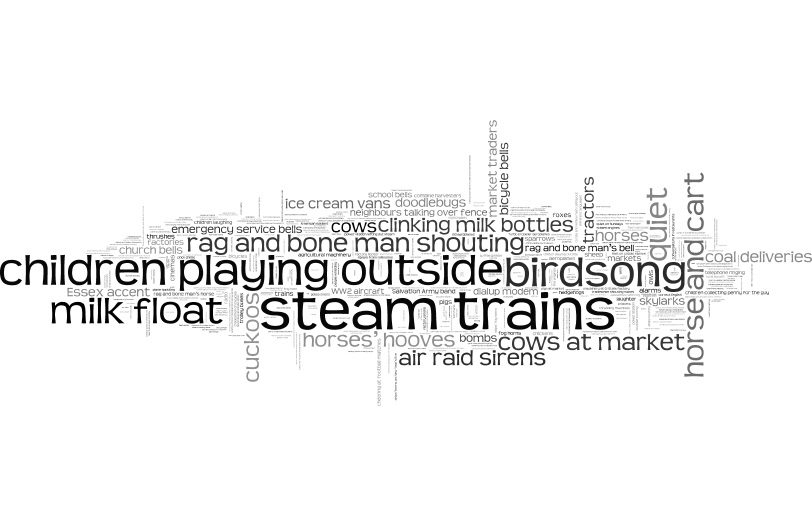
Perhaps you can identify with this collection of ‘lost sounds of Essex’, collected in 2015 when we asked people which sounds they no longer hear (Word Cloud created at Wordle.net).

Wordcloud of suggestions of lost sounds

What other changes become apparent from playing with Essex Sounds? Is there some vital sound that is missing from the map? Please help us make it more representative by adding your own contributions. Or perhaps you are a sound artist inspired by our collection of historic and modern sounds. We would love to hear ideas about how we can reuse these sounds and present them in new ways.

But above all, please take time to listen to the present-day Essex. Wake up five minutes earlier to allow time to listen before you start your day. Pause in your commute. Think again before popping on headphones. Close your eyes and open your ears.

Would you be interested in a sound walk event around Essex, which would incorporate an introduction into active listening, making sound recordings, and editing the results? We are running a survey to gauge interest in such an event. Please let us know what you think, and you could win a discount on the ticket price.

A Poem Upon the Ceremonial Opening of Coggeshall’s Listening Bench

As part of our Heritage Lottery Funded project, You Are Hear: sound and a sense of place, we are working with volunteers to install listening benches across Essex. These solar-powered park benches play clips of recordings from the Essex Sound and Video Archive, recordings chosen and put together by our volunteers. The listening bench for Coggeshall was successfully unveiled on Tuesday 11 July. Each listening bench launch has its own character, but this was the first to include a poetry recital in honour of the bench! We loved the poem so much that we wanted to reprint it, with an introduction by another volunteer to explain how the Coggeshall bench came about.

Miall James writes:

Back in January I went into the Coggeshall Library, and one of the staff asked me if I knew anyone who’d be interested in setting up a Listening Bench. So I asked what it was, was told, and said, OK, I’ll give it a go. I recruited my friend Nic Johnson, a well known, if fairly new in Coggeshall terms, local resident, and together we enlisted the aid of two more, thought that was enough and presented ourselves to the Essex Record Office.

Photograph of volunteers with listening bench

Volunteers who worked on Coggeshall’s listening bench (L-R: Michael Horne, Nic Johnson, Miall James, Stan Haines (who opened the bench), and Sylvie Overnell).

One of the two was Michael Horne, a well-known local historian and poet (and Lord of the Manor of Little Coggeshall), who in fact wrote some of what finally went onto the bench; the other was Sylvie Overnell, a retired local teacher, with local contacts. We looked at what was required, divided up the work and got on with it. There were no arguments; we discussed what to do, agreed and got on with it. Indeed it’s wonderful what can be done if no one’s bothered about who gets the credit! Finally, after about five months’ work we were ready, and the bench was ready for use.

Photograph of Miall James and Stan Haines standing behind listening bench

Miall James with Stan Haines officially ‘opening’ Coggeshall’s listening bench

We recruited Stan Haines, who has lived in the town most of his life, and was Chairman of the Parish Council for 48 years, to officiate at the opening.

The only thing that went wrong was the weather on the day, which wasn’t as kind as it might have been!

We’ve had some very good feedback, and we feel that, with a little fine-tuning, our Listening Bench will be something our fellow citizens can enjoy for many years to come.

Michael Horne’s poem composed for the occasion

A Poem Upon the Ceremonial Opening of Coggeshall’s Listening Bench at Doubleday Corner
11 July 2017

Photograph of Michael Horne in front of bench

Michael Horne reciting his poem

On this occasion so polite,
I can do nothing but endite
A hymn of praise, with joy intense,
To Coggeshall’s newborn Listening Bench.

We’ll take upon us, even now,
An eleemosynary vow
To set up Peace, Goodwill and Sense
Upon our worthy Listening Bench.

The stories that we now can hear
Bring memories back that are so dear
To all who’ve taken up residence
Near Coggeshall’s stalwart Listening Bench.

[one_half]They speak of pubs and crafts and trades
From days of yore, of men and maids
Who gave our town its eminence,
Preserved now on the Listening Bench.

In times of great austerities,
With caps on pay and a pension squeeze,
When fiscal stocks we must retrench,
We’ll still possess our Listening Bench.

People will come this bench to view
Both in and outside the EU,
And accents Dutch, Peruvian, French
Will echo from our Listening Bench.[/one_half]

[one_half_last]So men may come and men may go,
Enslaved by Time’s incessant flow,
But anything of permanence
Will stay within our Listening Bench.

And now I’ll cease these paltry rhymes
Unworthy of these glorious times,
Let’s shout instead, with Power Immense,
Three cheers for Coggeshall’s Listening Bench![/one_half_last]

Check our website for details of further listening bench launches, and to keep track of our two touring benches. Can you visit them all?

Map of all 18 listening benches

HLF Logo

Harlow Housing and Design Interviews Online

Harlow New Town was established in 1947, when the New Town Development Corporation began to purchase land around the old town and erect new housing estates. The houses primarily served to relieve housing pressures on bombed-out, overcrowded London, particularly from the East End. The first residents began moving in from 1949.

So say the textbooks, but what personal stories lie behind these brief facts? At the Essex Sound and Video Archive, we hold a wonderful collection of oral history interviews conducted by Dr Judy Attfield in the 1980s for her research project, Harlow Housing and Design (SA 22). These interviews reveal what it was like to live in the new town. Our Heritage Lottery Funded project, You Are Hear: sound and a sense of place, has enabled us to digitise all of the original cassettes and make them freely available through Essex Archives Online.

Screenshot of SA 22 catalogue

A satisfying sight: the icons show that there is audio material attached to that catalogue entry.

At first, we thought the digitisation would be a straightforward task. Shortly after the collection was first deposited with us in 1996, we created access copies on cassette, to safeguard the original masters (our standard procedure in the Sound Archive). The access copies are all neatly labelled and clearly identified, one cassette per interview.

However, when we looked in the box containing the original cassettes, things were not quite so straightforward. We digitise from the original recording (or as near to the original recording as we can get), to capture the purest sound. On revisiting the masters, we realised that the interviewer had used one cassette for multiple interviews – a common practice when you want to make the most of the cassette tape you have. Piecing each recording together to make one complete interview has caused our digitiser, Catherine Norris, several headaches.

But now they are all digitised. Similar to our procedure with physical analogue recordings, we keep a master, uncompressed .wav file safely in storage. We then create compressed .mp3 copies as our new access copy. You can still come into the Searchroom and listen to the recordings, but you can also now listen from home, through Essex Archives Online.

Each interview is valuable in its own right, but as a collection it is even more fascinating. Dr Attfield spoke to a range of people: developers, architects, and town councillors who shed light on the planning of the new town; shopkeepers; people who moved to Harlow before the new town; and people who moved as part of the new town settlement. Putting these different viewpoints together gives a rich, rounded impression of this time in history. Some interviewees say that women found it more difficult than men to settle in new towns and felt lonely and depressed; some say that women found it easier to form new bonds because they were surrounded by women in a similar position, raising children away from their parents in unfamiliar surroundings. Some were ecstatic to have their own front doors, their own staircases in two-storey homes; some missed the familiarity of London, even if they were living in cramped, shared housing. The multiplicity of memories challenges generalisations about life in a new town. It also demonstrates (by listening to the accents of the interviewees, if nothing else) that not everyone in Harlow in the 1950s was an ex-Eastender.

The collection also serves as a good example of how to conduct an oral history interview. Dr Attfield had a specific interest in the interior design of the new houses. She directed questions to gather information on this topic. However, she also asked wider questions for context. She let her interviewees say what they wanted with minimal interventions, but also guided the interview to cover her set of questions. Occasionally she probed her interviewees for more details, or challenged their viewpoints to get a better understanding, without revealing any judgement of their opinions.

Dr Attfield made a significant research contribution in the fields of material culture, gender studies, and design history, among other overlapping areas. Based for many years at the Winchester School of Art, her book Wild Things: The Material Culture of Everyday Life (Oxford: Berg, 2000) has become a key text in her field. She passed away in 2006. We are very grateful that she deposited her recordings about Harlow with us, for future researchers to use and enjoy.

One particularly moving interview from the collection is that with Mrs Summers, who moved to the new town from Walthamstow in 1952 (SA 22/1364/1). At several points in the interview, Mrs Summers describes the long adjustment period when ‘home’ still meant London before completely settling in Harlow. As well as missing her family, in this clip she describes how she ‘couldn’t get used to the newness of things’ after coming from Walthamstow with its ‘houses with big windows… little tiny houses… nice houses… [and] grubby-looking houses’.

At a time when neighbourhood plans for vast numbers of additional houses are being developed across Essex – across the country – perhaps these experiences of new settlers can help with the process of creating new communities.

Dr Attfield published an article based on these interviews in the book that she co-edited with P Kirkham, A View from the Interior: Women and Design (London: Women’s Press, 1995). The article can be consulted at Colchester Library.

We hope to showcase clips from these recordings on a listening bench in Harlow, in time for the 70th anniversary of the New Town in 2017. If you are interested in helping to work on the bench for Harlow, please get in touch: info@essexsounds.org.uk