Essex’s Industrial Archaeology: Housing the workers

Today we bring you some more industrial treasures from the archive in the run up to our special one-day conference on Essex’s Industrial Archaeology on Saturday 6 July. Tickets are £15 and can be booked by telephoning 01245 244614. Details on our speakers and their topics can be found here.

In order to attract – and keep – workers, many employers decided to build housing for their workers. Some built the cheapest, most basic housing possible, but others had a genuine concern for their workers’ welfare and built good quality homes, appreciating that healthy, content workers would be more loyal and productive. Most such houses were built after industrialisation had firmly taken hold in the mid-late nineteenth century, but there are also earlier and later examples of such developments, on varying scales.

Tony Crosby will be talking about industrial house from sites all around the county at Essex’s Industrial Archaeology, but here we share with you just a few examples, from Bentall’s in Heybridge, Crittall’s in Silver End, and Bata in East Tilbury.

E.H. Bentall & Co. of Heybridge

E.H. Bentall & Co. were ironfounders and agricultural implement makers based in Heybridge, who in the early twentieth century also dabbled with the internal combustion engine and car manufacturing. Bentall’s sold agricultural machinery all over the country and all over the world, such as this chaffcutter which ended up in Australia. By 1914 the company employed 6-700 people.

Bentall’s began building housing for their workers in the mid-late 1800s, with houses reflecting the social status of different levels of employees. The eight two-storey cottages built at Well Terrace were let to supervisors, and as such had a higher level of architectural detail than other developments. In the sale catalogue below, they are described as each containing: ‘Entrance Passage, 3 Bedrooms, 2 Sitting Rooms, Kitchen with Copper and Sink, Water laid on. Outside Pail Closet, Coalhouse and Wood Shed. Nice Garden.’ Well Terrace can be found on the map below, just to the north-east of the wharf.

Twelve three-storey houses were built in Stock Terrace for employees with large families, although some were set aside for younger single employees, subject to the supervision of a landlady. Two terraces of eight cottages called The Roothings were also built with minimum detailing for basic grade foundry workers (lot 40 on the map below). Bentall’s building became quite experimental, and in 1873 three terraces of single-storey flat-roofed concrete cottages were built, called Woodfield Cottages, although the roofs were later pitched following water leaks. More of these houses were built at Barnfield Cottages in the early twentieth century, along with several semi-detached Arts and Crafts style houses for managers.

In 1930 Bentall’s sold off a huge amount of housing stock, all with ‘good weekly tenants’, and the sale catalogue and accompanying plan (D/DCf B839) show us the extent of the housing Bentall’s had built up for their employees. The company had hit hard times in the late 1920s and 1930s, which could perhaps explain why they sold off so much property, but they did eventually recover and prosper again.

Plan showing properties sold by Bentall’s in 1930 (D/DCf B839) (Click for a larger version)

Extract from sale catalogue showing just a few of the properties sold by Bentall’s in 1930 (D/DCf B839)


Crittall Manufacturing Company, Silver End

Silver End village plan (D/DU 1656/1)

This plan for Silver End shows the development of housing for workers of Crittall’s, a metal window frame manufacturer. The development was conceived as a model village by Francis Henry Crittall, whose workforce had outgrown his existing factories in Braintree, Maldon and Witham. In the 1920s, he bought the land surrounding the tiny hamlet of Silver End, and built a new factory and a village surrounding it.

Aerial view of Silver End (I/Mp 290/1/1)

Crittall wanted his workforce to have comfortable, modern housing with hot running water and indoor bathrooms, and large outdoor spaces. The village also included a village hall, a dance floor, a cinema, a library, a snooker room and a health clinic. Crittall also purchased farmland surrounding the village so it could be as self-sufficient as possible and the price of food would be kept low.

Silver End was built in the tradition of enlightened employers providing ‘ideal’ environments for their workers, such as Titus Salt at Saltaire, and Cadbury at Bournville, and was also the first garden village in Essex.

The development at Silver End employed innovative modernist architecture, and was written up in the Builders and Architects Journal in 1919 (D/Z 114/2)

The Bata Shoe Company, East Tilbury

The Bata Shoe Company, founded by Tomas Bata in Czechoslovakia, opened a factory in the Essex marshes at East Tilbury in 1933. Over the following decades the company grew and eventually operated 300 shops across Britain and employed 3,000 people.

The Bata company built not only housing but educational and recreational facilities for their workers, and a real community grew around the factory. The Bata Reminiscence and Resource Centre is collecting the memories of the people who lived and worked at Bata and has built up a vast collection of artefacts and photographs, available to see at the Centre. You can find out more about them here.

Aerial photo of factory and estate c.1960 (Reproduced courtesy of the Bata Reminiscence and Resource Centre)

Bata Hotel, c.1937 (Reproduced courtesy of the Bata Reminiscence and Resource Centre)

Queen Elizabeth Avenue c.1971 (Reproduced courtesy of the Bata Reminiscence and Resource Centre)

Swimming pool on the Bata estate (Reproduced courtesy of the Bata Reminiscence and Resource Centre)

Essex’s Industrial Archaeology

Saturday 6 July 2013, 9.30am-4.30pm

Tickets £15 – please book in advance by telephoning 01245 244614

See here for more information
Essex’s Industrial Archaeology: Courtauld’s – silk weaving in Braintree

Today we bring you some more industrial treasures from the archive in the run up to our special one-day conference on Essex’s Industrial Archaeology on Saturday 6 July. Tickets are £15 and can be booked by telephoning 01245 244614. Details on our speakers and their topics can be found here.

Courtaulds, founded in 1794, became one of the UK’s largest textile businesses. It was established by George Courtauld, the son of a family descended from a Huguenot refugee, and his cousin Peter Taylor.

George was apprenticed to a silkweaver in Spitalfields at the age of 14 in 1775, and after his seven year apprenticeship set up on his own as a silk throwster. After making several trips to America between 1785 and 1794, where he married and began his family, Courtauld returned to England and established George Courtauld & Co. The company began with a water-powered silk mill at Pebmarsh, and by 1810 George’s son Samuel (1793-1881) was managing his own silk mill in Braintree.

According to the Oxford Dictionary of National Biography, George Courtauld ‘proved to be a remarkably incompetent businessman’. By 1816, the company was in financial trouble, and his ambitious son Samuel took over to rescue the family business.

Samples of fabrics manufactures at Courtauld's

Samples of fabrics manufactured at Courtauld’s

Under Samuel’s leadership, the company became known as Samuel Courtauld & Co., and opened new mills in Halstead and Bocking. Samuel expanded into hand-loom and power-loom weaving as well as silk throwing, and from about 1830 began manufacturing the fabric that really made the family’s fortune – black silk mourning crape, which became the standard mourning dress in Victorian England.

The firm was always heavily dependent on young female workers; in 1838 over 92% of workforce was female. By 1850, the business had grown to employ over 2,000 people in three silk mills, and over 3,000 by the 1880s.

Looms at the Courtauld works (A6798 pt 12 )

Looms at the Courtauld works (A6798 pt 12 )

Machinery at the Courtauld works (A6798 pt 12)

Machinery at the Courtauld works (A6798 pt 12)

Looms at the Courtauld works (A6798 pt 12)

Looms at the Courtauld works (A6798 pt 12)

Machinery at the Courtauld works (A6798 pt 12)

Machinery at the Courtauld works (A6798 pt 12)

Silk production used machines for spinning and weaving and centralised production in factories, gradually bringing to an end the tradition of weavers working on hand looms at home. Samuel Courtauld introduced a shift system, using two 12-hour shifts so that his mills were working all day and night.

Plan of housing built for Courtauld's workers (D-RH Pb1-16)

Plan of housing built for Courtauld’s workers (D-RH Pb1-16)

Samuel’s biographer D.C. Coleman describes his leadership as a ‘benevolent despotism’. Under him the company built workers’ cottages, schools, reading rooms and a hospital in Braintree. He refused to allow any trade union activity at his factory but offered his own system of rewards and punishments for his workforce. 

Samuel’s hard work in building up the business paid off; by the time of his death in 1881 he was worth about £700,000.

Courtauld’s Ltd will be the subject of one of our talks at Essex’s Industrial Archaeology, delivered by the present George Courtauld, who worked for the company for about 20 years. 


Essex’s Industrial Archaeology

Saturday 6 July 2013, 9.30am-4.30pm

Tickets £15 – please book in advance by telephoning 01245 244614

See here for more information

‘Mutual preservation’ in eighteenth-century Great Oakley

Archivist Allyson Lewis blogs for us about an exciting new accession…

We recently purchased the Articles of Association of an Association ‘for the mutual preservation of property and the more effectual prosecution and bringing to justice of house-breakers, horse stealers and thieves of every kind’ (Accession A13635 (D/DU 2835)).  This early form of insurance/neighbourhood watch scheme was formed by the inhabitants of Great Oakley and surrounding parishes on 4 February 1794.  The deed is signed by all the members, including new members to 1899.  

The heading of the Articles of Association (click for larger version)

Each member paid a membership fee of at least 10s 6d.  This money was used to publish a description of stolen property on hand bills and in the newspapers and to offer rewards for information leading to the recovery of stolen property.  The Articles specify the following rewards to be offered to anyone apprehending and convicting offenders who had committed a crime:

House breaking                               £5 5s

Stealing of horses or cattle                        £5 5s

Highway or footpad robbery           £5 5s

Breaking open barns, stables or outhouses       £3 3s

Stealing poultry, turnips, apples, pears, damaging hedges etc           £1 1s

Signatures of members of the Association

In the days before any police force, local associations of this kind were felt necessary, particularly in times of war or trouble.  This Association dates from the period of the Napoleonic wars which gave rise to a general fear of revolution and invasion.  The parishes are in the neighbourhood of Harwich where many men would be stationed in the Martello tower and as militia organised to defend the county from attack by the French.  Perhaps the members of the Association had experienced thefts from deserters or militia men trying to head home.  It is surprising that the Association was still considered necessary at the end of the 19th century, long after the formation of the county police force in 1840.

Your favourite ERO documents – Photograph of Elizabeth Greenwood

As part of our 75th anniversary celebrations this year, we recently asked you, our users, to nominate your favourite ERO documents. Thank you very much to those of you who have sent in nominations so far – today we bring you the first in a series of your favourites.

Photograph of Elizabeth Greenwood, born in 1788

This photograph of Elizabeth Greenwood was nominated by Rosalind Kaye, who has been using the ERO for her research for over 20 years. This is why she nominated this photograph:

Elizabeth was born in 1788, yet in this charming little photograph you feel you can touch her shawl, it is so clear. She produced 8 children, two of whom made their mark in Halstead – Robert Ellington (banker, farmer and proprietor of the gas works) and Lucy (founder and superintendent of the Halstead Industrial School). They were Quakers.

Thank you very much to Rosalind for nominating the photograph, we can see exactly what she means about the clarity of Elizabeth’s shawl, and how amazing it is to have a photograph of someone born in the eighteenth century.

We’ll be bringing you more favourites over the next few months. Nominate yours by downloading our form and either returning it in to the Searchroom desk or e-mailing it to hannahjane.salisbury[at]essex.gov.uk

Nominate your favourite record

As part of our 75th anniversary celebrations this year, we want to hear from you.

We always like to hear how searchers are using our collections, whether it’s in the Searchroom or online through Seax and Essex Ancestors, so we’ve decided to ask searchers to nominate their favourite record, and to tell us what it is about it that appeals to you.

Entries can be long or short, medieval or modern, whole volumes or single sheets, parchment or photographs or DVDs or cassettes. All you need to do is to download our nomination form here and either return it in to the Searchroom desk or e-mail it to hannahjane.salisbury[at]essex.gov.uk

Nominated documents may be featured on our blog or in displays at our open day on Saturday 14 September.

To get the ball rolling, here is one of the favourite documents of Hannah Salisbury, Audience Development Officer:


Bond to Indemnify the parish of Walden agt Ann White’s Child by Mr Rebecca, 1773 (D/B 2/PAR8/35)

Bastardy Bonds were used to protect parish ratepayers from ending up paying to support unmarried mothers and their children if the mother was unable to support herself.

There are hundreds of such bonds in our collection, mostly dating to the eighteenth century, but this one particularly stands out for me because of the story it tells.

Dated 24 April 1773, the bond tells us that Ann White, a servant at Audley End near Saffron Walden, had given birth to a male child, the son of Biagio Rebecca, an Italian painter employed at the house by its owner, Sir John Griffin Griffin.

Extract from D/B 2/PAR8/35

Extract from D/B 2/PAR8/35

Rebecca had acknowledged that the child was his, but clearly had no intention of marrying the hapless Ann. To indemnify the parish from ever having to support her and their child, Rebecca had agreed to deposit £100 with Sir John Griffin Griffin, to whom Ann would have to apply when in need of funds to support herself and the child. In paying this lump sum, Rebecca absolved himself of all responsibility to Ann and their child. You can view the document in full on Seax here.

The story continues in the baptism register of St Mary’s Saffron Walden where the child’s baptism is recorded:

*John Biagio, son of Biagio Rebecca & Ann White *(base-born)

N.B. Senior Biagio Rebecca was a most ingenious artist who was employed by Sir John Griffin, at Audley End, to paint the cieling [sic] & Panels of ye little south drawing Room, & several family portraits in the great Room over the eating Parlor!!! [sic]

Baptism of John Biagio, 24 December 1772. Extract from parish register of St Mary’s, Saffron Walden (D/P 192/1/5, image 40)

You can still see Biagio Rebecca’s paintings at Audley End, and read his entry in the Oxford Dictionary of National Biography (Essex Library card holders can access the ODNB for free with their library card number).

Fascinating Find: John Lewis’s Medieval roots in Chelmsford

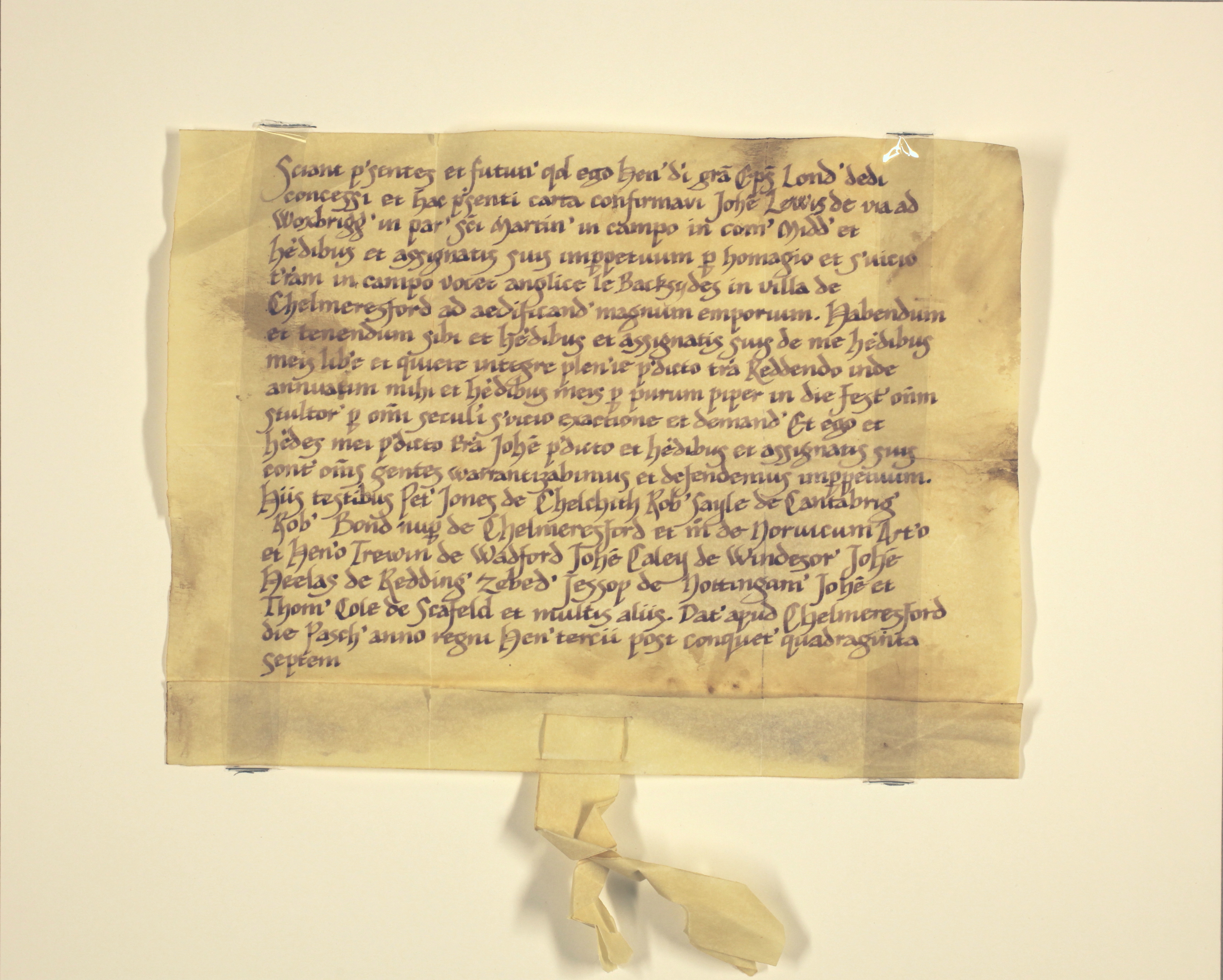
A deed dating from 1263 was recently discovered by our archivists in the county archive which shows that Henry of Sandwich, the Bishop of London, granted land to John Lewis (recorded as ‘Johannes Lewis’ in the medieval Latin) of the Uxbridge Road in Middlesex to build ‘a big shop’ in Chelmsford town centre.

This story has particular relevance for 1 April, as in return for the land John Lewis was to pay Henry of Sandwich ‘one chilli pepper on the feast of All Fools’ each year.

The deed names several other men as witnesses, Peter Jones of Chelsea, Robert Sayle of Cambridge, Robert Bond recently of Chelmsford and then of Norwich, Arthur and Henry Trewin of Watford, John Caley of Windsor, John Heelas of Reading, Zebedee Jessop of Nottingham, and John and Thomas Cole of Sheffield.

750 year old deed discovered giving land in Chelmsford

750 year old deed discovered giving land in Chelmsford to ‘Johannes Lewis’ to build ‘a big shop’


Archie Ives, spokesman for Essex Record Office said today: “This is a very exciting find and shows the importance of new stores in the development of medieval Chelmsford, just as it is today. I am delighted that the Record Office has found evidence for the development of department stores at such an early date. It shows that Chelmsfordwas leading the way in retail 750 years ago.”

The deed ties in with a later map of Chelmsford dating to 1591, which helps us to identify the land in question. Lewis was granted ‘land in the field called in English Le Backsydes’, which is clearly shown on the later map to the east of the High Street. The map also shows us how little the shape of Chelmsford has changed since the medieval period.

Extract from Walker map of Chelmsford, 1591 (D/DM P1)

Extract from Walker map of Chelmsford, 1591 (D/DM P1)

In an interesting coincidence, the 750 year old document reflects the 75th anniversary of the foundation of the Essex Record Office.


Full English translation:

Let all men present and future know that I Henry [of Sandwich], by the grace of God, Bishop of London have given, conceded and by this present charter have confirmed to John Lewis of the Uxbridge road in the parish of St. Martin in the Fields in the county of Middlesex and his heirs and assigns for ever for homage and service, land in the field called in English Le Backsydes in the town of Chelmsford to build a big shop.  To have and to hold to him and his heirs and assigns from me and my heirs quietly freely and fully the said land paying annually to me and my heirs one chili pepper on the feast of All Fools for all secular service, exactions and demands and I and my heirs will warrant and defend the said land to the said John and his heirs and assigns against all people forever.  These being witnesses Peter Jones of Chelsea, Robert Sayle of Cambridge, Robert Bond recently of Chelmsford and now of Norwich, Arthur and Henry Trewin of Watford, John Caley of Windsor, John Heelas of Reading, Zebedee Jessop of Nottingham, John and Thomas Cole of Sheffield and many others.  Given at Chelmsford on Easter Day in the forty-seventh year of the reign of Henry III.

Original Latin transcription:

Sciant p[re]sentes et futuri q[uo]d ego Hen[ricus] d[e]i gr[ati]a Ep[iscopu]s Lond[on] dedi concessi et hac p[re]senti carta confirmavi Joh[ann]e Lewis de via ad Woxbrigg[e] in par[ochia] s[an]c[t]i Martin[i] in campo in com[itatu] Midd[lesex] et h[er]edibus et assignatis suis imp[er]petuum p[ro] homagio et s[er]vicio t[er]ram in campo vocet anglice le Backsydes in villa de Chelmeresford ad aedificand[am] magnum emporium.  Habendum et tenendum sibi et h[er]edibus et assignatis suis de me et h[er]edibus meis lib[er]e et quiete integre plen[ar]ie p[re]dicto t[er]ra Reddendo inde annuatim mihi et h[er]edibus meis pro unum purum piper in die fest[um] om[niu]m stultor[um] p[ro] om[n]i secul[ar]i s[er]vicio exactione et demand[a].  Et ego et h[er]edes mei p[re]dicto t[er]ra Joh[ann]e p[re]dicto et h[er]edibus et assignatis suis cont[ra] o[mn]es gentes warrantizabimus et defendemus imp[er]petuum.  Hiis testibus Pet[ro] Jones de Chelchith, Rob[erto] Sayle de Cantabrig[ia], Rob[erto] Bond nuper de Chelmeresford et m[oment]o de Noruicum, Art[ori]o et Hen[ric]o Trewin de Wadford, Joh[ann]e Caley de Windesor[a], Joh[ann]e Heelas de Redding[es], Zebed[ae] Jessop de Nottingam[ia], Joh[ann]e et Thom[e] Cole de Scafeld et multis aliis.  Dat’ apud Chelmeresford die Pasch[a] anno regni Hen[rici] tercii post conquest[um] quadraginta septem

Easter eggs in Essex’s past

Are you looking forward to chocolate eggs this weekend? Archivist Katharine Schofield takes a look back at Easter eggs in an earlier guise…

The tradition of giving Easter eggs can be traced back to the early Christian tradition of giving up dairy products for Lent.  All of the household eggs would be used up on Shrove Tuesday (Pancake Day) and none could be eaten again until Easter, when households would need to restock. 

In 1297 an extent was made of the manors of Walton, Thorpe and Kirby (D/DHw M1) which detailed all the land and valued all the rights of the lord of the manor.  Manorial tenants held land from the lord in return for the payment of goods, money and labour.

In the three Soken manors, the tenants owed regular amounts of work to the lord on the lands which were kept ‘in hand’ (demesne land); that is they were farmed directly with the labour of the tenants.  As well as threshing, weeding, reaping, ploughing, mowing and making hay, keeping and shearing sheep, they had to maintain the lord’s granary and byre and provide a horse for harrowing.

The lord of the three manors was St. Paul’s Cathedral and this explains why among their duties, the tenants had to load corn from the manor house on to a ship.  In addition to the labour, they also paid rent and provided food.  Those tenants who held one hide of land (120 acres) were obliged to give the lord 300 eggs at Easter.

Extract from D/DHw M1

Extract from D/DHw M1, detailing the labour and goods owed by the tenants of the three Soken manors to their lord, including 300 eggs at Easter. The word ‘Pasha’ (Easter) can just be made out at the beginning of the second line.

You can find out more about manorial documents at our new workshop Discover: Manorial documents on Tuesday 31 October 2013. Details are available in our events guide, which can be downloaded here.

Conserving Essex’s past: Saffron Walden on the Map

In the days when you can carry a device in your pocket which can access not only a map of the whole globe but satellite images of the earth’s surface, it is hard to imagine life without easy access to accurate maps.

Historic maps are fascinating and often beautiful documents, and the Essex Record Office holds many maps which help us to tell the story of our county’s past. Some of these maps have been well treated and survive today in good condition, perhaps a little faded and worn but largely complete. Others, however, have not been quite so lucky.

Regular readers may remember that in spring 2012, a dirty, tattered piece of parchment was found in a farm outbuilding in Wendons Ambo, near Saffron Walden. Upon unrolling it, it was discovered to be a map of the historic town ofSaffron Walden, dating to 1757. This makes it the earliest known map of the town. This is a very special find, showing in great detail the historic centre of Saffron Walden, much of which survives today.

Before conservation work. The map was brittle, dark, mouldy, and peppered with small tears and holes.

Before conservation work. The map was brittle, dark, mouldy, and peppered with small tears and holes.

The map was made by Edward John Eyre, whose slightly later, larger 1758 map of the area around the town may well already be familiar to Saffron Walden residents. It is likely that both maps were commissioned by Elizabeth Countess ofPortsmouthor her nephew, Sir John Griffin Griffin, who inherited part of the nearby estate of Audley End. 

In June 2012 the map was transferred on permanent loan to the Essex Record Office for conservation work and storage. Despite the degree of damage it has suffered, the hand-drawn streets and buildings are still remarkably clear. Since the map arrived at ERO, our expert conservators have worked to stabilise the map to prevent any further deterioration, and have made any repairs possible. 

During conservation work. As part of the conservation work the map was stretched out after being humidified. This looks alarming but it mimics the original treatment process the parchment went through when new.

During conservation work. As part of the conservation work the map was stretched out after being humidified. This looks alarming but it mimics the original treatment process the parchment went through when new.

After months of painstaking effort, the conservation work is now complete, and the map is due to make a special one-day visit to its home town for local people to come and see it.

For your opportunity to see the original map and to find out more about its conservation, come to Saffron Walden on the Map at Saffron Walden Town Hall on Saturday 16 March, 10.30am-3.30pm, were ERO Senior Conservator Tony King will be talking about his work. There will also be talks from other experts about historic maps and how they were made. You can download a programme for the day here.

After conservation work. The map is still very dark due to the layer of discoloured varnish which cannot be removed, but it has been flattened and tears and holes filled in. Despite the damage it has suffered, the outlines of the streets and buildings are remarkably clear.

After conservation work. The map is still very dark due to the layer of discoloured varnish which cannot be removed, but it has been flattened and tears and holes filled in. Despite the damage it has suffered, the outlines of the streets and buildings are remarkably clear.

Stories from the Stores: blacksmith’s ledger of John Packard Smith of Chipping Ongar, A13540 (D/F 326)

Account books and ledgers can be an excellent way of finding out about details of daily life in the past. Archivist Sarah Dickie rifles through the ledger book of John Packard Smith, blacksmith of Chipping Ongar, and turns up some unusual details of early twentieth century life…

John Packard Smith is listed in the 1908 Kelly’s Directory of Essex as a blacksmith, cycle agent and repairer. We found a couple of entries in 1911 for repairing and fitting cycle tubes but this does not feature as a large part of his work. The accounts in the ledger show that Smith’s work was predominantly as a blacksmith and farrier. For example on 13 August 1913 he made ‘a new steel plate to Deerings Binder Knife, Filing out [w]hole of New Casting & Fixing to Knife & Rivets’ for a sum of 2 shillings 3 pence for Mr. Bennett of Little Myles. Shoeing horses took up a great deal of his time, e.g. 22 May 1908 ‘To 3 shoes and one Bar shoe & dressing foot with tar 3s 6d’ for Mr. Brown of New House Farm (Greenstead-juxta-Ongar).

Front cover

Front cover – showing how well used the ledger was

The ledger is extremely detailed and we get know a lot of personal details; Smith shoed horses called Druid, Pantaloon, Cardinal and Match Girl for Mr. H.E. Jones, whilst he made nuts and bolts for McNoble the builders to do repairs at ‘The Bear’, a pin for a boiler plug at Blake Hall and new gutter brackets for High Ongar Rectory. In this throwaway age it is surprising to see how many everyday objects were repaired. There are bills for a new hoop for a wine cask, repairing the woodwork on a wheel barrow wheel as well as fitting horse shoes for the Cheshire Regiment in June and July 1915. Many of his customers were farmers so it is no surprise that he was repairing harrows, undertaking major works on a hay shaker and supplying a new thumb screw for a churn.

Accounts for Mr Jones

Accounts for Mr Jones, who was obviously a regular customer, naming the horses he brought to be shod.

Accounts for the Cheshire Regiment, 1915

Amongst his customers was the Eddison Steam Rolling Co. (shortening long reversing rod), Miss Bishop of Roden House School (soldering music stand), Bishop’s Stortford and Epping Gas Co. (mending and strengthening a generator bar), Mr. Bianchi of Hall Farm, Greenstead-juxta Ongar (repairing kitchen range) and Mr. Britton of the ‘Two Brewers’ [High Ongar] (shoeing horses).

This volume provides a wealth of detail on local businesses and individuals, as well as fascinating information on the work of a blacksmith at the beginning of the twentieth century just before the motor car took hold.
Graveyard Shift

North Road Burial Ground in Southend-on-Sea had – like many graveyards – languished somewhat unloved for several years. It has now, however, been the lucky recipient of 12 months of love and attention from the Shared Spaces project.

Shared Spaces was set up by Blade Education, a Southend-based not-for-profit organisation, and involved local volunteers and nearby Westborough Primary School in investigating and preserving the heritage of the cemetery. The project wanted to reconnect local people with the past of their town through the stories of the people buried at the cemetery, and also to show that graveyards can be used as a beneficial educational resource, linking today’s generations with those of the past.

Students from Westborough Primary School searching the gravestones for people's stories

Students from Westborough Primary School searching the gravestones for people’s stories

Over 8,000 people are buried on the site, and the project has not only sought to create a database of all their names, but to research some of their life stories. This information is being made available in a free online database, and will also be deposited with the ERO. Heritage trail boards have also been installed at the cemetery, to serve as a reminder about the real lives lived by the people buried there.

One such story was that of Thomas Kerridge, a hansom cab driver who drove people between the Blue Boar Hotel and Southend Victoria railway station. One day in 1925, Thomas was badly injured when he was kicked in the chest by the horse which pulled his cab. He survived the kick, but the wound became infected, and in an age before antibiotics Thomas died a few days later, aged 46. His wife Sarah was left with little income and seven children aged between 13 years and 6 weeks old. It is believed that Thomas was buried at North Road because his family lived close by.

Photograph of Thomas Kerridge

Photograph of Thomas Kerridge

The school children have been an integral part of the project, and not only have they learned about the history of their town, they have had lessons in the graveyard including gardening, photographer, and nature hunts. They have also had the opportunity to learn about their own family histories, with ancestors from all over the world.

To find out more about the project and to search the database online, visit http://bladeeducation.wixsite.com/northroaddatabase You can also find out more about Blade Education here.

Nature hunt at North Road Burial Ground

Nature hunt at North Road Burial Ground