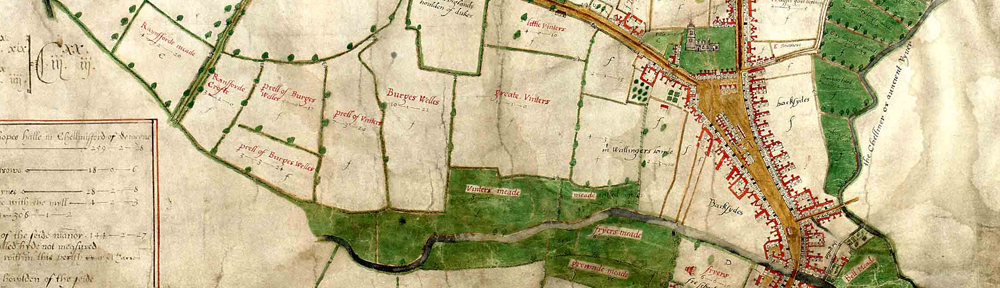
As well as asking our users about their favourite documents from our collections, we have also been asking ourselves. Here, Senior Conservator Tony King shares his perspective on one of his favourite documents, a cartulary of the estates of Sir William Capel, 1294-1511 (A8173). Some of the nominated documents will feature in a display at our open day on Saturday 14th September.
As a Conservator at Essex Record Office I am lucky to have contact with some remarkable documents from the collection so it is difficult to pick a favourite but Acc. A8173, a cartulary of estates of Sir William Capel, c.1511 encapsulates many of my favourite aspects of interpreting our collection. Documents can reveal so much, not just from their written content but also as a physical object; the craftsmen who made the parchment, the scribe who filled the pages and the binder who bound them together have all left their mark on this volume.

The parchment pages of the volume show numerous small repairs carried out through the ages. Some are healed scars sustained while the animal was still alive, other small patches were applied by the parchment maker while the processed skin dried and other tears happened hundreds of years later and have been patched by subsequent users of the book.

The binding is a rare surviving example of a chemise binding where a soft allum tawed leather cover is stitched together and the bound book slipped into it, very much like a dust jacket on a modern hardback book. The edges of the chemise cover overhang the top and bottom edges of the book to form protective flaps over the edge of the pages. Although the chemise now appears grey, areas that have been turned onto the inside of the boards and have been protected are red in colour indicating that the whole cover may have been dyed red originally.

This book seems to have had a long working life and shows signs of regular use. The metal clasps which keep the boards securely closed, maintaining pressure on the parchment pages to keep them flat, are later additions as shown by evidence of earlier fittings on the back board which would have held straps to do the same job. This indicates that the book was still relevant many years after its binding and was maintained as a working resource.
Not only is the volume a rare example of this style of bookbinding, it also bears the physical evidence which points towards hundreds of years of use. Further examination of the binding structure and condition would yield more information about the techniques and decisions made whilst making it and hint at how it was used and regarded in the past. Scientific techniques such as DNA analysis could tell us the species and breed of the animals used for the parchment shedding light on the medieval parchment trade. This cartulary demonstrates how as well as holding a wealth of information in the text, a document can also provide a window on the past by looking closely at it as an object.
If you would like to nominate your own favourite ERO document, we would love to hear from you. Simply download this form, and return it to the Searchroom desk or by e-mail to hannahjane.salisbury[at]essex.gov.uk. There are also paper copies available at the Searchroom desk. Nominated documents may be featured on this blog or in displays at our open day on Saturday 14 September 2013.


