Parish register stories

Parish registers are some of our most frequently used documents, and as well as providing useful information on baptisms, marriages and burials, sometimes an individual’s story is recorded in more detail. This is more common in the earlier centuries of the keeping of parish registers before standardisation, when record keepers could write as much or as little as they liked. Inevitably, however, such entries nearly always raise more questions than they answer.

The register for Little Clacton contains a very sad and somewhat mysterious story dating from 1592, when a bride, Prudence Lambert, hanged herself the morning after her wedding to Clement Fenn:

Clement Fenn singleman, and Prudence the late wife of Nycholas Lambert, wch dwelt in Little Clacton Lodge; were maryed uppon Teusdaye [six], the xvth day of August; but the (most accursed creature), did the verye next morning, desperatelie hang her selfe, to the intolerable grieffe of her new maryed husband, and the dreadfull horror and astonishment of all the countrye. 

Extract from Little Clacton parish register, 1592 (D/P 80/1/1 image 45)    

Prudence’s burial is recorded two days later in the same register:

Prudence Fen, now the wife of Clem[e]nt Fen, and late the wife of the above named Nicholas Lambert; was buried out of the compass of Christian burial; in ye furthest syde of the churchyard northward; uppon the xviith daye of August; for that shee most accursedlie hanged her selfe.

Extract from Little Clacton parish register, 1592 (D/P 80/1/1 image 61)


Another unusual case was found in the pages of the register for Great Hallingbury in 1708:

Anne the daughter of John Hastler and Sarah the Relict of his Father Edward Hastler (by an Incestuous cohabitation for which she did publick penance in the Parish Church of this Parish of Sunday the 11 of March last past and Sunday the twenty eighth following; the first time in the Parish Church of this Parish and the second in the parish Church of Bishop Stortford the father having absconded himself) was baptised privately on the 25th day of 8ber 1707 and her baptism publicly certified in the Church on Easter Sunday April the 4th

Extract from parish register for Great Hallingbury, 1708 (D/P 27/1/4 image 29)


A story which hopefully had a happier ending is found amongst the baptisms in the parish register of Ugley in 1759:

Anne daughter of John Grimshaw, a Sailor in the Dreadnought Man of War, & Jane his wife found in Labour in the Road, & taken care of by the Parish, was born June 27th & baptized July 7th

Extract from Ugley parish register, 1759 (D/P 373/1/2 image 17)


If you want to explore parish registers for yourself, you can do so using Essex Ancestors, which is available online for a subscription, or for free in the ERO Searchroom.  You can also look out for our Discover: Parish Registers sessions to really find out how to get to grips with these amazing documents.

Essex’s Industrial Archaeology: Courtauld’s – silk weaving in Braintree

Today we bring you some more industrial treasures from the archive in the run up to our special one-day conference on Essex’s Industrial Archaeology on Saturday 6 July. Tickets are £15 and can be booked by telephoning 01245 244614. Details on our speakers and their topics can be found here.

Courtaulds, founded in 1794, became one of the UK’s largest textile businesses. It was established by George Courtauld, the son of a family descended from a Huguenot refugee, and his cousin Peter Taylor.

George was apprenticed to a silkweaver in Spitalfields at the age of 14 in 1775, and after his seven year apprenticeship set up on his own as a silk throwster. After making several trips to America between 1785 and 1794, where he married and began his family, Courtauld returned to England and established George Courtauld & Co. The company began with a water-powered silk mill at Pebmarsh, and by 1810 George’s son Samuel (1793-1881) was managing his own silk mill in Braintree.

According to the Oxford Dictionary of National Biography, George Courtauld ‘proved to be a remarkably incompetent businessman’. By 1816, the company was in financial trouble, and his ambitious son Samuel took over to rescue the family business.

Samples of fabrics manufactures at Courtauld's

Samples of fabrics manufactured at Courtauld’s

Under Samuel’s leadership, the company became known as Samuel Courtauld & Co., and opened new mills in Halstead and Bocking. Samuel expanded into hand-loom and power-loom weaving as well as silk throwing, and from about 1830 began manufacturing the fabric that really made the family’s fortune – black silk mourning crape, which became the standard mourning dress in Victorian England.

The firm was always heavily dependent on young female workers; in 1838 over 92% of workforce was female. By 1850, the business had grown to employ over 2,000 people in three silk mills, and over 3,000 by the 1880s.

Looms at the Courtauld works (A6798 pt 12 )

Looms at the Courtauld works (A6798 pt 12 )

Machinery at the Courtauld works (A6798 pt 12)

Machinery at the Courtauld works (A6798 pt 12)

Looms at the Courtauld works (A6798 pt 12)

Looms at the Courtauld works (A6798 pt 12)

Machinery at the Courtauld works (A6798 pt 12)

Machinery at the Courtauld works (A6798 pt 12)

Silk production used machines for spinning and weaving and centralised production in factories, gradually bringing to an end the tradition of weavers working on hand looms at home. Samuel Courtauld introduced a shift system, using two 12-hour shifts so that his mills were working all day and night.

Plan of housing built for Courtauld's workers (D-RH Pb1-16)

Plan of housing built for Courtauld’s workers (D-RH Pb1-16)

Samuel’s biographer D.C. Coleman describes his leadership as a ‘benevolent despotism’. Under him the company built workers’ cottages, schools, reading rooms and a hospital in Braintree. He refused to allow any trade union activity at his factory but offered his own system of rewards and punishments for his workforce. 

Samuel’s hard work in building up the business paid off; by the time of his death in 1881 he was worth about £700,000.

Courtauld’s Ltd will be the subject of one of our talks at Essex’s Industrial Archaeology, delivered by the present George Courtauld, who worked for the company for about 20 years. 


Essex’s Industrial Archaeology

Saturday 6 July 2013, 9.30am-4.30pm

Tickets £15 – please book in advance by telephoning 01245 244614

See here for more information

‘Mutual preservation’ in eighteenth-century Great Oakley

Archivist Allyson Lewis blogs for us about an exciting new accession…

We recently purchased the Articles of Association of an Association ‘for the mutual preservation of property and the more effectual prosecution and bringing to justice of house-breakers, horse stealers and thieves of every kind’ (Accession A13635 (D/DU 2835)).  This early form of insurance/neighbourhood watch scheme was formed by the inhabitants of Great Oakley and surrounding parishes on 4 February 1794.  The deed is signed by all the members, including new members to 1899.  

The heading of the Articles of Association (click for larger version)

Each member paid a membership fee of at least 10s 6d.  This money was used to publish a description of stolen property on hand bills and in the newspapers and to offer rewards for information leading to the recovery of stolen property.  The Articles specify the following rewards to be offered to anyone apprehending and convicting offenders who had committed a crime:

House breaking                               £5 5s

Stealing of horses or cattle                        £5 5s

Highway or footpad robbery           £5 5s

Breaking open barns, stables or outhouses       £3 3s

Stealing poultry, turnips, apples, pears, damaging hedges etc           £1 1s

Signatures of members of the Association

In the days before any police force, local associations of this kind were felt necessary, particularly in times of war or trouble.  This Association dates from the period of the Napoleonic wars which gave rise to a general fear of revolution and invasion.  The parishes are in the neighbourhood of Harwich where many men would be stationed in the Martello tower and as militia organised to defend the county from attack by the French.  Perhaps the members of the Association had experienced thefts from deserters or militia men trying to head home.  It is surprising that the Association was still considered necessary at the end of the 19th century, long after the formation of the county police force in 1840.

Essex’s Industrial Archaeology: Marconi Wireless Telegraph Co. Ltd

On Saturday 6 July 2013 we are hosting a special one-day conference on Essex’s Industrial Archaeology.

Essex is perhaps not thought of as a typically industrial county, but industry is a fascinating part of our county’s past, and shaped the lives of the people who lived here. We have six speakers who will be covering a range of topics and roving around the county:

David Alderton: Why Industrial Archaeology?

Prof. Roy Simons OBE: Marconi, the Father of Wireless

Paul Gilman: title TBC

David Morgans: Beeleigh Steam Mill

George Courtauld: The history of Courtaulds Ltd. InEssex– the first 100 years

Tony Crosby: Industrial housing inEssex

You can find out more about some of our speakers and their talks here. Tickets are just £15 which includes refreshments and a buffet lunch.

In the run up to the conference, we will be bringing you some industrial treasures from our collections to show you some aspects of Essex’s (sometimes surprising) industrial past, beginning with a sample of photographs from our collection of Marconi’s famous New Street factory, taken by Fred Spalding soon after its opening in 1912.

Professor Roy Simons OBE will be discussing the history of this famous company at the conference. Professor Simons is a Marconi veteran himself – he began working on radar systems for the company in 1943 – and since his retirement he has researched the early history of Marconi’s. We will also be showing archive footage of Marconi’s factory shot in 1934, where you can see some of the photographs below brought to life.

Guglielmo Marconi – the ‘father of wireless’  – was an extraordinary man, and Chelmsford owes much to him and the companies he established. Marconi established the world’s first wireless factory in Hall Street in Chelmsford in 1898, but by 1912 demand for the equipment manufactured there had grown so much that the company moved to new purpose-built premises in New Street. Marconi wireless equipment was used to broadcast distress signals from the Titanic, and the first publicised entertainment radio broadcast came from the New Street factory in 1920, when the famous Dame Nellie Melba sang. The company continued to improve on voice transmissions, and later became involved in the development of television. Marconi’s also played a crucial role in developing radar, which was critical to Allied victory in the Second World War. The New Street site has now been unused for a number of years, and after much discussion is currently being redeveloped.

Marconi’s factory in New Street, Chelmsford, built over just 17 weeks by a workforce of over 500 people (D/F 269/1/3676)

Marconi’s factory in New Street, Chelmsford, built over just 17 weeks by a workforce of over 500 people (D/F 269/1/3676)

Men working in the machine shop at Marconi’s New Street factory (D/F 269/1/3683)

Men working in the machine shop at Marconi’s New Street factory (D/F 269/1/3683)

Women working in Condenser and Mounting shop at Marconi’s New Street factory (D/F 269/1/3678)

Women working in Condenser and Mounting shop at Marconi’s New Street factory (D/F 269/1/3678)

The Power Test Room at Marconi’s New Street factory (D/F 269/1/3680)

The Carpenters Shop at Marconi’s New Street Factory (D/F 269/1/3681)


Essex’s Industrial Archaeology

Saturday 6 July 2013, 9.30am-4.30pm

Tickets £15 – please book in advance by telephoning 01245 244614

Click here for more information

Your favourite ERO documents: a death penalty debate

As part of our 75th anniversary celebrations this year, we recently asked you, our users, to nominate your favourite ERO documents. Thank you very much to those of you who have sent in nominations so far – today we bring you the next in a series of your favourites.

Today’s nomination (D/DEb 85/6) comes from Kate Masheder, who has been using the ERO for over ten years:

This letter relates to William Palmer who was condemned to death for sheep stealing in 1819.  He was the husband of Hannah Noakes Reeve, my gt gt gt grandmother but not (so far as we know) the father of Joseph, her firstborn, my gt gt grandfather.  William’s death left Hannah with a young son and baby, plus the six children from his first marriage.  Although Thomas Gardiner Bramston (MP) sent a letter appealing to Mr Justice Bayley for clemency, the death penalty was upheld.  I often wonder how Hannah managed during the year following his death and what happened to William’s children.  She did remarry but died in 1824 at the age of thirty.

In his letter, Mr Justice Bayley asked T.G. Bramston if he could think of any special grounds for clemency but none were forthcoming.  The crime was not a violent one but, because of his occupation as a butcher (with the means to get rid of the evidence) it was felt an example should be made of him.

The death penalty was a harsh one for a man with eight children but perhaps transportation would have left Hannah in worse circumstances as, even after a short sentence, he might not have returned home and she would have been unable to remarry.


The letter from Mr Justice Bayley discusses why it was decided to make an example of William Palmer by sentencing him to death for sheepstealing. As a butcher, he was able to easily conceal his crimes, and had stolen for sale rather than for food. Bayley discusses the problem of sheepstealing in Essex and the need to deter others, even though Bayley wrote that ‘it would have relieved my mind from great uneasiness, could I have found any Circumstances in the Case which would have warranted me … to have granted a Reprieve’.

Thank you very much to Kate for nominating this document as a favourite. We’ll be bringing you more favourites over the next few months. Nominate yours by downloading our form and either returning it in to the Searchroom desk or e-mailing it to hannahjane.salisbury[at]essex.gov.uk

Your favourite ERO documents – Photograph of Elizabeth Greenwood

As part of our 75th anniversary celebrations this year, we recently asked you, our users, to nominate your favourite ERO documents. Thank you very much to those of you who have sent in nominations so far – today we bring you the first in a series of your favourites.

Photograph of Elizabeth Greenwood, born in 1788

This photograph of Elizabeth Greenwood was nominated by Rosalind Kaye, who has been using the ERO for her research for over 20 years. This is why she nominated this photograph:

Elizabeth was born in 1788, yet in this charming little photograph you feel you can touch her shawl, it is so clear. She produced 8 children, two of whom made their mark in Halstead – Robert Ellington (banker, farmer and proprietor of the gas works) and Lucy (founder and superintendent of the Halstead Industrial School). They were Quakers.

Thank you very much to Rosalind for nominating the photograph, we can see exactly what she means about the clarity of Elizabeth’s shawl, and how amazing it is to have a photograph of someone born in the eighteenth century.

We’ll be bringing you more favourites over the next few months. Nominate yours by downloading our form and either returning it in to the Searchroom desk or e-mailing it to hannahjane.salisbury[at]essex.gov.uk

Nominate your favourite record

As part of our 75th anniversary celebrations this year, we want to hear from you.

We always like to hear how searchers are using our collections, whether it’s in the Searchroom or online through Seax and Essex Ancestors, so we’ve decided to ask searchers to nominate their favourite record, and to tell us what it is about it that appeals to you.

Entries can be long or short, medieval or modern, whole volumes or single sheets, parchment or photographs or DVDs or cassettes. All you need to do is to download our nomination form here and either return it in to the Searchroom desk or e-mail it to hannahjane.salisbury[at]essex.gov.uk

Nominated documents may be featured on our blog or in displays at our open day on Saturday 14 September.

To get the ball rolling, here is one of the favourite documents of Hannah Salisbury, Audience Development Officer:


Bond to Indemnify the parish of Walden agt Ann White’s Child by Mr Rebecca, 1773 (D/B 2/PAR8/35)

Bastardy Bonds were used to protect parish ratepayers from ending up paying to support unmarried mothers and their children if the mother was unable to support herself.

There are hundreds of such bonds in our collection, mostly dating to the eighteenth century, but this one particularly stands out for me because of the story it tells.

Dated 24 April 1773, the bond tells us that Ann White, a servant at Audley End near Saffron Walden, had given birth to a male child, the son of Biagio Rebecca, an Italian painter employed at the house by its owner, Sir John Griffin Griffin.

Extract from D/B 2/PAR8/35

Extract from D/B 2/PAR8/35

Rebecca had acknowledged that the child was his, but clearly had no intention of marrying the hapless Ann. To indemnify the parish from ever having to support her and their child, Rebecca had agreed to deposit £100 with Sir John Griffin Griffin, to whom Ann would have to apply when in need of funds to support herself and the child. In paying this lump sum, Rebecca absolved himself of all responsibility to Ann and their child. You can view the document in full on Seax here.

The story continues in the baptism register of St Mary’s Saffron Walden where the child’s baptism is recorded:

*John Biagio, son of Biagio Rebecca & Ann White *(base-born)

N.B. Senior Biagio Rebecca was a most ingenious artist who was employed by Sir John Griffin, at Audley End, to paint the cieling [sic] & Panels of ye little south drawing Room, & several family portraits in the great Room over the eating Parlor!!! [sic]

Baptism of John Biagio, 24 December 1772. Extract from parish register of St Mary’s, Saffron Walden (D/P 192/1/5, image 40)

You can still see Biagio Rebecca’s paintings at Audley End, and read his entry in the Oxford Dictionary of National Biography (Essex Library card holders can access the ODNB for free with their library card number).

Fascinating Find: John Lewis’s Medieval roots in Chelmsford

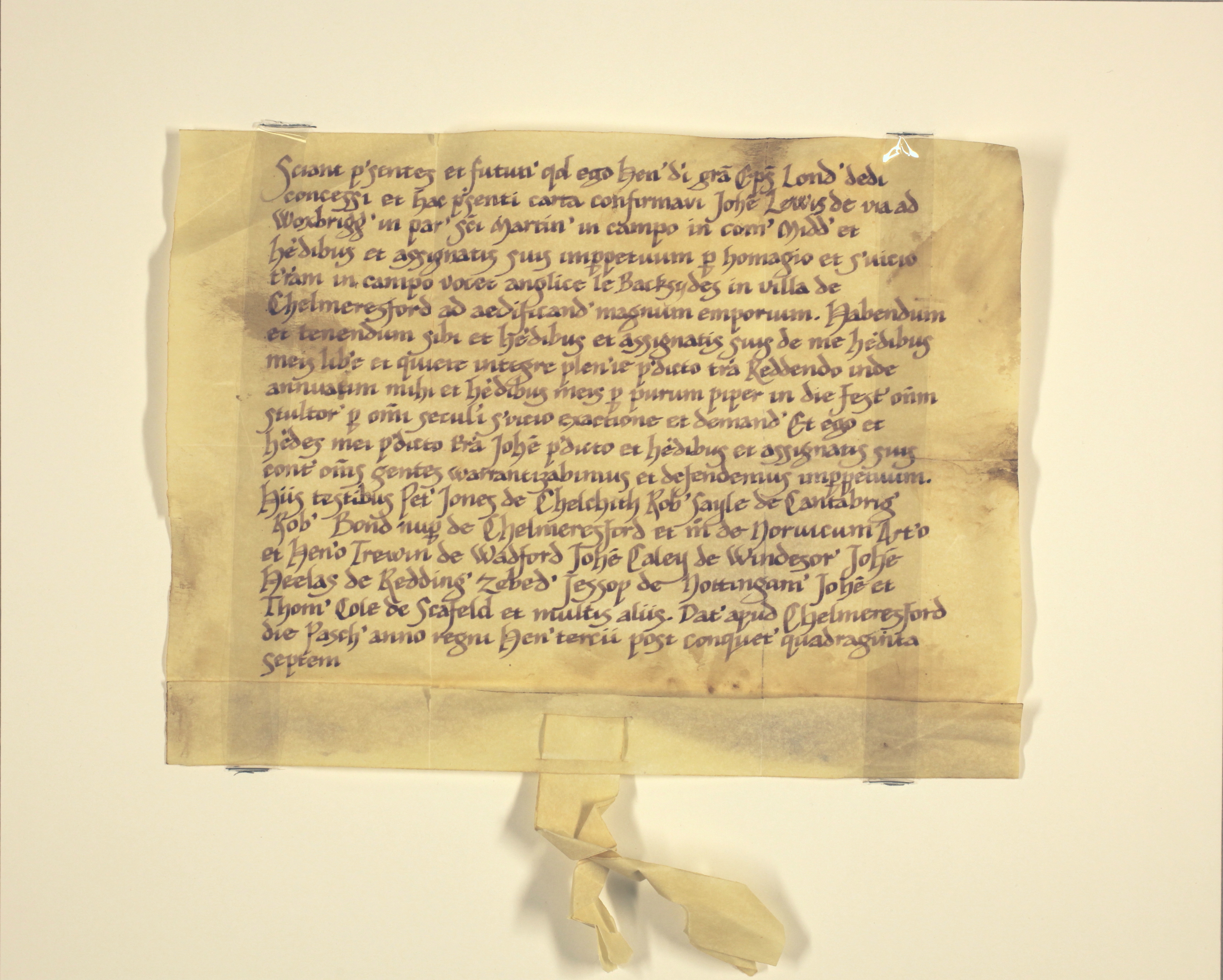
A deed dating from 1263 was recently discovered by our archivists in the county archive which shows that Henry of Sandwich, the Bishop of London, granted land to John Lewis (recorded as ‘Johannes Lewis’ in the medieval Latin) of the Uxbridge Road in Middlesex to build ‘a big shop’ in Chelmsford town centre.

This story has particular relevance for 1 April, as in return for the land John Lewis was to pay Henry of Sandwich ‘one chilli pepper on the feast of All Fools’ each year.

The deed names several other men as witnesses, Peter Jones of Chelsea, Robert Sayle of Cambridge, Robert Bond recently of Chelmsford and then of Norwich, Arthur and Henry Trewin of Watford, John Caley of Windsor, John Heelas of Reading, Zebedee Jessop of Nottingham, and John and Thomas Cole of Sheffield.

750 year old deed discovered giving land in Chelmsford

750 year old deed discovered giving land in Chelmsford to ‘Johannes Lewis’ to build ‘a big shop’


Archie Ives, spokesman for Essex Record Office said today: “This is a very exciting find and shows the importance of new stores in the development of medieval Chelmsford, just as it is today. I am delighted that the Record Office has found evidence for the development of department stores at such an early date. It shows that Chelmsfordwas leading the way in retail 750 years ago.”

The deed ties in with a later map of Chelmsford dating to 1591, which helps us to identify the land in question. Lewis was granted ‘land in the field called in English Le Backsydes’, which is clearly shown on the later map to the east of the High Street. The map also shows us how little the shape of Chelmsford has changed since the medieval period.

Extract from Walker map of Chelmsford, 1591 (D/DM P1)

Extract from Walker map of Chelmsford, 1591 (D/DM P1)

In an interesting coincidence, the 750 year old document reflects the 75th anniversary of the foundation of the Essex Record Office.


Full English translation:

Let all men present and future know that I Henry [of Sandwich], by the grace of God, Bishop of London have given, conceded and by this present charter have confirmed to John Lewis of the Uxbridge road in the parish of St. Martin in the Fields in the county of Middlesex and his heirs and assigns for ever for homage and service, land in the field called in English Le Backsydes in the town of Chelmsford to build a big shop.  To have and to hold to him and his heirs and assigns from me and my heirs quietly freely and fully the said land paying annually to me and my heirs one chili pepper on the feast of All Fools for all secular service, exactions and demands and I and my heirs will warrant and defend the said land to the said John and his heirs and assigns against all people forever.  These being witnesses Peter Jones of Chelsea, Robert Sayle of Cambridge, Robert Bond recently of Chelmsford and now of Norwich, Arthur and Henry Trewin of Watford, John Caley of Windsor, John Heelas of Reading, Zebedee Jessop of Nottingham, John and Thomas Cole of Sheffield and many others.  Given at Chelmsford on Easter Day in the forty-seventh year of the reign of Henry III.

Original Latin transcription:

Sciant p[re]sentes et futuri q[uo]d ego Hen[ricus] d[e]i gr[ati]a Ep[iscopu]s Lond[on] dedi concessi et hac p[re]senti carta confirmavi Joh[ann]e Lewis de via ad Woxbrigg[e] in par[ochia] s[an]c[t]i Martin[i] in campo in com[itatu] Midd[lesex] et h[er]edibus et assignatis suis imp[er]petuum p[ro] homagio et s[er]vicio t[er]ram in campo vocet anglice le Backsydes in villa de Chelmeresford ad aedificand[am] magnum emporium.  Habendum et tenendum sibi et h[er]edibus et assignatis suis de me et h[er]edibus meis lib[er]e et quiete integre plen[ar]ie p[re]dicto t[er]ra Reddendo inde annuatim mihi et h[er]edibus meis pro unum purum piper in die fest[um] om[niu]m stultor[um] p[ro] om[n]i secul[ar]i s[er]vicio exactione et demand[a].  Et ego et h[er]edes mei p[re]dicto t[er]ra Joh[ann]e p[re]dicto et h[er]edibus et assignatis suis cont[ra] o[mn]es gentes warrantizabimus et defendemus imp[er]petuum.  Hiis testibus Pet[ro] Jones de Chelchith, Rob[erto] Sayle de Cantabrig[ia], Rob[erto] Bond nuper de Chelmeresford et m[oment]o de Noruicum, Art[ori]o et Hen[ric]o Trewin de Wadford, Joh[ann]e Caley de Windesor[a], Joh[ann]e Heelas de Redding[es], Zebed[ae] Jessop de Nottingam[ia], Joh[ann]e et Thom[e] Cole de Scafeld et multis aliis.  Dat’ apud Chelmeresford die Pasch[a] anno regni Hen[rici] tercii post conquest[um] quadraginta septem

Easter eggs in Essex’s past

Are you looking forward to chocolate eggs this weekend? Archivist Katharine Schofield takes a look back at Easter eggs in an earlier guise…

The tradition of giving Easter eggs can be traced back to the early Christian tradition of giving up dairy products for Lent.  All of the household eggs would be used up on Shrove Tuesday (Pancake Day) and none could be eaten again until Easter, when households would need to restock. 

In 1297 an extent was made of the manors of Walton, Thorpe and Kirby (D/DHw M1) which detailed all the land and valued all the rights of the lord of the manor.  Manorial tenants held land from the lord in return for the payment of goods, money and labour.

In the three Soken manors, the tenants owed regular amounts of work to the lord on the lands which were kept ‘in hand’ (demesne land); that is they were farmed directly with the labour of the tenants.  As well as threshing, weeding, reaping, ploughing, mowing and making hay, keeping and shearing sheep, they had to maintain the lord’s granary and byre and provide a horse for harrowing.

The lord of the three manors was St. Paul’s Cathedral and this explains why among their duties, the tenants had to load corn from the manor house on to a ship.  In addition to the labour, they also paid rent and provided food.  Those tenants who held one hide of land (120 acres) were obliged to give the lord 300 eggs at Easter.

Extract from D/DHw M1

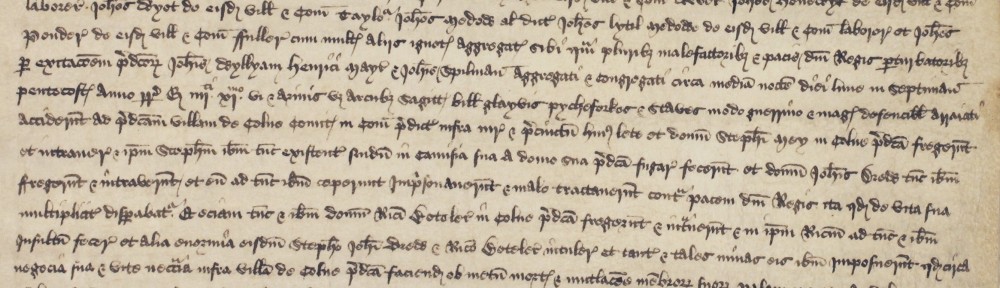
Extract from D/DHw M1, detailing the labour and goods owed by the tenants of the three Soken manors to their lord, including 300 eggs at Easter. The word ‘Pasha’ (Easter) can just be made out at the beginning of the second line.

You can find out more about manorial documents at our new workshop Discover: Manorial documents on Tuesday 31 October 2013. Details are available in our events guide, which can be downloaded here.

Conserving Essex’s past: Saffron Walden on the Map

In the days when you can carry a device in your pocket which can access not only a map of the whole globe but satellite images of the earth’s surface, it is hard to imagine life without easy access to accurate maps.

Historic maps are fascinating and often beautiful documents, and the Essex Record Office holds many maps which help us to tell the story of our county’s past. Some of these maps have been well treated and survive today in good condition, perhaps a little faded and worn but largely complete. Others, however, have not been quite so lucky.

Regular readers may remember that in spring 2012, a dirty, tattered piece of parchment was found in a farm outbuilding in Wendons Ambo, near Saffron Walden. Upon unrolling it, it was discovered to be a map of the historic town ofSaffron Walden, dating to 1757. This makes it the earliest known map of the town. This is a very special find, showing in great detail the historic centre of Saffron Walden, much of which survives today.

Before conservation work. The map was brittle, dark, mouldy, and peppered with small tears and holes.

Before conservation work. The map was brittle, dark, mouldy, and peppered with small tears and holes.

The map was made by Edward John Eyre, whose slightly later, larger 1758 map of the area around the town may well already be familiar to Saffron Walden residents. It is likely that both maps were commissioned by Elizabeth Countess ofPortsmouthor her nephew, Sir John Griffin Griffin, who inherited part of the nearby estate of Audley End. 

In June 2012 the map was transferred on permanent loan to the Essex Record Office for conservation work and storage. Despite the degree of damage it has suffered, the hand-drawn streets and buildings are still remarkably clear. Since the map arrived at ERO, our expert conservators have worked to stabilise the map to prevent any further deterioration, and have made any repairs possible. 

During conservation work. As part of the conservation work the map was stretched out after being humidified. This looks alarming but it mimics the original treatment process the parchment went through when new.

During conservation work. As part of the conservation work the map was stretched out after being humidified. This looks alarming but it mimics the original treatment process the parchment went through when new.

After months of painstaking effort, the conservation work is now complete, and the map is due to make a special one-day visit to its home town for local people to come and see it.

For your opportunity to see the original map and to find out more about its conservation, come to Saffron Walden on the Map at Saffron Walden Town Hall on Saturday 16 March, 10.30am-3.30pm, were ERO Senior Conservator Tony King will be talking about his work. There will also be talks from other experts about historic maps and how they were made. You can download a programme for the day here.

After conservation work. The map is still very dark due to the layer of discoloured varnish which cannot be removed, but it has been flattened and tears and holes filled in. Despite the damage it has suffered, the outlines of the streets and buildings are remarkably clear.

After conservation work. The map is still very dark due to the layer of discoloured varnish which cannot be removed, but it has been flattened and tears and holes filled in. Despite the damage it has suffered, the outlines of the streets and buildings are remarkably clear.