First World War centenary – useful resources

2014 will, of course, mark the centenary of the outbreak of the First World War.

The ERO’s collections contain a great deal of material relating to the First World War that tell us about life in Essex during the War years, and the experiences of Essex people service abroad. We will be using this blog over the year to highlight particular stories, so watch this space for those.

We are also planning a special event later in the year to mark the centenary – further details will be coming soon.

In the meantime, we thought it would be useful to bring together a range of resources that researchers might find useful for family history, local history, and community projects, both at the ERO and elsewhere.


Essex Record Office resources

You can of course search Seax, our online catalogue, to begin your research. A video tutorial on how to use Seax is available here.

Surviving First World War service and pension records and medal roll indexes are available on Ancestry, which can be accessed for free in the ERO Searchroom or at your local Essex Library

ERO First World War source list

Essex Sound and Video Archive sources on the First World War

Paul Rusiecki’s book The Impact of Catastrophe: The People of Essex and the First World War (1914-1920) is an essential companion for anyone interested in Essex during the War years, and is available to purchase from the ERO Searchroom, by e-mailing ero.enquriry@essex.gov.uk

Impact of Catastrophe cover edit

We are in the process of compiling a session for schools on Essex during WWI – if you would like to book a session please e-mail ero.events@essex.gov.uk


Resources for Essex

Now the Last Poppy has Fallen project

Now the Last Poppy Has Fallen is a project funded by the Heritage Lottery Fund and Essex County Council which will focus on the lives of individuals, families and communities in Essex during the First World War. The ERO is taking part along with 6 Essex museums, and the project will be producing a travelling exhibition as well as working with schools. You can follow the project on:

BlogFacebookTwitterPinterest


Women working at Hoffmann's ball bearings factory in Chelmsford, 1914 (Frederick Roberts Collection, Anglia Ruskin University, held at ERO)

Women working at Hoffmann’s ball bearings factory in Chelmsford, 1914 (Frederick Roberts Collection, Anglia Ruskin University, held at ERO)


Essex Regiment Museum

The Essex Regiment Museum in Oaklands Park, Chelmsford, tells the story of the Essex Regiment and the Essex Yeomanry.


East Anglian Film Archive

The East Anglian Film Archive has 200 hours of film footage online, including some fascinating pieces relating to the First World War, such as the following:

Zeppelins over East Anglia (watch from 18:30 for segment on Essex)

Women at work on a farm in Willingale, 1916

A roll of honour of men from Braintree who served in WWI

Presentation of a tank to Chelmsford, 1919


Chelmsford War Memorials

The Chelmsford War Memorials site details biographical information of the men included in Chelmsford’s war memorials, and is a really fabulous resource if you are interested in Chelmsford, or any of the men on the memorials.


Essex Branch of the Western Front Association

The Western Front Association was formed to further interest in the Great War and to perpetuate the memory, courage and comradeship of those who served on all sides. The Essex Branch of the Association has a whole programme of talks which will be running in 2014 which can be found here.


Resources for the United Kingdom

Imperial War Museum online resources

www.1914.org is the IWM’s centenary site which highlights events and resources from across the world. If you are running a project or event of your own relating to the centenary you can join the website as a partner and add your event. As a partner you will also have access to a tremendous range of resources that the IWM has compiled to help you with your project. You can also follow the First World War Centenary on Facebook and Twitter.

Lives of the First World War is the IWM’s major WWI online project, bringing together material from museums, libraries, archives and family collections from across the world together in one place. IWM wants your help to explore these documents, link them together and start telling the stories of those who served in uniform and worked on the home front.

Voices of the First World War allows you to hear about the First World War from those who were there, using recordings from the IWM’s sound collection. The podcasts can be listened to on the link above, or downloaded from iTunes, and include everyone from soldiers, sailors and airmen to munitions workers, schoolchildren and ambulance drivers.

Faces of the First World War is a set of photographs of WWI servicemen on IWM’s Flickr pages. These images are some of the first items collected by the IWM; in some cases, bereaved families donated their only family of their lost loved one. Some have only a name, rank and unit, so the IWM is asking for help from people to add information to the photographs.

The IWM is also in the process of transforming its First World War galleries to reopen in July 2014 – more here


The National Archives

Advice from TNA on First World War records


Soldiers’ wills

Search for soldiers’ wills on a database on gov.uk

Read more about the digitisation project here


Wales in WWI

Find out about the Welsh experience of the First World War on www.cymru1914.orgthis project has conducted mass digitisation of primary sources relating to the First World War from the Libraries, Special Collections and Archives of Wales


Great War Nurses blog

The Great War Nurses blog contains lots of information about women who served as military nurses from the Boer War through to the end of the First World War

The same author also writes about military hospitals and the Army Nursing Service.


Further afield

The Commonwealth War Graves Commission website includes a database which lists  the names and place of commemoration of the 1.7 million men and women of the Commonwealth forces who died during the two world wars.

Centenary News provides independent, impartial and international coverage of the First World War Centenary and Centennial 2014-2018.

Europeana is running a Europe-wide project to collect pictures, letters, postcards, souvenirs of other items relating to WWI. You can add your own stories, perhaps from family papers or photographs, or explore stories contributed by others.

Putting Art on the Map – a joint project between the Imperial War Museum and HistoryPin focusing on First World War artworks (PS, HistoryPin is a wonderful resource for sharing and exploring historic images – you can upload pictures and virtually ‘pin’ them to a map, and explore what others have pinned)


This list is by no means exhaustive, so if you have any other suggestions that you think researchers – especially those interested in Essex – would find useful, please let us know leaving a comment or e-mailing us.

If you do undertake research into the First World War using ERO’s collections we would love to hear from you.

The Fighting Essex Soldier: the background

Ahead of The Fighting Essex Soldier: War Recruitment and Remembrance in the Fourteenth Century on 8 March 2014, we asked one of our speakers, Dr Jennifer Ward, to fill us in on some of the background of what Essex society looked like in the 1300s.

With the conference on The Fighting Essex Soldier: War Recruitment and Remembrance in the Fourteenth Century being held at the ERO on 8 March next year, we shall all learn a lot about warfare and the ways in which most Essex people were involved in the wars.  2014 marks a significant anniversary in the history of Scottish warfare, since it marks the defeat of the English at the battle of Bannockburn.

Much of the history of the fourteenth-century wars with Scotland and France can be reconstructed from documents and books in the ERO.  Society was hierarchical, and leadership was undertaken by kings and nobles.  The great Essex lords – the de Bohuns of Pleshey and Saffron Walden, the FitzWalters of Little Dunmow, and the Bourchiers of Stansted Hall in Halstead – were all involved.  John Bourchier was unfortunate enough to be taken prisoner by the French in 1370, leaving his wife to raise his ransom and to take charge of his estates.  William de Bohun, earl of Northampton, was one of the commanders at the battle of Crecy in 1346.

All lords had their retainers who wore their livery and received fees.  In 1315, Sir John de Northtoft became the retainer of Sir Thomas de Vere (D/DCw T46/2).  He was to receive two robes a year at Christmas and Pentecost, a saddle to match those of Thomas’s other knights, and a yearly fee of £4.  The arrangement was to last ten years.  Retainers were used for peacetime and/or wartime duties.

D/DCw T46/2

Click for a larger version


For the Hundred Years War, the Crown raised cavalry by drawing up indentures with military leaders, specifying how many men they were to bring, their pay, and the terms of their military service.  An indenture of 1384 between Richard II and his half-brother, Sir Thomas Holland, earl of Kent, (D/DRg 1/62) laid down the details of Thomas’s governorship of Cherbourg.  He was to have as large a fighting force as he thought necessary, was to have all ransoms and profits of war, and he was to be paid £4,000 a year by the king.  A later indenture of 1417 between Henry V and Sir Roger Fiennes (D/DL F15) provided for Roger to serve the king for a year with ten men-at-arms.  Again, pay and conditions of service were laid down.

D/DRg 1/62

Click for a larger version

Seal of Richard II

Seal of Thomas Holland, earl of Kent and Richard II’s half-brother

Reverse of seal of Richard II, complete with medieval fingerprints

Reverse of seal, complete with medieval fingerprints

D/DL/F15

Click for a larger version

Infantry, including archers, were recruited by commissioners of array in each county.  Many Welsh contingents of archers served in the wars.  Merchant ships were used for transport, and were confined to the ports if a campaign was being planned.

During the fourteenth century, the gentry of the county became increasingly prominent in local administration and justice, as well as serving in the wars themselves.  Sometimes they fought as young men, and took on administrative tasks as they grew older.  They served as commissioners of array, as keepers of the peace, and from the mid-fourteenth century as justices of labourers and justices of the peace.  It was essential for the king’s peace to be kept in the county while the king was campaigning abroad.

Moreover, much money was needed for the prosecution of the war.  England, unlike many other European countries, had a national system of taxation, with each levy of taxes having to be agreed to by parliament.  Parliament, comprising the king, the nobility, and the commons made up of two knights from each county and two burgesses from each town, grew rapidly in importance from the reign of Edward I onwards.  The taxes were originally levied on people’s movable goods, but from 1334 each village or town had to pay a fixed sum.  The assessment for Boxted survives (D/DRg 1/35), and here the 1334 tax was levied on landholdings, both small and large.

D/DRg 1/35

Click for a larger version

Most Essex people were affected in some way with the wars, and the 1340s and 1350s brought great victories at Crecy and Poitiers.  However, in 1348-9, the Black Death reduced the English population by at least 0ne-third, and the court rolls for Essex show that many villages and towns suffered severely, such as Blackmore and Margaretting (D/DK M108, D/DP M717).  There are signs in the court rolls of increasing peasant restiveness after the Black Death.  This culminated in the Great Revolt of 1381, sparked off by refusal to pay the third poll tax.  Men of Essex were no longer willing to pay taxes and put up with serfdom in an era of population decline and military defeat.


Find out more at The Fighting Essex Soldier: War Recruitment and Remembrance in the Fourteenth Century on Saturday 8 March 2014. More details here. Dr Ward has curated a display of documents to accompany the conference which will be in the Searchroom from January-March.

Diary of John Farmer of Saffron Walden, Quaker, of his travels in America 1711-1714

Regular Searchroom visitors might have noticed that each month we display a different Document of the Month. November’s selected document is a diary made by John Farmer of Saffron Walden, describing his travels in America between 1711 and 1714 (Acc A13685). Here, Archivist Allyson Lewis tells us about this fascinating document…

The members of the Religious Society of Friends (Quakers or Friends) were early settlers in America, escaping religious and social persecution in England.  In America they were similarly persecuted by the Puritans in New England and settled further South in what is now New Jersey.  William Penn, a Quaker who was educated at Chigwell School, was granted a huge tract of land which he called Pennsylvania and which became a model for religious tolerance and a refuge for many European sects including Mennonites and the Amish who continue to practice their separate way of life there today.

Amongst the Quakers there is a tradition of asking for permission to travel to witness their faith amongst other people.  John Farmer, a Quaker living in Saffron Walden in the early 18th century, asked for permission to travel further than most – to America.

On his return he wrote a journal about his travels, recording meetings with other Quakers.  He boarded the Thomas of London bound for Maryland, arriving in January 1712.  He went on to North Carolina, Virginia, Pennsylvania, the Jerseys, New York, Rhode Island, and Nantucket Island meeting Friends in local meetings and attending the Dover, New Hampshire Quarterly meeting.   He records that many Quakers being pacifists refused to make use of weapons and garrison houses to protect themselves from raiding Indians during the ongoing war and were left unharmed.

While in North Carolina he heard of a Friend who was in dispute with his local meeting in Pennsylvania so moved himself and his family to North Carolina.  However he refused to join the local meeting of Friends but settled about 20 miles away amongst “very wicked people” for the sake of “very cheep and good land which they and he forceably took from Indians: whereas he might have bought his land of Indians for an iron pottage pot but would not.  These Indians having been much wronged by English French and Pallitins [Palatines, German refugees transported to the colonies by the British government in 1710] did at last com suddenly upon ym and killed and took prisoners as I was told 170 of them and plundered and burnt their houses.  Amongst the rest the said Friend was killed as he lay sick in his bed and his wife and 2 young children were carried away captive and indured much hardships.  But upon a peace made with ye Indians they were delivered and returned to Pennsylvania.”

jfarmer1

The Quakers’ message of equality before God and respect for all was well received by the Indians.  Their fair dealing in trade and refusal to carry weapons were also factors in their good relations with the Native Americans.  John Farmer had meetings with many Native Americans in Maryland, Pennsylvania and Virginia.  He met with a group of natives in Maryland and speaking with the help of an interpreter told them about his beliefs in God, Jesus Christ and the Holy Spirit, “to which ye Indians severall times gave their approbation in their way by a sound.”  They followed him to a Friends’ meeting at George Truit’s house in Mulberry Grove near the ‘Poakamoak’ [Pocomoke] River on the eastern shore of Chesapeake Bay.

Another meeting was held in “the Indian king’s palace” near the Susquehanna River about 60 miles west of Philadelphia, where he slept on bear skins on platforms in front of a fire as it was a cold and frosty night.

jfarmer2

John Farmer calculated that he had travelled 5,607 miles around North America before he continued his mission in the West Indies where he visited Quakers who had been banished to the Caribbean from New England. He returned to Saffron Walden in 1714.

jfarmer3

The diary will be on display in the Document of the Month case in the Searchroom thoughout November, and will be available for searchers to order in due course.

Favourite ERO documents: interview with Mrs Champion about the Canvey Island Floods of 1953

Today is World Day for Audiovisual Heritage, organised by the International Association of Sound and Video Archives, and this year’s theme is “Saving Our Heritage for the Next Generation”. We thought that this was a good opportunity to dip into the Essex Sound and Video Archive as part of our favourite documents series.

As well as asking our users about their favourite documents from our collections, we have also been asking ourselves. Here, Sound Archivist Martin Astell tells us about one of his favourite recordings in the Essex Sound and Video Archive, an interview with Mrs Champion about the Canvey Island Floods of 1953 (SA 6/306/1).

Choosing a favourite item from the Essex Sound and Video Archive is difficult for me as I have heard and watched so many wonderful recordings of all kinds relating to Essex people and places. The archive holds numerous recordings which can be enjoyed for their entertainment value – beautiful music, amusing anecdotes, interesting documentaries, dramatic productions, and so on.

However, I have chosen one of our oral history interviews which, rather than being entertaining, is sobering, shocking and moving. It is an interview with Mrs Peggy Champion, recorded in 1978, in which she remembers her experiences during the floods which engulfed Canvey Island and other parts of Essex on the night of 31 January 1953.

In this interview – which lasts only 7 minutes – Mrs Champion (who, at the time of the floods was Mrs Peggy Morgan) tells the story calmly and without hyperbole of how she woke in the night to find sea water in the bedroom of her home on Canvey Island and how, during the course of that night, she witnessed the deaths of her husband, her mother-in-law, and her five-year-old son.

It has been said that listening to an oral history interview is the closest one can come to time travel since it involves real people from the past talking about real events as they were genuinely experienced, and the emotional impact of this one recording can perhaps tell us more about the experience of natural disaster than any number of statistics or written reports.

I believe that hearing this recording was one of the things which spurred Patricia Rennoldson Smith to gather testimony from other survivors of the 1953 floods for her book The 1953 Essex Flood Disaster: The People’s Story, and every time I hear it I am reminded of why it is so important that sound and video recordings are preserved and made available alongside the other records held in the Essex Record Office.

Letters Close

Archive Assistant Edd Harris is back with some more medieval matters for you…

Close relations of the Letters Patent that we have looked at previously are the Letters Close (if you will pardon me the pun?)

Letters Patent are the open public proclamations of the royal court intended for anyone and everyone to read. In contrast, the Letters Close are the court’s private correspondence, intended only for the individual to whom they are addressed.

Like the Letters Patent, Letters Close still include wax seals, but rather than hanging from the letter the wax was used to seal the folded letter closed, in the way we often see in period dramas.

They deal with the more day-to-day activities of the court and as such the original Letters as sent out to the individual are extremely rare and often difficult to identify in collections. As the seal had to be broken in order to read the Letters, the seals are even rarer and at the moment only one known example exists of an unopened Letters Close, dating from the reign of Henry VIII.

Like the Letters Patent, they were recorded on rolls which are now stored at the National Archives in Kew. The first Close Roll begins in the year 1204, although there had been Letters Close before that date. The entries from the Close Rolls are also calendared (transcribed and/or translated from Latin, and indexed) in the Public Record Office (PRO) calendars, which are invaluable for researchers. Our collection of calendars in the Essex Record Office Library runs from 1227 through to 1509 (though the rolls for 1227-1272 are only recorded in the original Latin).

Following an extensive search through the catalogue of documents held at the Essex Record Office (Indiana Jones style hats were optional for those involved in the quest), we eventually identified what may well be the only original Letters Close in the archive, D/DP T1/1487.

ggg

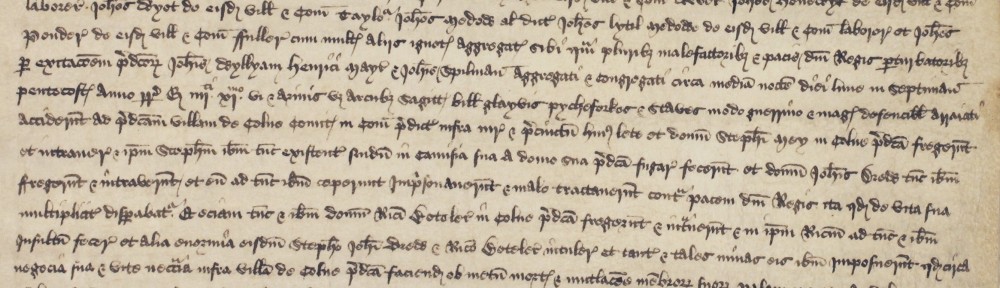
This may be the only original Letter Close in the ERO’s collections (D/DP T1/1487). It is shown with its entry in the Close Rolls. You can see the remnants of sealing wax along the top of the Letter.

D/DP T1/1487 contains two mandates (or instructions) from the King with two separate dates, one from the 30th of May and the other from the 2nd of June 1358. They are addressed to two different people, the Sheriff of Essex and the Barons of the exchequer. Presumably the barons are effectively being copied into the message to the Sheriff as it impacts them too. The instructions relate to a rather intriguing case.

It appears that a dead man was discovered in a ditch on the Priory of Thoby’s demesne land in Mountnessing. He had apparently been killed by robbers. Eight pounds was discovered on his person, which was delivered to the Prior of Thoby to be held “to the use of” whoever it belonged to (what we would call “holding in trust” today). The rightful owner of the money, however, could not be identified nor could the King claim ownership, so the mandate orders that Prior is discharged from his duty and was presumably allowed to keep the money.

Unusually the mandates use the same text as a previous entry accidentally sent to the Sheriff of Kent earlier that year, so presumably the letter we have is the second attempt to send it to the right Sheriff.

Black History Month

Archivist Sarah Dickie writes for us about records of Black communities at ERO… 

As October is Black History Month, we thought we would look at one or two Black people who are recorded living in Essex in previous centuries. Although the perception is that not many Black and Asian people were present here until relatively recently, this is not the case. The Record Office keeps a running list of references to Black people found in parish registers and other documents and the current total is 156, covering the period from 1580 to 2011. In most cases the only record is that of a baptism, marriage or burial and from these we can only guess the background details. For example, Sarah Drake had her daughter, Jacoba, baptised in Broomfield on 26 July 1725 naming the father as ‘Jacob, the Blackmoor servant to Mr. Hill at the Parsonage.’ [Mr. Hill was not the vicar.]  In 1736/7, Rebecca Magarth, a Black maid, belonging to Edward Kelsall of New House, Broomfield was baptised. Did Jacob at the parsonage know Rebecca – we can only surmise, although with the size of the parish at that time, they may well have known of each other’s existence. What about Ann Madre, the daughter of Charles and Margaret Madre, baptised in 1736 in the neighbouring parish of Great Waltham and described in the margin as ‘Black’? She lived only a short distance away but may never have come into contact with Rebecca or Jacob; we will never know. 

Baptism of Rebecca Magarth, recorded in the Broomfield parish register in January 1736/7 (D/P 248/1/1)

Baptism of Rebecca Magarth, recorded in the Broomfield parish register in January 1736/7 (D/P 248/1/1)

What is tantalising about these entries is how little we know about the people concerned. Sometimes, as in the case of Maria Sambo, they have left a bit more information behind. Maria first appears in Essex records in January 1732 when she signed as a witness on the marriage bond of Henry Dunnings for his marriage to Mary Seabrook.  Her own marriage took place in Earls Colne in November 1737 when she married Warren Hull, a glover. She was 25 then but no record of her baptism has been found in Essex. However, there is a record of the christening of a Maria Sambo, the daughter of Thomas and Mary Sambo, at St. John Zachary in London on 14 November 1712.  Maria and Warren Hull had four daughters, although as two were given the same Christian name it appears only three survived.  Maria’s death is recorded in the Earl’s Colne burial register for 1766 ‘Maria a Negro the wife of Warren Hull was buried May 4 1766’. Her three daughters all died, unmarried, within a year of her so we cannot trace the family further.

Marriage of Maria Sambo to Warren Hull in Earls Colne, 1737 (D/P 209/1/4)

Marriage of Maria Sambo to Warren Hull in Earls Colne, 1737 (D/P 209/1/4)

Burial of Maria Hull nee Sambo in Earls Colne, 1766 (D/P 209/1/5)

Burial of Maria Hull nee Sambo in Earls Colne, 1766 (D/P 209/1/5)

However, although there is certainly further information to be found in the records, it is only with the help of staff and searchers passing on details they have found using parish registers and other documents that we are able to compile a list of references for further research.

Black and Asian communities in Essex today are under-represented in our collections and we welcome deposits of records from new (as well as old) communities in Essex so if you have any records that you would like us to have, either on loan or as a gift, please contact ero.enquiry@essex.gov.uk It is important that archives record everyone’s history so that we can leave an accurate picture of Essex today for future generations.

ERO @ 75: The Open Day

Well, colour me exhausted!

After a thoroughly enjoyable Heritage Open Day on Saturday, I am sure you will forgive us a brief hiatus in the social media sphere. We all had a great time and we hope you did too. It was great to see so many people, roughly more than 500 came through the door by our closest estimates and every tour was packed. In fact, in the the end we had to lay on a few additional tours to ensure as many people could enjoy a guided tour of our searchroom or a visit to our conservation studio (from which one of my friends returned green with envy, saying “Some of the kit in there…fantastic!” He may have had too much blue icing though.

Our thanks must also go out to all our lovely volunteers without whom the day would not have been possible.

I thought I should share with you a few of the photos from the day, there are many more to follow.

IMG_1347small

IMG_1358small

Lord Petre, Lord Lieutenant of Essex, Councillor Kay Twitchen, Chairman of Essex County Council and Stephen Dixon, Archive Services Manager, cutting our 75th Anniversary cake.

IMG_1346small

IMG_1363small

IMG_1365small

Favourite ERO documents: Cartulary of the estates of Sir William Capel, 1294-1511

As well as asking our users about their favourite documents from our collections, we have also been asking ourselves. Here, Senior Conservator Tony King shares his perspective on one of his favourite documents, a cartulary of the estates of Sir William Capel, 1294-1511 (A8173). Some of the nominated documents will feature in a display at our open day on Saturday 14th September.

As a Conservator at Essex Record Office I am lucky to have contact with some remarkable documents from the collection so it is difficult to pick a favourite but Acc. A8173, a cartulary of estates of Sir William Capel, c.1511 encapsulates many of my favourite aspects of interpreting our collection. Documents can reveal so much, not just from their written content but also as a physical object; the craftsmen who made the parchment, the scribe who filled the pages and the binder who bound them together have all left their mark on this volume.

Book cut out

The parchment pages of the volume show numerous small repairs carried out through the ages. Some are healed scars sustained while the animal was still alive, other small patches were applied by the parchment maker while the processed skin dried and other tears happened hundreds of years later and have been patched by subsequent users of the book.

Book open cut out

The binding is a rare surviving example of a chemise binding where a soft allum tawed leather cover is stitched together and the bound book slipped into it, very much like a dust jacket on a modern hardback book. The edges of the chemise cover overhang the top and bottom edges of the book to form protective flaps over the edge of the pages. Although the chemise now appears grey, areas that have been turned onto the inside of the boards and have been protected are red in colour indicating that the whole cover may have been dyed red originally.

IMG_1322 edit

This book seems to have had a long working life and shows signs of regular use. The metal clasps which keep the boards securely closed, maintaining pressure on the parchment pages to keep them flat, are later additions as shown by evidence of earlier fittings on the back board which would have held straps to do the same job. This indicates that the book was still relevant many years after its binding and was maintained as a working resource.

Not only is the volume a rare example of this style of bookbinding, it also bears the physical evidence which points towards hundreds of years of use. Further examination of the binding structure and condition would yield more information about the techniques and decisions made whilst making it and hint at how it was used and regarded in the past. Scientific techniques such as DNA analysis could tell us the species and breed of the animals used for the parchment shedding light on the medieval parchment trade. This cartulary demonstrates how as well as holding a wealth of information in the text, a document can also provide a window on the past by looking closely at it as an object.

If you would like to nominate your own favourite ERO document, we would love to hear from you. Simply download this form, and return it to the Searchroom desk or by e-mail to hannahjane.salisbury[at]essex.gov.uk. There are also paper copies available at the Searchroom desk. Nominated documents may be featured on this blog or in displays at our open day on Saturday 14 September 2013.

Your favourite documents: Deed of the Royal Essex Forest, 1252

As part of our 75th anniversary celebrations this year, we recently asked you, our users, to nominate your favourite ERO documents. Thank you very much to those of you who have sent in nominations so far – today we bring you the next in a series of your favourites.

Today’s nomination comes from Richard Morris, one of the Verderers of Epping Forest, a post that has existed for nearly 1,000 years to protect and administer the forest. Richard’s nominated document is D/DCw T1/1, a deed of the Royal Forest of Essex dating from 1252.

Deed of the Royal Fores of Essex, 1252(D/DCw T1/1)

Deed of the Royal Fores of Essex, 1252. It is just possible to make out the remains of the enthroned figure of Henry III on the partially surviving seal (D/DCw T1/1)

This is one of the earliest surviving deeds of the Royal Forest of Essex, later Waltham Forest, of which Epping Forest is today the remaining fragment, albeit still covering over 6,000 acres.

The deed, dated 1252, refers to the restoration from King Henry III to Richard Muntfichette of the office of bailiff of the Forest of Essex, which he had lost when the infamous Robert Passelew was Judge of Forest Pleas.

The signatories to the deed, which includes part of the Great Seal of Henry III, include the Earl of Gloucester, the Earl of Norfolk (Marshal of England), William de Valence, the King’s brother, and the Earl of Albermarle.

The deed is one of the most important concerning the history and administration of the Forest of Essex.

Thank you to Richard for nominating this early document concerning one of Essex’s most notable historic landscapes.

If you would like to nominate your own favourite ERO document, we would love to hear from you. Simply download this form, and return it to the Searchroom desk or by e-mail to hannahjane.salisbury[at]essex.gov.uk. There are also paper copies available at the Searchroom desk. Nominated documents may be featured on this blog or in displays at our open day on Saturday 14 September 2013.

New Accession: 2nd Rayleigh Scouts log book, 1924-1944

Katharine Schofield, Archivist, writes for us about an interesting new arrival at the archive…

A log book of the 2nd Rayleigh (Holy Trinity) Troop of Boy Scouts was recently deposited and digital images are now available free of charge on Seax (D/Z 608/1). 

The troop was started in 1924 and the log book begins with the first parade and details of patrol leaders and the colour of the scarves.  The volume is particularly notable for the many photographs of camps and other activities of the Scouts.  These include photographs of the Essex Jamboree of Whitsun 1927 held at Priory Park, Southend and attended by Lord Baden-Powell (image 17).  Later that year the summer camp was held at Soligny in France, although the camps were more normally held in the Rayleigh area or at Heybridge Basin. 

Essex Jamboree of Whitsun 1927 held at Priory Park, Southend and attended by Lord Baden-Powell (D/Z 608/1 image 17)

In May 1935 to celebrate George V’s Silver Jubilee, the troop prepared a beacon as part of the Scout Beacon Chain in a meadow off Crown Hill opposite the Mount and the volume includes photographs of this.  Having made such a good job of this, they were then asked to prepare a bonfire to mark George VI’s coronation in 1937. 

ggg

Building a bonfire to mark the coronation of George VI in 1937 (D/Z 603/1 image 54)

When war was declared in 1939 the troop were engaged in War Service distributing posters calling up the reserves and staffing Council Offices with messengers 24 hours a day for a week ‘until the powers that be decided that no one under 16 could act in that capacity’ (image 66).  Thereafter the log book becomes much less detailed.  The Scouts were engaged in bill posting, waste paper collection, the collection of scrap metal and helped to put up more than 100 Morrison Shelters for Rayleigh Urban District Council.  As the war continued the log book records those who left to join the Armed Forces; sadly three former members of the troop lost their lives serving in the RAF.

ggg

A thank you letter to the Scouts for their help in putting up a Morrison shelter (D/Z 608/1 image 69)