The return of Sargant Wilson: deeds in family history

Archives Assistant Edd Harris blogs for us about just a few of the things family historians can learn from property deeds…

Do you remember our friend Sargant Wilson? At the beginning of October we discovered his marriage licence which told us that in 1834 at the age of 60 he married Karenhappuch Morgan, ten years his junior. We have come across the couple again although unfortunately in less happy times.

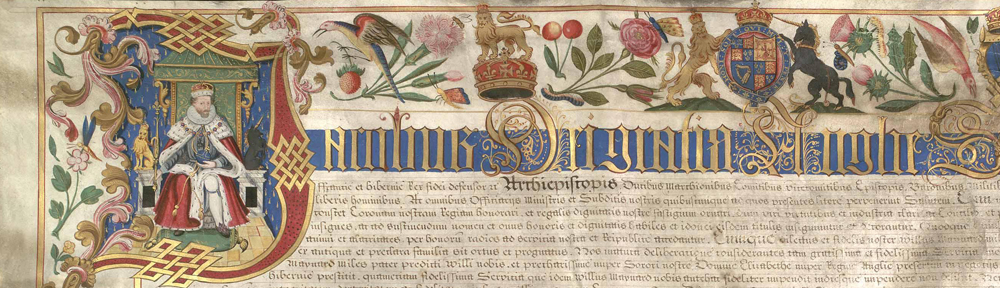
Extract from admission of Karanhappuch Morgan (D/DCf M73)

This document is an admission onto copy hold land (D/DCf M73). This is a type of land holding used when land is part of a Manor. The people who hold land from the Manor are recorded in the Manor Court Roll along with any payments or rents that they are due to pay as well as a description of the land and its previous owners. The new landholders are then provided with a copy of that entry in the Court Roll, hence the name ‘copy hold’.

Extract from admission of Karanhappuch Morgan (D/DCf M73)

In the recitals of this particular example from Southminster in 1844 (ten years after his marriage) we are told that Sargant Wilson has died. The land that he held has been passed back (surrendered) to the Manor. The admission then goes on to say that Sargant Wilson left the land to his wife by his will which is quoted at length, describing the property and revealing that it was bequeathed to him by his former wife Dorothy and that he had a son who predeceased him.  It goes on to admit his second wife Karenhappuch onto the land in his place and collects a fine or payment for doing this.

Extract from admission of Karanhappuch Morgan (D/DCf M73)

This just goes to show that family history can move far beyond the usual records of births, marriages and deaths. We now know that Sargant Wilson had a previous marriage to a Dorothy with whom he had a son, he had written a will, held land in the Manor of Southminster and we have a rough date for his death, all from one document.

You can search for deeds on Seax by the name of a person or property. Not all deeds are catalogued to this level of detail however, in which case manorial court rolls may be helpful. These records can be challenging, but as we have seen in the case of Sargant Wilson they can also be extremely rewarding, not only for family history but for house history and local history too. If you would like any further advice, then talk to ERO staff in the Searchroom, e-mail us on ero.enquiry@essex.gov.uk, or telephone 01234 244644.

Schools on a Naze Adventure

ERO staff are frequently to be found not just in our building in Chelmsford, but all over the county. Our education officer Sarah Girling has been working with school children around Walton-on-the-Naze to find out about how this vulnerable bit of coastline was defended in the Second World War…

173 pupils from three Essex schools have been learning about their local World War Two history on the Naze at Walton this October.

On a trail around the Naze headland searching for remains of WW2 coastal defences

On a trail around the Naze headland searching for remains of WW2 coastal defences

Frinton Primary, Walton-on-the-Naze Primary and Hamford Primary Academy School were involved in four days of visits to the militarised area of the Naze during World War Two, looking at surviving pillboxes and the area used for secret guided missile testing.

Roger Kennell of the Clacton Victoria County History group tells children about an infantry pillbox

Roger Kennell of the Clacton Victoria County History group tells children about an infantry pillbox

Year 5s from Walton-on-the-Naze Primary School with teacher Liz Wilson, local historians Fred Nash and Roger Kennell, and ERO education officer Sarah Girling

Year 5s from Walton-on-the-Naze Primary School with teacher Liz Wilson, local historians Fred Nash and Roger Kennell, and ERO education officer Sarah Girling

They also climbed the Naze Tower, listening to a talk given by Michelle Nye-Browne, the manager of the 300 year old Grade II* listed building, which was used as a radar tower.

The Naze Tower

The Naze Tower

Inside the Naze Tower, learning about how it was used as a radar station in the Second World War

Inside the Naze Tower, learning about how it was used as a radar station in the Second World War

The Naze Tower in use as a radar station in WW2

The Naze Tower in use as a radar station in WW2. Image reproduced courtesy of the Naze Tower.

Looking out from the top of the Naze Tower

Looking out from the top of the Naze Tower

As part of the European-funded World War Two Heritage project, pupils learned about the defences that were built during the Second World War and how they would have been used if German invasion forces had landed on the Essex coast.

Looking at a pillbox which has fallen into the sea

Looking at a pillbox which has fallen into the sea. The coast at Walton has been eroded at a rate of 2 metres a year, and some of the WW2 defences have fallen off the cliff edge

Led by enthusiastic historians, Roger Kennell and Fred Nash, the children were inspired by the stories including an eccentric Brigadier, who when faced with a missile that was heading back to its launch site on the Naze, calmly raised a ‘colourful golf umbrella’ as the bits of broken metalwork fell to the ground.

Roger Kennell shows children the site where soldiers lived during wartime

Roger Kennell shows children the site where soldiers lived during wartime

The pupils had obviously learned something of the Second World War back at school but the visit was a chance for pupils to really understand how national and international events impacted their local community. The Naze itself was inhabited by the army and the RAF, making it their home for the duration of the war.

Pupils using the specially designed Four on a Naze Adventure workbooks to find out about the WW2 coastal defences at the Naze

Pupils using the specially designed Four on a Naze Adventure workbooks to find out about the WW2 coastal defences at the Naze

The project will be continuing and will include a visit to the Essex Record Office for pupils to investigate local records that reveal what life was like for ordinary people living in Walton during the war, interviewing locals to find out about their memories, and holding a 1940s tea party at each school to celebrate the end of the project.

To find out more about the educational work of the ERO, visit our services for schools webpage.

This project is part of the EU Interreg-funded World War Two Heritage project taking place on both sides of the Channel.

Sharing Our History: Marconi in Chelmsford

On Wednesday 7 November, the ERO is hosting a University of Essex event focusing on the centenary of the opening of Marconi’s famous Chelmsford factory…

Do you have memories of working at or with Marconi?  As part of the Festival of Social Science, the University of Essex is hosting an oral history event to commemorate Guglielmo Marconi, and the centenary of the opening of the world’s first purpose-built radio factory in New Street in Chelmsford.

Marconi, who is often credited with being the inventor of radio, first established his company in a former silk works in Hall Street in Chelmsford in 1898. But this soon became too small for his expanding operation, and in February 1912 work began on the 70,000 square foot factory in New Street. The works were opened in June that year. 

Eight years later the factory played host to the first experimental wireless broadcast, which featured Dame Nellie Melba singing two arias. The signal was received throughout Europe and as far away as Newfoundland, Canada.

Marconi's New Street factory

Marconi’s New Street factory

This free event is open to all, for people wanting to find out more about Marconi the man and the technological advances he made, as well as those who worked for Marconi, or who had relatives who worked there, to come along to share and record their memories.

Chaired by Martin Astell, Sound Archivist at the Essex Record Office, the event will feature a film and short talks by Peter Turrall, Chairman of the Marconi Veterans’ Association, who will talk about Marconi the man and how he came to be in Chelmsford, and Dr Geoff Bowles, curator of the Sandford Mill Museum, who will talk about the collection of Marconi artefacts which are held there.

Members of the audience will also be asked to share memories of Marconi’s history in Chelmsford.

Afterwards there will be free tea and cakes and a small exhibition relating to Marconi. A film crew will be on hand and those who wish to do so will be asked to take part in interviews which will then be placed on a website to form a lasting record of the event.

Entry is free and no booking is required: if you have any queries please email events@essex.ac.uk or phone 01206 872400

Wednesday 7 November 2.30-4.30pm

Essex Record Office, Wharf Road, Chelmsford, Essex CM2 6YT

Women at work in the Marconi factory

Women at work in the Marconi factory

Men at work in the Marconi factory

Men at work in the Marconi factory


‘To make a cake the Preinces of Oringes way’

We recently brought to you some recipes from the pen of Abigail Abdy, who lived in Kelvedon and Coggeshall in the 1660s and 1670s. She carefully recorded her recipes, for medicines and for food, in a book which she titled ‘Mrs Abigail Abdy her book’ (D/DU 161/623).

Abigail died in 1679, but this was not the end of the use of her book; two more hands fill the remaining pages.

The second hand is a mystery, but in the 1930s Miss A.D.Harrison made a conjecture who the third hand may have belonged to (D/DU 161/661).

Three years after Abigail’s death, her husband Sir Mark Guyon remarried, to a Mrs Augurs, his waiting-maid, and Miss Harrison suggests that it was Mrs Augurs who wrote the later recipes.

The author clearly had her sights set on high society, with her recipes including ‘The Kings majesties excellent receipt for the Plague’, and ‘To make a cake the Preinces of Oringes way’, which is another giant of a cake:

To make a cake The Preinces of Oringes way

Take nine pound of very good flower serced [sifted] and dried and a pound and a half of suger serced and dride a pound of Almons well beten an ounce of spices of all sorts mingell these well into the flower then take a pinte an a halfe of creame and three pound of butter and mingell in the creame a littell hotter then milke from the cow a pinte an a halfe of Ale yeast and pore in the yeast to the flower then pore in the creame with the butter melted in it then put in the eges which is to be foreteene halfe whites well betten then to one a lettell flower over it and cover it up hote and let it stand halfe an houer to worke and then make it up with nine pound of minced resons and put it into a paper hoope. 

We especially like the instruction to use cream ‘a littell hotter then milke from the cow’. 

More recipes from the archives coming soon!

Mrs Abigail Abdy her Booke

As The Great British Bake Off continues on BBC2, we bring you the second in our special series exploring some of the recipe books in our collections. 

Today we look at another of our very earliest recipe books, written by Abigail Abdy, beginning in 1665 (D/DU 161/623).

Title page of Abigail Abdy's book - reading 'Mrs Abigail Abdy her book May the 24th 1665'

Title page of Abigail Abdy’s book – reading ‘Mrs Abigail Abdy her book May the 24th 1665’

Abigail was born in 1644, the daughter of Sir Thomas Abdy of Felix Hall, Kelvedon, a lawyer and landowner. Sometime after 1670 she married Sir Mark Guyon, son of Sir Thomas Guyon, a rich clothier, becoming his second wife.

Much of the book is taken up with medical concoctions, for both humans and animals, such as ‘A very good Drink for ye Rickitts’, ‘A good Receipt for sore eyes, when one has the smallpox’, ‘To make the plague water’, ‘To make cordiall water, good against any infection, as the plague, small pox &c.’, and ‘A very good drinke for a Bullock’.

Given that the book was begun in 1665, during the Great Plague in London, it is not surprising that the recipes concentrate on warding off and treating infection.

 Alongside these mixtures are recipes much more recognisable to modern eyes, such as these for macaroons and sugar cake: 

Abigail Adby's recipe for macaroons

Abigail Adby’s recipe for macaroons

To make mackaromes

Take 2 pound of Veliney Almonds to a pound of double refined sugar, it must be beaten & searced [sifted] then take your almonds and lay them in water, overnight, & let them lye till the next morning, & then blaunch [blanch] them & put them into a mortar, & beat them & as you beat them, put some sugar amongst them, & onely wet your pestle with rose water to keepe them, from oyling, this must be beat but half as much as Marchpain then take the whites of 2 or 3 eggs and beat them till they froath, then put the Almonds into a dish upon a Chafinedish [chafing dish] of Coales & put in the froath of your eggs, & keepe it stirring or  else it will burne to the dish you must stirre it till it be through hott then lay it upon wafers the ovin must be something hotter than for marchpain.


Abigail Adby's recipe for sugar cake

Abigail Adby’s recipe for sugar cake – including the instruction to beat the mixture for an hour!

 To make sugar Cakes

Take a pound of flower, halfe of it [rice] flower a pound of sugar finely sifted, 8 or 9 eggs halfe the whites, but all the yolkes, beat the eggs very well with rose water, then put in ye [the] flower, by degrees then beat it a little, then put in the sugar too by degrees it must be beaten about an houre then your Ovin bring of a good heat, beat them up, putting in a few Coliander seeds, then your pans being well buttered, put them in the Oven, being well hett, set them & when they be rissen take them out, knocking them out, scraping the botomes of the pans, then if they be not baked enough put them in againe, & let them stand a little longer.


Abigail died in 1679, aged just 35. Joseph Bufton, the Coggeshall diarist, records that she was buried quickly, late in the evening by torches, without a sermon, suggesting that she had died of an infectious illness, possibly the plague. This was not, however, the end for Abigail’s book – find out more in our next post, coming soon!

If you’re visiting the Record Office soon, look out for our display of recipe books in Reception, or pop up to the Searchroom to order Abigail’s book (D/DU 161/623), or Miss A.D. Harrison’s article about it (D/DU 161/661).

Dr Nick Barratt at the Essex Record Office

Ahead of his keynote speech at our Discovery Day on 8 September, Dr Nick Barratt recently dropped in for a chat. Here he is in the Essex County Council chamber, talking about Essex history, and why archives are so important:

Dr Barratt’s talk, ‘Why do we still need archives when we’ve got the internet?’, is at 1.30pm, and entry is free. Places are limited, so guarantee your seat by pre-booking on 01245 244620. See our events page for more details about the our Discovery Day and other great events.

The Discovery Day is part of Heritage Open Days.

‘To make a good cake’

Today, not only is it Julia Child’s 100th birthday, but last night the third series of The Great British Bake Off began on BBC2, and we thought that this was a good excuse to delve into some of the recipe books in our archive. People in the past enjoyed their cooking (or their eating) just as much as we do today, and went to great lengths to produce elaborate edible creations.

In this first of a special series of posts about some of the handwritten recipe books which are held at the ERO, we begin with one of the earliest recipe books in our collections, dating from around 1680 (D/DU 138/2).

Unfortunately there is no name inscribed on the book to give us a clue to its author, but we do know that it was handed down between generations of the Clapton-Rolfe family of Rayne Hall.

The first recipe in the book is for a cake of enormous proportions:

(Click for larger version)

Take 6 pound of fflower & 5 pound of butter and worke or rub it into your flower then take 3 poynts of ale east [yeast] and putt itt in the meddle of your flower and butter, 3 nutmegs, beate & sett it by to rise then take a poynt of Milk or Creame & half a poynt of Sack [white whine], make a possett [made by boiling the milk or cream before mixing it with the wine] & put 5 yellows of Eggs into your possett & Suger according to your pallet, then take a graine of Musk and Ambergrease [a waxy substance that originates in the intestines of the sperm whale, with a pleasant smell, which is also used in perfumery], and grinde itt with a little Suger well together, then mix all this together & worke it with your hande till itt bee prety stiff, then worke in 8 pounds of currantes & a pound of Carrawayes and sume Candied Oringe and Lemon peale & scitterun [citron] slices & soe worke itt till it bee all alike, butter your hoope and papers well, & putt your Cake into it, & bake itt.

And for the icing:

Then take 5 whites of Eggs & double refined Suger sifted throu a Sciprus Sive [a sieve made of cypress wood, which was durable and had a nice smell] & put into your whites of Eggs till it bee thick enough to spread with a knive, & beate itt till itt looke glassy & clare [clear], you can’t beate it too much, when your Cake is drawen spread your Ice one itt with a knife, & lett it dry: but put itt no more into ye [the] Oven for itt will make your Ice yellow.

As well as making us grateful for the modern use of full stops, this recipe uses fairly staggering quantities used – 6 pounds of flour, 8 pounds of currants – and must have been quite an extravagant affair.

Eliza Vaughan, who wrote about the recipe book in the 1930s, imagined the cake as an ‘ice-coated monster’ crowning the tea table at Rayne Hall, or being prepared perhaps as a wedding cake.

The book also includes a recipe for a pound cake, which is much more recognisable to modern eyes:

(Click for larger version)

Take a pound of fflower & drey itt by the fire, & A pound of butter & wash itt in Rose water, & A pound of suger well beten, & worke your butter in ye suger a grate while; then take 6 yelkes & 4 whites of Eggs & halfe a Nutmeg grated; then worke all together A grate while & you mush bake them in such pans, & bake them in A slow oven.

The book includes just 12 recipes in total, but also covers the art of pastry making and the preparation of certain meats, including chicken, rabbit, veal, lamb, pigeon, and turkey.

You can view digital images of the rest of the book on Seax here. Look out for more baking-themed posts over the next few weeks!

Further reading: Eliza Vaughan, ‘High baked meates and patty pan past’, in Essex Review, 1937, vol. 46

New accession: Old Harwich in photographs

The ERO has recently acquired a photograph album which contains some fantastic pictures of Harwich in the 1850s. Here we bring you an exclusive sneak peak at its contents before it is treated in our Conservation Studio and digitised. 

The album, although rather dilapidated, contains 47 rare salt paper prints of Harwich which seem to date from about 1855. Many of the photographs have faded, but despite this the images remain remarkably sharp.


They capture a moment when Harwich was being transformed by the rebuilding of the quay, the arrival of the railway and new developments such as Orwell Terrace. The album seems to have used the new technology of photography to deliberately create a record of these momentous changes.

Harwich was – and is – a busy port on Essex’s north sea coast. In the 1850s, the town’s quays were extended through land reclamation

The railway arrives in Harwich

An Atlas Works locomotive

The album includes images of the High Lighthouse, St Nicholas’s church, Orwell Terrace and Cliff House. They also show the short-lived first station in Harwich and works to reclaim land in Bathside to extend the quays.

Harwich’s short-lived first station

The album may have some personal connection with Robert Bagshaw who was the investor who built Orwell Terrace and Cliff House, and who was instrumental in bringing the railway to Harwich. Unfortunately the album does not have any contemporary indication of ownership. 


Orwell Terrace

Top-hatted men, probably investors in the new developments, in one of the streets of Harwich

The album also includes a photo-montage of many different people, almost exclusively men, who are possibly a mixture of local residents and people involved in the building works. The identification of the faces featured will be a challenge for dedicated enthusiasts!

The album has been catalogued as A13438, and we will now do everything that we can to preserve the images.

The album was purchased for the ERO by the Friends of Historic Essex, and we would like to thank them for this fascinating addition to the ERO’s collections.

Evacuees’ voices at ERO

By Martin Astell, Sound and Video Archivist

The Essex Sound and Video Archive has recently added to SEAX a collection of oral history interviews which focus on childhood experiences during World War II (SA 48).

The collection includes a number of interviewees who were evacuated from their homes to ‘safer’ parts of the country. The evacuation of children can be portrayed as an example of how the nation ‘pulled together’ during World War II to help one another through the crisis. However, the individual stories told by those who experienced evacuation can help to present a more complex narrative.

The recordings in this collection include an account of being treated very poorly by the family which had taken the interviewee into their home (SA 48/1/1) and another of the local children being told not to mix with the evacuees from London and being strictly segregated within school (SA 48/8/1). This interviewee also states that she and her siblings returned to Chingford despite the clear risk of being bombed because her mother, who had accompanied the children in their privately arranged evacuation while her husband remained at home, was in danger of falling into an affair with another man.

This collection has been catalogued with the help of volunteers, and joins our existing Sound and Video Archive sources material on the Second World War. You can download a guide to these sources by clicking the link below.

ESVA Sources on the Second World War

All of the recordings in the source list can be ordered in the Searchroom, and listened to or watched in the Essex Sound and Video Archive.


Stories from the stores: Anthony Carr, ERO’s Brain of Britain

At ERO, we pride ourselves on the expertise on our staff, but it seems like none of us could compete with one young archivist who worked here in the 1960s.

In 1962, Anthony Carr, then 24 and an assistant archivist at the ERO, won the accolade ‘Top Brain of Britain’ on the BBC’s radio general knowledge quiz ‘What Do You Know?’

(Essex Weekly News, 13 July 1962. Click for larger version)

Despite his youth, this was actually the third title which Carr had won on the quiz.

In 1956, at the age of 18, he had won the ‘Brain of Britain’ competition, beating a schoolmaster and a headteacher. He was the youngest ever winner, a record he maintains to this day.

Mr Carr had just left school and was working as a paper boy at the time, inspiring national headlines.

In the same year, he also won the 3-yearly competition ‘Brain of Brains’, beating the winners of ‘Brain of Britain’ from 1955 and 1954.

The ‘Top Brain of Britain’ competition which Mr Carr won in 1962 while working at the ERO was a 9-yearly title, in which 3 winners of the ‘Brain of Brains’ competition battled it out.

Not only did Mr Carr win, he scored more points than both of his opponents combined. His prize was a five guinea book token.

Mr Carr was very humble in his victory; interviewed afterwards he was reported to have said:

I take no special steps to acquire this sort of knowledge. I haven’t got a photographic memory. It’s largely a matter of luck whether you can answer the questions asked.

Despite his modesty, he was clearly a highly intelligent man and very widely read. Mr Carr has in recent years said that his time as a paper boy helped him to do well in the quiz, as reading the headlines as he delivered the papers helped him to stay well-informed on current affairs.

After four years at the ERO, Mr Carr returned to the University of Bangor, where he had previously studied, and eventually became a professor of medieval Welsh history.