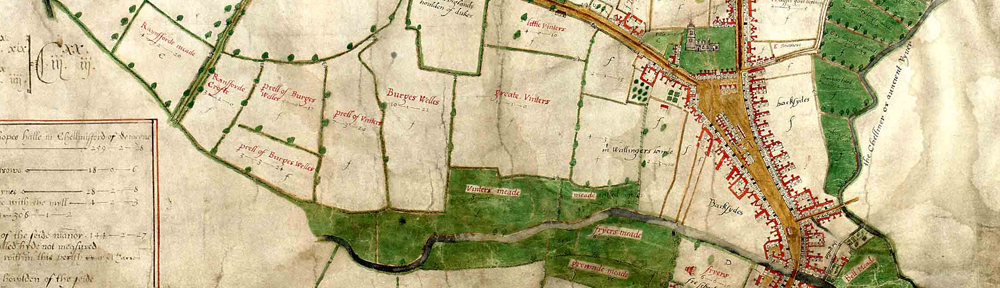
In this blog post, Archive Assistant Robert Lee explores a previous example of how the ERO Search Service can assist with property history.
One such case was a search request from Mr. Ben Parker of Great Braxted. The purpose of which was to help establish a general history of a farm called “Brick House” (or Brickhouse), south of Kelvedon near the River Blackwater.
Indeed this now comprises modern dwellings, but the farm encompasses three buildings which are Grade II listed1 with Historic England. The individual listings contain abridged architectural descriptions (e.g. timber frame, thatched or tiled roof, if any later alterations are apparent) which work towards establishing an approximate biography of the building in question. Indeed, the three entries for Brick House cite “C17 or earlier”; “C16 origin”; “C18”, respectively. Clearly, then, a farm which spans several eras: a wide net for historical inquiry.
It is difficult to determine with complete accuracy, but there does look to be a farmhouse, stables, and perhaps a barn on the 1777 Chapman & Andre Map of Essex. It is just across from A Corn Mill – a mill still stands on this site in Great Braxted.
‘A map of the county of Essex from an actual survey taken in MDCCLXXII:LXXIII & MDCCLXXIV by John Chapman & Peter André’. (MAP/CM/37/4 Plate 13)
This is also the case on the Gt. Braxted Tithe Map [D/CT 48B], with the accompanying apportionment suggesting that the farmlands were occupied by a Thomas Brown and owned by Peter Du Cane III. Now, properties tend to be allusive in archives due to changing house names, street re-numbering, et cetera. “Brown’s Farm” is the given name of Brick House in 1839, presumably on account of Thomas’ occupancy. This is inferred by simply overlaying a modern street map onto the tithe plan, but this was also evidenced by W.A. Gimson’s local history work Great Braxted, 1086-1957 [LIB/E/BRAXG1], which helpfully correlates the tithe apportionment with modern place-names.
Great Braxted Tithe Map 20 inches to 1 mile [72″ x 63″]. Dated 1839. (D/CT 48B)‘Great Braxted, 1086-1957’ by W.A. Gimson. (LIB/E/BRAXG1)
We can see Thomas Brown’s payments in an 1838 tithe survey as well [D/DDC E11]. The accounts for Brown’s farm are broken down into more detailed plots than the tithe apportionment, and include House, Garden, Yards; Cart Lodge Field; and Barn Meadow Field – which correlate with the three Historic Building listings.
It is clear, however, that Peter DuCane III was the principal landowner within Great Braxted. The DuCanes were prominent cloth merchants, the family having descended from Hugenot ancestry. Peter DuCane purchased Braxted Park from the Darcy family in 1745; an estate which includes Braxted Lodge, a Georgian Mansion. Given Peter DuCane’s ownership, and its proximity to Braxted Park, it seemed plausible that Brick House Farm was formerly an aggregate of the whole estate. This was confirmed by a 1923 Sale Catalogue for Braxted Park [SALE/A62] which includes Lot 5, A Desireable Dairying and Corn Granary Farm known as Brickhouse farm.
Sale catalogue for Braxted Park, Great Braxted. Includes photographs and plan. Dated 20 July 1923. (SALE/A62)
For the remainder of the search, we looked at establishing more historical occupants. Maldon district’s electoral registers show an Anthony Patten residing here from 1891-1902. The 1910 Finance Act records show a John Melson residing at the farm. On the 1911 National Census, Thomas Goodwin and his family reside here – as is the case in the 1912 & 1914 Essex Trade Directories. In the 1926 and 37 Trade Directories, Ralph Goodwin lives here.
If you would like us to look into the history of your house in Essex, contact us for details of how to get started.
Grade II indicating “particularly important buildings of more than special interest” ↩︎
Archive Assistant Desmond Crone highlights examples of the types of material that you might find in the Essex Record Office collections when researching your property. Some are from searches recently carried out for customers of our Search Service.
Maps Modern copies of maps
Detail from the c.1590 modern copy of map of Waltham Holy Cross and Epping from Cecil Papers, Hatfield House (T/M 80/1)
Estate maps
Detail from the 1666 ‘A mapp of the mannors of Skreenes and Tyhall together with Lightfoots Searles and Bradleys Birches …’ (D/DXa 21)
Chapman and André’s Map of the County of Essex 1777 We hold copies of the 1777 Map of Essex by John Chapman and Peter André in the Searchroom and it is also available online here.
Detail from the Berden enclosure map 1841 surveyed by Arthur Nockolds of Stansted Mountfitchet (Q/RDc 29B)
Enclosure maps Compared to other counties Essex has rather fewer statutory enclosure awards having been largely enclosed from an early date. The exception are parishes in the north-west and extreme west of the county, so there are enclosure awards for about 20 parishes dating from 1799 through to 1865. The other awards made between 1770 and 1895 deal with various waste lands and heaths. Where an enclosure map exists it may, if earlier in date than the tithe maps of c.1837-1850, be the oldest complete map of a parish.
Detail from the Laindon tithe map of 1839, by John Hills, surveyor, Billericay (D/CT 199B)
Tithe maps and apportionments c.1837-1850 These are a product of the 1836 Tithe Commutation Act, which required the payment of tithes to be changed from being paid in kind to being paid in money. The map and the accompanying schedule known as the apportionment give the names of all owners and occupiers of land in the parish so that tithe payments could be worked out.
Many of the apportionments have been transcribed as part of the Essex Society for Archaeology and History’s Essex Place-Names project.
Ordnance Survey maps For example the First and Second editions of the 25” to the mile series (1862-1896) plus the New Series revisions (1913-1947), the nineteenth and twentieth century 6” series, and for the major settlements the 120” series.
The National Library of Scotland host an extensive collection of Ordnance Survey (and other) maps on their website. There are gaps in their collection of First edition 25” to the mile maps.
First edition OS map showing the details recorded at the North Hill end of the High Street, Colchester. Surveyed 1875 (MAP/OS/4/27.12.3)
Sale particulars Compiled by estate agents to support the marketing of a property, they typically include descriptions, photographs and maps.
Sale catalogue of property in Aythorpe Roding, Beauchamp Roding, Blackmore, Fyfield, High Roding, Shellow Bowells and Willingale Doe (D/DMa B71/12) Sale catalogue for Warley Place estate, Great Warley (SALE/B1986)Sale catalogue for Warley Place estate, Great Warley (SALE/B1986)
Deeds These bundles can include a variety of document types in addition to conveyances, such as wills and mortgages; they are a rich source of names of people, their occupations and parish of residence, as well as the property details.
Indenture of Birds Green, Willingale Doe (D/DTc T24)Deeds of The Ferryman beerhouse, Willingale Doe (D/DTc T25)
Electoral Registers Registration was introduced following the Reform Act of 1832. Registers have been produced annually since then, with the exceptions of the years 1916, 1917 and 1940-44. Note that until 1928 the number of people eligible to vote in elections was restricted. Before 1867 in urban areas, and before 1884 in rural areas most men could not vote, and no women could vote in parliamentary elections before 1918.
Index page of the Northern Division electoral register dated 1849 (Q/RPr 1/9)Page of the Northern Division electoral register dated 1849 (Q/RPr 1/9)
Rate Books These list the rate payers for a local authority, and we can use them to confirm the name of the rate payer, the rateable value of the property and the amounts due in general and special rates and when paid.
Page from rate book No.10 St.Clement’s Ward, Southend-on-Sea (D/BC 1/2/2/2/14/2)
Building Plans Essex Record Office hold hundreds of thousands of building plans from the mid-19th century to the mid-20th century. There are large collections of the documentation filed with local authorities such as Southend-on-Sea and Canvey Island, as well collections from architects’ offices, such as the Chancellor collection.
Local government building plans: each application will usually include an application form and at least one plan, and will have information about the owner, the building and its location. Often the plans will include elevations, sections, a floor plan and a block or key plan showing the site from above and including details about nearby properties and roads. Sometimes the packets will include correspondence and certificates about inspections and the completion of construction.
Building plan of five bungalows, Station Road, Leigh (D/BC 1/4/12/10878)Building plan of five bungalows, Station Road, Leigh (D/BC 1/4/12/10878)Building plan of five bungalows, Station Road, Leigh (D/BC 1/4/12/10878)
An extensive architectural collection came to the Record Office from the practice of Frederic Chancellor (1825-1918). There are plans for hundreds of public and private buildings, including many of Essex’s churches. The project to clean, conserve and make these thousands of plans accessible began in 2014 and is now nearing completion (catalogue reference D/F 8).
Innkeeper Licences Where the property has in the past been a licenced premises the Record Office holds details of innkeepers from 1580 until fairly recently, with a gap between 1830 and 1870 when no licences were issued (with the exception of some beer shop licences issued 1840-48).
From 1870 we hold records from the petty sessions in each of the Hundreds.
Register of licences for the Ongar Division kept according to the Intoxicating Liquor (Licensing) Act, 1872 (35 and 36 Vict., c.94, s. 36) (P/N L2)Register of licences for the Ongar Division kept according to the Intoxicating Liquor (Licensing) Act, 1872 (35 and 36 Vict., c.94, s. 36) (P/N L2)
Look out for next month’s blog post exploring a case study of one of our house history searches.
In the first in a series of case studies on our search service, Archive Assistant Robert Lee takes a look at a search request to show what a will transcription may involve.
Transcribing wills is not always an easy endeavour, and it can be a lengthy process, though never boring. One request was recently commissioned by David Howe, a historical researcher in America, for the transcript of two wills from the 16th century. They concern a Thomas Wallys (1552 – D/AEW 2/413) and a Thomas Welles (1555 – D/AEW 3/99) respectively, both of Stanford Rivers. This search was an attempt to untie an old genealogical mystery regarding David’s 10th Great Grandfather Robert Howe (1571-1637). Robert’s father John Howe (1540-92) married Joan Welles (1540-1617) in 1560 in Bobbingworth, but the trail goes dark beyond Joan’s parentage. These wills were selected with a view to establishing Thomas Welles/Wellys as Joan’s father.
There were several reasons why these transcriptions were a somewhat difficult task. Notwithstanding idiosyncrasies in word abbreviations, general deviations from established forms of handwriting, and defects in the paper itself, wills are packed with historical and theological allusions. One is introduced to legal and monarchical nuances now well past obsolete. It is a great pleasure to be able to examine them at this level of detail. My early modern British history is wanting, but to look so intimately into the lives of those who experienced it is the most helpful method of revision.
The will of Thomas Wallys was composed in 1552, during the reign of Edward VI. As the will begins:
1. In the name of God amen the third day of marche in the fifth year of the 2. reigne of his sovereign lord king Edward the syxth kyng of England France 3. and of Irland & in r-pect of the church of England and Irland the supme- 4. hed. (D/AEW 2/413)
This format will be familiar: an introduction which appeals to God and the reigning monarch. We see the first of a few abbreviations here, note the use of r[es]pect and sup[re]me. The year is not given explicitly (not as a cardinal number), rather as the fifth regnal year of Edward VI (being 28 January 1551 – 27 January 1552). Thomas bequeaths his soul unto God, and shares out his livestock and money amongst his children. His two sons are promised:
ii Hen and
fyve marks in money to be delivered… at the age of xxi years…
and three daughters promised:
ii hen and fortye shilynge
agree to be delyvered to them & either of them at the day of theyre maryages.
Filial inequality aside, we can observe uses of the silent e (‘fortye’ & ‘shylinge’; ‘maye’ and ‘reigne’ in the previous lines), and parallel use of i and y, both common in early modern English. Like the regnal year, monetary values are written as roman numerals and other amounts are mostly given in word form. Whilst Arabic numerals had been introduced in England some centuries before this will, they had not yet taken on ubiquity, and as such roman numerals were preferred by scribes. A ‘Mark’ is a monetary value equivalent to 13 shillings and 4 pence (or 2/3 of a pound).
One section that caused some confusion is his initial bequest.
The handwriting here is particularly difficult, but we concluded that this states:
10. [I give] and bequeath to the amendyng of the highways xxxiiii S viii d which 11. was left in my hands by Thomas Welles my father of the legacye & (D/AEW 2/413)
Thomas here bequeaths money toward the upkeep of the roads in Stanford Rivers. The monetary value ostensibly reads as xxxiiii S (34 shillings) and viii d (8 pence), but on second glance it may be more complex. 34 shillings is an odd value, given that 20 shillings make up a pound: i li xiv S viii d (1 pound, 14 shillings, 8 pence) might make more sense. What is more, the symbol after 34 more resembles an R (Perhaps a reader can clarify this?).
Some other interesting extracts:
29. I wyll to Thomas Wallys & George Wallys one weynell calff (D/AEW 2/413)
A weynell calff (weanel calf) is a young calf, six to seven months old, that has been “weaned” from its mother, and is thus on a diet of grass rather than its mother’s milk.
13. (I) bequeath to Catheryn my wyfe w-thassent & consent ^of^ my Landlord Willm grene 14. of London marchannt-taylor or thassent & consent of hys guarantors & assynes 15. to whome the lease of Stanford Hall wherin I dwell shall own of hym or of 16. any of them obtayned all that my lease and terme of yeres yet to 17. come of Stanford hall where I dwell to have and to hold to her for 18. and duryng the termes of yeres yet to come yf she so long do lyve upon 19. condycyon that she the sayd Catheryn my wyff shal be orderyd unlyd and 20. advysed by my sayd landlord & such as shall be by hym made owner or 21. owners of the sayd lease at Stanford hall aft hym & upon condycyon that 22. she do not marry agayne aft my decease w_out hys or theyre argreement or 23. agreements to any persons duryng the sayd yeres and further I Wyll (D/AEW 2/413)
A verbose passage. It appears to be saying, simply: My wife can have my lease so long as my landlord agrees and so long as she doesn’t marry again. One is often reminded of the adage that scriveners of this period were “paid by the line”.
The subsequent will for Thomas Welles, though dated only three years hence in 1555, is immediately different. As it begins:
1. In the name of God amen the xixth (19th) daye of October in the iid (2nd) and 2. thirde yeare of kyng phillipe & quene marys most excel- 3. -lent majestyes, by the grace of god, kyng & queene of England, 4. France, Naples, H(J)erusalem, & Ireland, defenders of the fayth 5. Princes of spayne & Sicilie, archdukes of Austria, dukes 6. Of Mylan, Burgondie & Brabande, counties of Hasburge 7. Flaunders and [Ti]roll and in the year of our Lorde god a 8. Thousand fyv[e] [hun]ddred fyftie & fy[ve]… (D/ABW 3/99)
Emendation of inspeximus and confirmation of patent with large initial portrait of King Philip and Queen Mary and elaborate decoration on heading (D/B 3/13/11)
As the seasoned historian will observe, this deluge of titles is indicative of the royal marriage which had recently taken place between Mary I of England and Phillip II of Spain. The titles reflect the royal domains which were granted because of this marriage, which is believed to have been foremost a political endeavour.
18. …Item I give to the povertie of 19. Standf[o]rd Rivers x S to be equally divyded amongst them 20. That hath most neade… (D/ABW 3/99)
And furthermore we can find historical, if domestic, idiosyncrasies, particularly with the inventory of goods being bequeathed:
28. (I) Gyve to Joanne Wells my daughtter ii payer of sheets a borde 29. clothe ii table napkynes a Kettell of viii galonds a harnesse 30. girdle a pewter platter a ca-stycke & iiiL vi S viii D of curra-t 31. money to be delyvd unto her by margaret my wyffe… (D/ABW 3/99)
The goods are recognisable (I am still not 100% on what a harness girdle is, though I have learnt not to haphazardly google every phrase that presents itself in historical documents) and perhaps reinforce the stark nature of property and belongings in Early-modern Britain.
Over the course of transcribing this will – penning through indexes of historical trades and picking the brains of my colleagues – I admit I’d initially overlooked the mention of Joan/Joanne Wells, indeed the point of this research to begin with. We agreed that the dates would line up with Joan’s alleged birth year of 1540, and that perhaps this is the person we’re looking for. Unfortunately, the Joan mentioned is unmarried, and thus this will, alone, cannot prove that this Joan married John Howe. As ever, certainty is rarely guaranteed in matters of genealogical history.
Here at ERO we offer an in-house search service, wherein researchers can request archival material to be examined and reported on. This can be ideal for those keen to access historical Essex records that cannot otherwise visit the archives in person. This service can assist with:
Genealogical enquiries We can search our records to help you with your family history, utilising our parish register collection, marriage license bonds, poor law records, estate records, hospital records, school records, manorial court rolls, or any other records which hold details of your ancestors. ERO also has access to services like Ancestry and FindMyPast and so can cross-reference with national indices such as the 1841-1921 census returns and civil registration birth/marriage/death entries. See our guide on starting your Family History for more details.
House history We can search our records for information on the history of properties within Essex. The ERO holds a large collection of pre-1946 building plans, as well as historic maps, pre-registration deeds, electoral registers, and sale catalogues. See our guide on starting your House History for more details.
Transcribing Handwriting We can transcribe wills, deeds, or any other documents from our collection comprised of antiquated script, or otherwise mystifying handwriting. Please note however that we do not offer a translation service so cannot transcribe documents in Latin or any other language.
Any other historical interests If you have interests in other aspects of Essex history, not included in the above categories, there may still be interesting material we can search for you, so please do get in touch for a discussion.
If you are interested in a search, email us at ero.searchservice@essex.gov.uk and we can send a request form over to you. Searches are currently charged at a rate of £43.75 per hour.
Once searches are complete, you will be contacted to make payment either over the phone, or you may wish to pay in advance with a cheque or postal order. We will then email over a written report, outlining everything that was compiled and examined, along with all the information was collected from them*. Where appropriate we can also include photographs of documents. We advise all researchers to first have a look over our online catalogue Essex Archives Online to identify material of potential interest. You can then include the relevant document references on the application form.
*It is always worth remembering that we cannot guarantee positive information from a search, and it may well be that search results are minimal or negative.
Stay tuned for our upcoming monthly series showcasing a selection of case studies that our search service team have worked on. Next month we will be exploring sixteenth century will transcriptions.