Meet the photographer

We’re getting excited to share the creative side of our collections with visitors at our Heritage Open Day next week (Saturday 10 September 2016), including an insight into our most extensive photographic collection, the Spalding Collection. This collection includes some 7,000 images depicting 19th and 20th century Essex, created by three generations of the Spalding family, all of them named Fred.

Alongside a display of some of the Spalding images, we will have our very own digitiser and early photography expert Andy Morgan with a display of historic cameras, to explain how the photographs were taken.

The first Fred Spalding (1830-1895) took up the new art form of photography in the 1860s. Born in Danbury, Spalding was the fifth child of a shoemaker, and had several lines of business before becoming a professional photographer (in an 1859 directory he is listed as a ‘bird stuffer and furniture broker’). By 1862 he was listed as Chelmsford’s only photographer, mastering the complex equipment and chemical processes demanded by the early days of the pursuit.

Tindal Square, Chelmsford, in 1876

Tindal Square, Chelmsford, in 1876, with the first Spalding shop in the centre. Spalding combined his photography business with a ‘fancy goods’ shop. To illuminate his portrait photographs with natural light, Spalding had a glass studio built on the roof, which can still be seen today. (D/Z 206/1/86)

At this stage Spalding would have been using the wet collodion method of photography, invented by Frederick Scott Archer in 1851. To create an image, a glass plate was coated with a mixture of collodion and potassium iodide, sensitized with a solution of silver nitrate, and then exposed for anything from a few seconds to several minutes. While still damp, the chemicals were fixed and developed, producing a negative image on the glass plate, which could then be used to produce a positive print. The whole process – from coating the plate to making the exposure to developing the negative – had to be completed within about 10-15 minutes, before the chemicals had time to dry.

IMG_1302

Glass negatives on a lightbox. Some of the glass negatives in the Spalding collection are as large as 12×10 inches. Glass negatives can produce a wonderfully sharp image, but of course are extremely fragile.

This short Vine loop shows how we can use editing software such as Photoshop to turn an image taken from a glass negative into a positive image. This is a photograph of women at work in Marconi’s first factory in Hall Street, c.1900.

Fred Spalding’s earliest surviving view of the lower end of Chelmsford High Street, with Shire Hall visible in the distance, taken in the late 1860s on a glass plate using the wet collodion process. Taking a photograph outdoors using this process was extremely challenging. (D/F 269/1/3715)

Fred Spalding’s earliest surviving view of the lower end of Chelmsford High Street, with Shire Hall visible in the distance, taken in the late 1860s on a glass plate using the wet collodion process. Taking a photograph outdoors using this process was extremely challenging. (D/F 269/1/3715)

Victorian photographers experimented with different printing processes from albumen paper, coated with egg white to the later gelatin silver prints introduced in the 1880s. The Spaldings used a variety of processes including carbon print and platinotype in a search to find a print that would not fade.

The largest print from the Spalding collection, with a pencil to give an idea of scale. It shows the Prince of Wales’s visit to Easton lodge near Great Dunmow in 1891, the home of his mistress, Daisy, Countess of Warwick. The prince is standing in the centre of the back row, with Daisy to his left.

The largest print from the Spalding collection, with a pencil to give an idea of scale. It shows the Prince of Wales’s visit to Easton lodge near Great Dunmow in 1891, the home of his mistress, Daisy, Countess of Warwick. The prince is standing in the centre of the back row, with Daisy to his left.

Frederick Spalding junior (1858-1947) grew up immersed in the world of his father’s photography. In the early 1890s he moved the growing business to 4 Chelmsford High Street, next door to the Saracen’s Head Hotel, and built a reputation as a portrait, landscape, and commercial photographer.

Fred Spalding junior, photographed in his father’s studio in Tindal Square in the mid-1860s. (D/F 269/1/3719)

Fred Spalding junior, photographed in his father’s studio in Tindal Square in the mid-1860s. (D/F 269/1/3719)

By 1891, Frederick Spalding junior was well-established in his Chelmsford ‘fancy goods’ shop and photography business. In addition to portrait, landscape and commercial photography, Spalding took a keen interest in Chelmsford’s history, and fought to save ancient parts of the town, documenting them through photographs as they disappeared. Several of his photographs display a creative flair for posing groups of people – here are two of our favourite striking images.

Chelmsford Borough Fire Brigade proudly demonstrate their new fire escape ladder against the side of Chelmsford’s Corn Exchange, May 1899. Until 1918 the Chelmsford Fire Brigade relied on horses to pull their fire engines. (I/Sp 15/350)

Chelmsford Borough Fire Brigade proudly demonstrate their new fire escape ladder against the side of Chelmsford’s Corn Exchange, May 1899. Until 1918 the Chelmsford Fire Brigade relied on horses to pull their fire engines. (I/Sp 15/350)

Jackson’s dairy farm at Wickford, early 1920s, when new hygiene rules were having an effect on cowmen’s clothing. Essex became the first county to hold a clean milk competition in 1920. (D/F 269/1/4492)

Jackson’s dairy farm at Wickford, early 1920s, when new hygiene rules were having an effect on cowmen’s clothing. Essex became the first county to hold a clean milk competition in 1920. (D/F 269/1/4492)

Join us at our Heritage Open Day, a celebration of creativity in the archives, on Saturday 10 September 2016 to see more from the Spalding Collection, and lots more. You can find all of the details here.

Document of the Month, September 2016: History of Wormingford with illustrations by John Northcote Nash

Carol Walden, Archivist

September sees the opportunity to visit a huge range of locations across England through Heritage Open Days. Here at Essex Record Office we will be open 10am-4pm on Saturday 10 September and we’ve taken the theme of creativity in the archives to inspire our choice of activities and displays.

The current document of the month in the Searchroom is a history of Wormingford compiled by the Women’s Institute (WI) in 1958. The village is located approximately halfway between Colchester and Sudbury to the south of the River Stour. The history records the creation of Wormingford WI in 1926 saying that early talks included ‘How to keep a husband happy’ that decided ‘food and tobacco did the trick’! Due to the lack of a venue for meetings the WI petered out. It was re-started in 1949 when a village hall was built and C1046 and A11292 contain various records of the group.

The history draws on a number of sources to tell the story of the village from Palaeolithic times with copies of original records, photographs and illustrations. The latter are of particular note as they are reputed to have been sketched by local resident John Northcote Nash CBE, RA.

The information we have is that the illustrations are by Nash, but they are unsigned and there is no contemporary note in the typescript that they are by him. This could potentially be explained by the fact that none of the individual contributors to the history are named. A published edition of the history names his wife, Christine Nash, as the author of a drawing used on the front cover, but doesn’t attribute the other illustrations to anyone. We are attempting to make contact with art history specialists to confirm whether the information we have that the sketches are by John Nash is correct.

Wormingford history book with illustrations

History of Wormingford with illustrations reputed to be by John Northcote Nash (A11292)

Nash was certainly part of the local scene at the time the history was being compiled. From 1929 he spent the summers in Wormingford and in 1944 bought Bottengoms Farm in the village. He painted several scenes of the local area, such as this one of Melting Snow at Wormingford (1962) which today is at the Beecroft Art Gallery in Southend.

Nash, John Northcote; Melting Snow at Wormingford; Southend Museums Service; http://www.artuk.org/artworks/melting-snow-at-wormingford-2708

Nash, John Northcote; Melting Snow at Wormingford; Southend Museums Service (from Art UK website)

Nash was born in London in 1893 and later moved to Buckinghamshire. He began to train as a journalist but switched career path to follow his brother, Paul Nash, as an artist. Paul enrolled at the Slade School of Fine Art in London, which opened opportunities for both brothers; they went on to hold a successful joint exhibition of their work in London in November 1913.

In the autumn of 1916 John joined the Artists’ Rifles, fighting on the western front for nearly two years before becoming an official war artist, as his brother had already done. Much of his work from this time, including Over the Top (1917), is today held at the Imperial War Museum.

'Over The Top'. 1st Artists' Rifles at Marcoing, 30th December 1917
‘Over The Top’. 1st Artists’ Rifles at Marcoing, 30th December 1917© IWM (Art.IWM ART 1656)

After the First World War Nash continued to paint in oils and watercolours as well as doing drawings and woodcuts for book illustrations, especially related to botany. From the 1920s to the end of his life Nash taught in Oxford at the Ruskin School of Art and in 1940 he was commissioned into the Royal Marines as an official war artist. Between the wars he had travelled extensively across Britain filling sketchbooks with drawings and notes to later be developed in the studio.

Nash was a founding member of the Colchester Art Society in 1946, serving as president between 1946 and 1979. He also taught at the Colchester Art School and held plant illustration classes at Flatford Mill in Suffolk. He continued to paint until his death in Colchester in 1977 and was buried at St Andrew’s, Wormingford.

The village history displayed in the Searchroom contains a number of sketches purported to be by Nash of views around Wormingford, including the ford, the old workhouse, the Queen’s Head and the mill. It is open to the pages showing a drawing of Mr William Sac, the last carrier, along with his horse Sturme and another of his cottage. The carrier departed Wormingford at 9.30am and arrived at The Bull, Colchester at 12 noon. It left for the return journey at 4.30pm arriving back in the village at 7pm, all for the cost of 6d for adults, 3d for children and parcels at 2d.

Wormingford history book with illustrations

Illustration of ‘The Last Carrier’ in history of Wormingford (A11292)

Other entries in the document mention the appearance of a ‘beast’, possibly a crocodile, in the valley (1400); visits by Elizabeth I to the village; accounts of witches, such as ‘Old Jemima’ (1880); bombs dropped by a Zeppelin in Metland Field (1914); and the Americans manning the airfield who ‘taught the village to chew gum’ (1939).

The typescript will be on display in the ERO Searchroom throughout September 2016.

Join us for our Heritage Open Day on Saturday 10 September, 10am-4pm – full details here.

Music in the archives

For this year’s Heritage Open Days we are celebrating creativity in the archives, including a chance to experience the sound of the music that would have been enjoyed at Thorndon Hall and Ingatestone Hall in the sixteenth century.

Thorndon and Ingatestone Halls, both near Brentwood, were owned by the Petre family. A number of surviving sources tell us about the musical instruments owned by the family and the music being performed in the household. Visitors to ERO on Heritage Open Day will be treated to something of the experience of the Petre family and their guests with live performances throughout the day.

Old Thondon Hall Walker map

Map showing Thorndon Hall by John Walker, 1598 (D/DP P5)

Ingatestone Hall

Drawing of Ingatestone Hall (undated) (I/Mb 196/1/30)

We are fortunate to have two music books from the household of John, 1st Baron Petre (1549-1614), which include sacred church music and secular music such as songs and dances. They are known as part books, as they only show one part of the composition, in this case the part for the bass singers.

John, 1st Lord Petre

John, 1st Lord Petre (1549-1614), owner of the music books Gaudeamus will base their performance on – from the Ingatestone Hall website

In this post we will share some sneak previews of some of the choral music which will be performed at our open day, and in another post soon we will investigate the musical instruments owned by the family.

John Petre music book

Both books have the name John Petre embossed in gold on their front covers (D/DP Z6/1 and D/DP Z6/2)

The sacred music included covers the whole Tudor period, from the reign of Henry VII (1485-1509) all the way through to the reign of Elizabeth I (1558-1601) and beyond into the early Stuart period. This music is all in Latin, the language of the Roman Catholic Church. This perhaps reflects the fact that the Petre family remained staunchly Catholic throughout the upheavals of the English Reformation (and somehow all managed to keep their heads). Despite writing in Latin, several of the composers featured in the part book served as Gentlemen of the Chapel Royal, the sovereign’s own choir. Despite being a Protestant, Elizabeth I is known to have a fondness for Latin church music.

To give you a little taster of this beautiful music, we thought we’d share a few previews of some of the pieces that Gaudeamus will be performing:

Ne irascaris Domine is by William Byrd (c.1540-1623), the best known composer associated with the Petre family. Like several other pieces which will be performed, it is a motet – a piece of choral music with several parts to it. Dating from 1589, its Latin title means ‘Be not angry O Lord’. The piece may have contained a political message for Protestant England, as it turned away from the Catholic church. (Read more about this motet here.)

William Byrd.jpg

William Byrd

Byrd was born in London, but his family had origins in Ingatestone. He was a pupil of the great composer Thomas Tallis, and became a major figure in the world of Elizabethan music. From the 1570s he became increasingly involved in the world of English Catholics, and at times was suspended from his position at the Chapel Royal, his movements were restricted and his house subject to search.

Byrd moved to Stondon Massey in Essex in about 1594, apparently to be nearer his patron, Sir John Petre. He lived the last 30 years or so of his life there, and it is thought he was buried there alongside his wife in 1623. His motet Ne irascaris Domine is included in the Petre part books, and was performed for a special recording for us a few months ago by Southend-based chamber choir Gaudeamus:

Ave Dei Patris filia is by Robert Fayrfax (1464-1521), one of the foremost composers of the early Tudor period. Its title means ‘Hail, daughter of God’, is typical of music before the Reformation, made up of complex, interweaving parts. You can get a little taste of it by listening to the extract from track 7 here.

Fayrfax played an important role in the music of the royal court, as well as in noble households. He was a Gentleman of the Chapel Royal by 1497, and led the Chapel Royal in Henry VIII’s state visit to France in 1520 known as the ‘Field of the Cloth of Gold’.


Lamentations is by Robert White (c.1538-1574), much of whose music was probably written for a young Elizabeth I. The 5 part Lamentations is a good example of the sort of intellectual Latin music that appealed to Elizabeth, a substantial composition lasting 22 minutes in all (Gaudeamus will be singing the first and last parts only).

White was probably born in Holborn, London, and was the son of an organ builder. As a child he was a chorister at Trinity College, Cambridge, and he stayed there as an adult singer. He took a Bacherlorship in Music from the University of Cambridge, before becoming Master of the Choristers in Ely and then at Chester Cathedral. In 1570 he was appointed organist and master of the choristers in Westminster Abbey. He died aged only about 36, along with the rest of his family, during an outbreak of plague in 1574.

Join us for our Heritage Open Day on Saturday 10 September 2016, 10am-4pm, to enjoy performances of all of these pieces and lots more, including a chance to see some of the treasures of our art and photography collections, and for fun family activities. You can find all of the details here.

1920s glamour at Hylands House

With the sounds of last weekend’s V Festival fading away, peace is returning to Hylands House in Widford, on the south-western edge of Chelmsford.

Today Hylands is also a popular wedding venue, and a reminder of just what a stunning location it is for such a celebration can be found in these photographs from nearly 100 years ago.

The wedding they show took place on 3rd August 1920, celebrating the marriage of Phyllis Gooch and Frank Parrish. Phyllis was the eldest daughter of Sir Daniel and Lady Gooch, who owned Hylands at the time. Taking place shortly after the end of the First World War this spectacular wedding, on what looks like a bright and sunny summer day, must have been a breath of fresh air as the country emerged from the privations of total war. Hylands itself had been used as a military hospital during the war, with the Gooch family assisting in its running.

The marriage ceremony took place at St Mary’s Church, Widford, which sits on the edge of the Hylands estate, so the bride would not have had far to travel. Phyllis was aged 20, and in the announcement of her engagement on 4 June 1920 in the Essex Chronicle as having ‘a charming vivacity, and during the war, with her parents, devoted a good deal of time for the benefit of those serving in the Forces.’

Her new husband Frank was aged 23. He was described as being ‘late 60th Rifles’, and his best man, Captain Alan Goodson, was also a military man. In the engagement announcement, Frank was described as:

The bridegroom-elect is a typical example of the young English manhood that sprang to the call to arms. Educated privately, he left school at the early age of 17 and joined the Inns of Court O.T.C. [Officer Training Corps] He quickly gained his commission and entered Sir Herbert Raphael’s battalion of the K.R.R.C. [King’s Royal Rifle Corps – Raphael’s battalion was set up at Gidea Park and was known as the Artists’ Rifles] On receiving his second star in 1916 he went to France, and in a daring raid on some German trenches he was taken prisoner. For nearly three years he was a prisoner of war, and was then among the fortunate ones who were kept in Holland, instead of being interned in Germany.

The photographs below were taken by our favourite local photographer, Fred Spalding. Not only are these photographs fascinating windows to the past, they are an extremely rare example of candid photography. Wedding photographs at this time, where they were taken, usually consist of perhaps one or two images, of the bride and goom leaving the church and a posed family portrait. The cameras of the time were cumbersome and heavy, and used glass plates covered in light-reactive chemicals to capture an image. They would usually have been used with a tripod, and required a long exposure to capture enough light to produce an image.

This is what makes the images below so unusual – candid, unposed photographs of wedding guests mingling, chatting, drinking champagne and eating wedding cake. These kind of shots would have been extremely challenging to take successfully, and Spalding must have pulled out all the stops to produce them. (There are a few exposures which went wrong, but we’ll forgive him for that.)

We think that Spalding may have used a camera such as a Graflex, which had a large. These kind of photographs would still have been challenging to take, but possible. Graflex manufactured the Speed Graphic camera, which was the press camera of choice for journalists in the first half of the 20th century.

Using the Chelmsford Chronicle description of the wedding from 6 August 1920 we can add some extra details to these stylish images:

The church had been beautifully decorated with graceful palms, lovely ferns, remarkably fine white hydrangeas, lilies etc., by Mr W. Heath, head gardener at hylands. There was a crowded congregation, which included friends of the family, the tenants of the estate, and village folk.

D-F-269-1-2528

A flag-bedecked and carpeted awning stretched from the roadway to the church door. The arrival of the guests was witnessed by a large concourse, and the whole village appeared to have donned their best for the occasion, the bride and her parents being very popular in the village.


The bride, who entered the church holding the arm of her father, looked radiant and very pretty. She was charmingly attired in white charmeuse with Brussels lace train, and carried a choice bouquet of orchids, carnations, and lily of the valley. Her train-bearer was her young sister, Daphne Gooch, who presented a delightful picture, dressed in pink georgette over maize colour, with tulle cap daintily wreathed with small roses.

D-F-269-1-2534

At the close of the service the organised played Mendelssohn’s “Wedding March,” and as the happy couple left the church the ringers rang a merry peal on the sweet-toned bells of the church.


D-F-269-1-2537

The bridesmaids were miss Cecile Eykyn and Miss margery Madge, who wore very becoming costume sof blue crepe-de-chine and picturesque gold mesh turbans; they also carried beautiful bouquets of pink carnations.

D-F-269-1-2520

‘Following the ceremony a reception was held at Hylands by Sir Daniel and Lady Gooch.’ – Phyllis greets her guests

D-F-269-1-2527

Guests on a lawn at Hylands, attended by a uniformed butler. Note the uniform wearing of coats despite the fact it was 3rd August.

D-F-269-1-2521

The bride and groom and guests, with elaborate wedding cake and staff serving drinks.

D-F-269-1-2519

The groom playfully places his top hat on one of the bridesmaid’s heads while the rest of the wedding party look on. The bestman, Captain Alan Goodson, had seved with the Royal Flying Corps during the First World War.

D-F-269-1-2524

‘Later Mr and Mrs Frank W. Parrish left for the honeymoon amid the hearty good wishes of the assembled guests.’ The couple left in a cream Crossley tourer, which was a wedding gift from the groom’s parents.

The wedding may well have had a bitterweet feel to it. Five years before their daughter’s wedding at St Mary’s Church, the Gooch family had buried their eldest son, Lancelot, there. He had died of influenza in Malta while serving with the Navy. Having lost his heir, Sir Daniel put the Hylands estate up for sale only a month after the wedding.

You can find out more about the techniques of early photography at our Heritage Open Day on Saturday 10 September 2016 – a celebration of creativity in the archives. Find out more here.

Chelmsford Then and Now: 26 High Street – Royal Bank of Scotland

In the ninth post in our series looking at the history of Chelmsford High Street, Ashleigh Hudson looks at no. 26 High Street through the centuries. Find out more about the project here.

Over the centuries, the lives of a whole cast of characters have played out at no. 26 Chelmsford High Street. Its origins are as a private residence, but it was used during the 19th century as grand lodgings for travelling judges visiting the town. Later it accommodated the Essex Weekly News offices, and today is occupied by the Royal Bank of Scotland.

In the early 18th century the property was owned by the Goodwin family of goldsmiths. They sold it in 1718 to Sherman Wall, an apothecary, who later passed it to his son, also apothecary named Sherman. In about 1738 Sherman’s daughter Amey married Benjamin Pugh, who was himself a child of an apothecary. Benjamin was a surgeon, and a pioneer in the fields of midwifery and smallpox inoculation. As part of their marriage settlement it was agreed that Amy would inherit the site of 26 High Street upon her father’s death. The building on the property must have been substantial, as it is referred to as the ‘mansion house’.

The marriage settlement of Benjamin Pugh and Amy Walls in which 26 High Street is referred to as the ‘mansion house’. (D/DU 755/45)

The marriage settlement of Benjamin Pugh and Amy Evans (nee Wall) in which 26 High Street is referred to as the ‘mansion house’, 1738 (D/DU 755/45)

Sherman Wall died in 1744, and by 1755 Benjamin Pugh established full control of the property and had commissioned the demolition of the existing buildings to make way for the handsome red brick four storey town house we see today. Benjamin owned the property until 1772 when he sold it to John Lucy.

For several decades in the 19th century the house was used to accommodate judges who were visiting Chelmsford to preside at the Assizes – periodic courts which heard the most serious criminal and civil cases. The engraving below, by J. Ryland, depicts the grandeur of the Assize procession through the High Street.

Engraving by J. Ryland depicting the judges’ procession through the High Street prior to the opening of the Assizes. (I/Mb 74/1/109).

Engraving by J. Ryland depicting the judges’ procession through the High Street prior to the opening of the Assizes. (I/Mb 74/1/109).

These lodgings must have been rather more luxurious than the judges had endured in the past. In 1806, the High Sheriff of Essex, James Urmston, wrote to the chairman of the Quarter Sessions (the county authority which preceded the County Council) highlighting the inadequacy of existing lodgings for the visiting judges. Accommodation had been provided by the Ipswich Arms (site of 73 High Street) which, according to Urmston, was in such a dire state the building faced demolition. Certainly, Urmston thought, the accommodation was not befitting ‘men distinguished by their rank and talents and venerable years of learning’.

The judges requested that their new lodgings should contain two dining or sitting rooms for the judges themselves, a sitting room for attendants, an office for the judges’ officers and clerks, a servants’ hall and large kitchen as well as eleven separate bedrooms.

After spending a few years in temporary lodgings in various private residences, a solution to the judges’ woes was found in the shape of the mansion house. The property had been purchased in 1811 by James Potter, a draper who had intended to use the house as his main residence. Shortly after purchasing it, however, Potter agreed to its use as judges’ lodgings. The judges must have been comfortable there as the arrangement continued until the house was sold in 1849.

Extract from the Sales Catalogue of 1849. The property contains a handsome bold staircase which led to a large suite of rooms on the first floor. The document also mentions that the apartments were recently occupied by the Judges of the Assize. (D/DU 755/45).

Extract from the Sales Catalogue of 1849. The property contains a handsome bold staircase which led to a large suite of rooms on the first floor. The document also mentions that the apartments were recently occupied by the Judges of the Assize. (D/DU 755/45).

In 1869 the property was bought by John Taylor and Edward Robbins, who ran the Essex Weekly News. Various alterations were made to the interiors of the building, including the addition of a machine room in 1903. Images captured by Chelmsford’s preeminent photographer Fred Spalding, who lived just a few doors away, show us what the printing room looked like at this time.

Watercolour by A.B. Bamford of 26 High Street in 1906. Occupied by Essex Weekly News. (I/Ba 14/22)

Watercolour by A.B. Bamford of 26 High Street in 1906. Occupied by Essex Weekly News. (I/Ba 14/22)

Building plan of the machine room, 26 High Street. (D/B 7 Pb74)

Building plan of the machine room, 26 High Street. (D/B 7 Pb74)

The Essex Record Office fortunately possess several Spalding photographs which capture the machine room in action.

SCN 1255

Essex Weekly News, Chelmsford High Street (SCN 1255)

Essex Weekly News, Chelmsford High Street (SCN 1256)

Essex Weekly News, Chelmsford High Street (SCN 1256)

Essex Weekly News, Chelmsford High Street (SCN 1257)

Essex Weekly News, Chelmsford High Street (SCN 1257)


(9) Current Image

The 18th century building is currently occupied by the Royal Bank of Scotland.

The Grade II listed building retains much of the original 18th century detailing today, despite having functioned in various capacities since it was built. The site is currently occupied by the Royal Bank of Scotland.

If you would like to find out more about this property see Hilda Grieve’s detailed history of Chelmsford, available in the ERO Searchroom. Alternatively, search document reference D/DU 755/45 on Seax for a large bundle of deeds relating to 26 High Street.

Document of the Month, August 2016: Journal of James Paroissien

Katharine Schofield shares with us an extract from the journal of James Paroissien, July – August 1808 (D/DOb F1/3)

As Team GB prepare for the Olympics in Rio de Janeiro, James Paroissien’s journal contains a fascinating insight into the country more than 200 years ago.

IMG_1226 1080x720

James Paroissien was baptised in St. Margaret’s Church, Barking on Christmas Day 1784.  He studied medicine and in 1806 he left England to practise as a surgeon in Montevideo, Argentina.  Once there he switched to trading as a merchant but left after the British invading forces were defeated in 1806-1807 and went to Rio de Janeiro.

The journal records his impressions of Brazil, although much of his account relates to hunting.  On 2 August he recorded that the weather was ‘exceedingly hot muggy and rainy … accompanied with violent gusts of wind’.  On Saturday 6 and Sunday 7 August they set off towards the Taghuihi river killing plover and other ‘fine’ birds, parakeets and even a sloth at the top of a high tree which ‘stuck so fast‘ that somebody had to climb up to retrieve the body.  On 7 August he described the river as being extremely beautiful with the banks imprinted with the marks of the capybara, which were described as being very numerous.  Continuing from the river they shot more birds and two golden monkeys, two toucans and a squirrel.

After his stay in Rio, Paroissien returned to Argentina before joining the army to fight for the liberation of Chile and Peru from the Spanish.  He served as surgeon-general and later as aide-de-camp to the commander José de San Martin, returning to England in 1821 to seek diplomatic recognition for the newly liberated Peru.  The mission failed and in 1825 he returned to South America as agent for the Bolivian Mining Company.  An economic crash in Britain left Paroissien ruined and he died after ill health prevented his return to Britain to clear his name in September 1827.

His diary will be on display in the ERO Searchroom throughout August 2016.

Captain Charles Fryatt: 100 years since his execution

Today, 27 July 2016, marks exactly 100 years since the execution of Captain Charles Algernon Fryatt by the German army in Belgium. He was tried by a military court despite being a civilian, and his death sentence was carried out just two hours after his trial, provoking international condemnation.

Fryatt worked for the Great Eastern Railway (GER) Company, captaining steam ships which sailed between Harwich or Tilbury and Rotterdam in the Netherlands. The ships carried post, food supplies and sometimes refugees fleeing the continent. The ships continued to sail during the war, despite the dangers of enemy warships and submarines, blacked out coastlines and floating mines. Here we take a look at the story of Fryatt and the crew under his command as told through the pages of the GER magazine.

GER magazine Capt Fryatt

The cover of the September edition of the Great Eastern Railway company magazine focused on the execution of Capt Charles Fryatt

Fryatt lived in Harwich and had joined the GER continental service as a young man in 1892. By the outbreak of the First World War he was a captain, and between the beginning of the war and his capture he made 143 trips across the Channel. The GER ships faced dangerous journeys during the war years, and on more than one occasion were hassled by German submarines. It was a run-in with a German submarine that ultimately led to Fryatt’s capture and execution.

The GER magazine of September 1916 described an incident in which the s.s Wrexham, under Fryatt’s command, had been chased by a submarine:

On March 2nd, 1915, about noon, near the Schouwen Bank, the ‘Wrexham’, proceeding to Rotterdam, was chased for 40 miles by an enemy submarine. Deck hands assisted the firemen to get every ounce of speed, and the enemy’s signal to stop was ignored. They made sixteen knots out of a boat which could hardly be expected to do fourteen knots, and dodging shells and floating mines, as well as the submarine, Captain Fryatt got his boat safely into Dutch waters. She entered Rotterdam with funnels burnt and blistered, the crew black with coal-dust.

A couple of weeks later, on 28 March 1915, Fryatt had a second meeting with a submarine, this time while in charge of the s.s. Brussels. A German submarine was sighted nearby, and the Brussels being unable to outrun it, Fryatt took the decision to attempt to ram it. He ordered the engineers to get all possible speed from the ship, and steered it straight at the submarine, which was forced to dive. Fryatt and others in the GER service were awarded watches for their bravery, but the Germans had different thoughts on the matter.

On the night of 22/23 June 1916, the Brussels, under Fryatt’s command, left the Hook of Holland with a cargo of food and refugees. The ship never arrived in Harwich, and two days later reports reached England that the ship had been captured by the German navy and taken into Zeebrugge in Belgium, then under German control. When the stewardesses were later released their tale was recounted in the GER magazine of November 1916:

After the tiring work of providing for the refugees on board the “Brussels” they were resting, when at 1.30a.m., June 23rd, they noticed the stopping of the engines and heard noises on deck. Chief Steward Tovill said there was trouble and told them to get their life-jackets on. The ship was the prize of five torpedo boats and the Germans were on board. The captain had been hailed in English. For the sake of the women and children he sent no wireless message: if it had not been for them there is little doubt that the Germans would not have been able to take the ship whole.


During the journey to Zeebrugge and then Bruges, ‘the captors on the way enjoy[ed] a most hearty meal. They called for wine but fortunately, think the stewardesses, there was none on board. The stewardesses were kept busy for some five hours serving the Germans and comforting the unfortunate weeping refugees’.

GER Magazine 1916 Brussels crew

Photographs of some of the crew of s.s. Brussels in the Great Eastern Railway magazine

According to the GER magazine, when the Germans wondered at the calmness of the stewardesses and asked if they were not afraid of being shot, ‘“We are Englishwomen” was considered sufficient reply’.

The crew of 40 men and 5 stewardesses was taken to Bruges and locked up in the town hall, before being scattered to various prison camps. Eventually, postcards from the crew reached Harwich, saying they were well enough but in need of aid packages. Fryatt sent his wife a letter from Ruhleben on 1 July; it only reached her on 29 July, just after his death.

Fryatt and his second-in-command, William Hartnell, were interrogated for three weeks, and on 27 July 1916 were tried by a military court in Bruges. Fryatt was found guilty of attempting to ram submarine U33 on 28 March 1915 and was sentenced to death. The sentence was carried out just two hours later – Fryatt was tied to a post and shot, receiving 16 bullet wounds. His death left behind a widow and seven children, aged between 18 and 2.

GER magazine Fryatt family

Mrs Fryatt with her six daughters and one son

The execution of Charles Fryatt provoked a storm of protest in Britain, and was denounced in the strongest terms in Parliament and in the press. The September edition of the GER magazine, in one of its milder statements, said ‘one does not expect a European nation to murder its prisoners of war’.

In its report of Fryatt’s death on 4 August 1916, the Chelmsford Chronicle condemned the German decision to capture and execute him:

The murder by the Germans of Captain Fryatt, who  commanded the Great Eastern Railway Co.’s steamship Brussels, brings the fact of German frightfulness home to the country in general, and Essex in particular. The gallant captain’s offence, in German eyes, was that he, in self-defence, attempted to run down and sink and enemy submarine, which by all international law, to which Germany herself subscribed, he was perfectly entitled to do. There seems little doubt, however, that the Germans had planned some time ago to capture the Brussels and her intrepid commander, and when the opportunity came they appear to have lost no time in placing Capt. Fryatt on a trial of a sort and condemning him to death, a sentence which was carried out with feverish expedition, so that the crime they had decided to commit might not be interfered with by a neutral nation…Of course the whole Empire is crying out for vengeance.

Mrs Fryatt received telegrams of sympathy and support from several high profile people and organisations, including from Buckingham Palace:

Madam,

In the sorrow which has so cruelly stricken you, the King joins with his people in offering you his heartfelt sympathy.

Since the outbreak of the war, His Majesty has followed with admiration the splendid services of the Mercantile Marine.

The action of Captain Fryatt in defending his ship against the attack of an enemy submarine was a noble instance of the resource and self-reliance so characteristic of that profession.

It is, therefore, with feelings of the deepest indignation that the King learnt of your husband’s fate, and in conveying to you the expression of his condolence I am commanded to assure you of the abhorrence with which His Majesty regards this outrage.

At the time of Fryatt’s death, the rest of the crew were still in prison camps. From their initial imprisonment in Bruges the stewardesses were put on a cattle train to Ghent, then sent to Cologne, then a camp at Holzminden near Hanover, then finally deposited at the border with neutral Holland. The GER staff magazine of November 1916 reported:

It was indeed a pleasure and a relief to see again the released stewardesses of the s.s. “Brussels.” Mrs. Elwood, Miss Elwood, Mrs. Stalker, Mis Bobby and Miss Smith have passed through a most trying experience and have done so in a manner of which G.E.R. women can be proud.

GER magazine Brussels stewardesses

The stewardesses of s.s. Brussels while being kept prisoner

After the war, the government decided to repatriate Fryatt’s body, along with the remains of Edith Cavell and the Unknown Soldier. (We have written previously about the papers we have in our collection from Bruges relating to the release of his remains to the British.)

In July 1919, the coffin was exhumed from its grave in Bruges in the presence of Hartnell and Fryatt’s brother William. The Chelmsford Chronicle of 11 July gives a full account of the day of processions and funeral services marking the return and reburial of Fryatt’s remains. The coffin was transported from Antwerp on HMS Orpheus, and was received at Dover with full military honours. To the strains of Chopin’s Funeral March, the coffin was carried to Dover station, and from there taken to London for a funeral service at St Paul’s Cathedral. Music was provided at the service by the orchestra of the Great Eastern Railway Musical Society, and the coffin was placed under the great dome of the cathedral. After the service, the coffin and mourners proceeded to Liverpool Street, and from thence to Dovercourt, where crowds awaited the return of their local hero. At the reburial, the Bishop of Chelmsford said that Fryatt was one of the representatives of the ‘self-sacrificing spirit of the English people’ during the great war.

Next time you pass through Liverpool Street station, see if you can spot the memorial to Captain Fryatt, which today can be found near the exit onto Liverpool Street.

Document of the Month, July 2015: Correspondence of James Brogden MP, 1816

Chris Lambert, Archivist

D/DSe 13

Our document this month is actually 3 documents, chosen to illustrate how a national political and economic crisis works at a personal level – or at least, how it did in Britain in 1816.

They all come from the correspondence of James Brogden, long-serving MP for Launceston in Cornwall. He actually lived in Clapham, but his papers came to Essex through his sister Susannah, who married into a local family.

1816 should have been a year of relaxation, with the long years of war against France finally over.  Unfortunately, peace did not bring prosperity.  Sudden demobilisation and a fall in demand for goods brought unemployment, poverty and riots.  As always, however, individual reactions to the crisis varied.

One response was to make use of the patronage networks that ran through society and government.  Brogden himself was a client of the Duke of Northumberland, the major landowner at Launceston, but as a government MP and chairman of the Ways and Means Committee he too received many requests for patronage and support.

In our first letter, from March 1816, one H. Stratton wrote from London hoping for a job in the government service, stimulating the economy: ‘the present pressure upon the Agricultural and other Public Interests will probably be relieved by some Legislative Enactment … similar to the late Commission of Exchequer Bills’, and he desired ‘to fill some situation under the new Establishment’.  Evidently this was not his first attempt (‘I venture again to take the liberty of intruding myself upon your notice’), but what resulted from it we do not know.

2016-07 D-DSe 13 - letter 1 watermarked

Our second correspondent, from August 1816, was of a different kind.  John Parker of Ashby-de-la-Zouch in Leicestershire had a longstanding connection with Brogden, whose family home was nearby at Narborough.  When Brogden’s mother died in 1814, the MP had sent Parker a £5 note to buy mourning, earning a tribute for ‘taking notice of a poor old man, and … numbering him among your most intimate friends’.  In 1816 Parker was 80 years old and in failing health.  Just a week before the present letter, he had complained to Brogden that ‘I cannot see to work in the Frame [presumably he was a handloom weaver], and if I could I do not know that I could get work, great numbers are out of work of all Trades …’

Now Parker gives thanks for the gift of a coat, waistcoat and pantaloons: ‘when Trade is bad, [a] poor man cannot afford any thing to purchase Cloathing.  I should rejoice to hear of the revival of Trade …’  Besides Brogden’s charity and 6 shillings a week from a sick club (shortly to fall to the club’s old age rate of 4 shillings), he relied on a small amount of invested capital.

2016-07 D-DSe 13 - letter 2, front watermarked

Those without capital or connections had few options.  In our third letter, from November 1816, an un-named correspondent reported a very different reaction to the crisis.  He had spent 3 hours at Spa Fields in London listening to the political reformer Henry (‘Orator’) Hunt address a public gathering: ‘the poor ragged people could not be complained [of] – the humbugging egotistical, stupid & impudent orator … nearly well might’.  A second meeting at Spa Fields in December descended into rioting and a march on the Tower of London.

2016-07 D-DSe 13 - letter 3, front watermarked

In the short term the government responded with repression, and an economic revival in 1817 helped to calm the situation.  The wider question of how to create a stable politics, able to respond to economic shocks, remained.

The three letters will be on display in the ERO Searchroom throughout July 2016.

Chelmsford Then and Now: 61 High Street – from pubs to Paperchase

Today, no. 61 Chelmsford High Street is occupied by Paperchase. In the eighth post in our series looking at the history of Chelmsford High Street, Ashleigh Hudson looks at what else has stood on the site through the centuries. Find out more about the Chelmsford Then and Now project here.

In the 16th century, the site of 61 High Street formed part of two tenements known as Cocksayes and Patchings. By 1618, the site was divided into three distinct properties. The central property (61) was occupied by the Ship Inn, later known as the Waggon and Horse. The inn was ideally situated opposite Springfield road, in the heart of the High Street.

Extract from John Walker’s map of Chelmsford, revealing two tenements on part of the site that would later comprise of 61 High Street. (D/DM P1)

Extract from John Walker’s map of Chelmsford, revealing two tenements on part of the site that would later comprise of 61 High Street. (D/DM P1)

From 1798 the inn was known as the Queen’s Head which was described as a ‘good accustomed public house now in full trade’ in 1807. The Sales Particulars reveal a large property, with considerable facilities for entertaining including a bar, a large parlour and a market room.

One of Spalding’s earliest photographs of the High Street c.1869. The Queen’s Head can be seen on the left.

One of Spalding’s earliest photographs of the High Street c.1869. The Queen’s Head can be seen on the left.

The Queen’s Head continued to provide visitors with modest accommodation throughout the 18th and 19th century and the inn benefited from a steady flow of trade.

The Queen's Head can be spotted on the far left of this image (I/Mb 74/1/55)

The Queen’s Head can be spotted on the far left of this image (I/Mb 74/1/55)

A later view of the Queen's Head

A later view of the Queen’s Head

Watercolour of the Queen’s Head Yard by A.B. Bamford in 1906.

Watercolour of the Queen’s Head Yard by A.B. Bamford in 1906.

The watercolour above, by A.B Bamford, depicts the Queen’s Head Yard in 1906. The romanticised image of the yard is perhaps at odds with reality. Most inn yards were a hub of activity, with horses passing through at all hours of the day and night. The yard certainly would not have appeared so inviting a century earlier. In the 18th century the Queen’s Head yard adjoined the prison yard belonging to the House of Correction which occupied the site of 63-64 High Street. Prison reformer James Neild visited the House of Correction in 1803 and reported the building to be ‘filthy and out of repair’ concluding:

‘What renders this wretched prison more unbearable [is] the offensiveness of the hog-stye of an adjoining public house.’

Neild was unfortunately referring to the Queen’s Head. One can imagine the visitors staying at the Queen’s Head did not enjoy a room with a view, thanks to the ‘hog-stye’ and prison yard located to the rear of the property.

By the 20th century, inns and public houses were slowly disappearing from the high street as the demand for retail increased. The Queen’s Head managed to survive until the 1970s when it was demolished. A quick comparison of the Ordance Survey (OS) map of 1963 and the OS map of 1974 reveals that a substantial section of the west side of the high street was completely redeveloped.

The Queen’s Head is identifiable on the 1963 map by the ‘PH’ initials, which stands for public house. The property has quite a distinctive, backwards ‘L’ shape and a narrow passageway is visible, sandwiched between the Queen’s Head and the site of 62 High Street.

The OS map from 1974 reveals a very different property on the site of 61 High Street. The shape of the building has completely changed and the narrow passageway has been consolidated to form part of the new building. Entry to the yard can only be obtained via the rear of the property.

OS maps of Chelmsford 1963 and 1974

OS maps showing dramatic change on the west side of Chelmsford High Street between 1963 and 1974

These maps illustrate how the town was transforming in the 20th century; based on these maps, one would imagine that the west side of the high street is virtually unrecognisable to those who remember the high street as it looked in the 1960s.

(7) Current Image

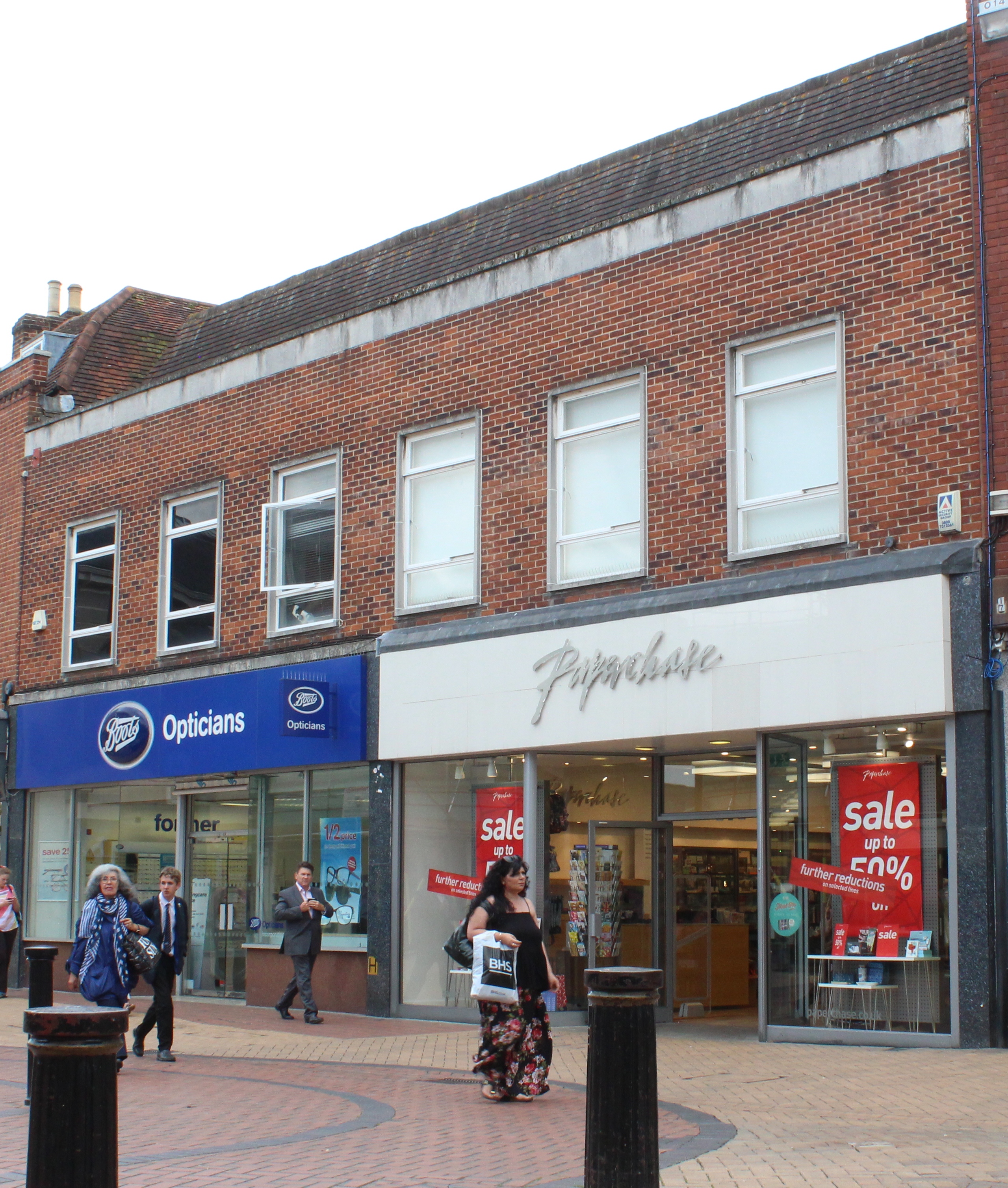
Current image of Paperchase, occupying the former site of the Queen’s Head.

Today nothing remains of the original Queen’s Head building and the site of 61 High Street is currently occupied by Paperchase.

If you would like to find out more about the Queen’s Head see Hilda Grieve’s detailed history of Chelmsford The Sleepers and The Shadows.  Alternatively, try searching the Queen’s Head in Essex Archives Online. The Essex Record Office possess a fantastic range of OS maps which are available for viewing in the Searchroom.

Document of the Month, June 2016: Psalmodia Evangelica, c.1789

Lawrence Barker, Archivist

 (A14439, part)

The document of the month for June is the first volume of a two-volume publication entitled Psalmodia Evangelica, ‘a complete set of psalm and hymn tunes for public worship’, published in St Paul’s Churchyard, London by Thomas Williams of Clerkenwell Green in about 1789.  It is a charming volume of psalm and hymn tunes which opens a window into protestant and non-conformist worship at the time of Jane Austen. The volume once belonged to Stebbing Independent Chapel (later Congregational Church), one of three music books we took into our custody at the beginning of April this year.  Presumably, it was used in the worship of that church.

IMG_0134 1080

The title page proudly claims that it contains ‘a greater number and variety than any former collection’.  There are some tunes which worshipers today would instantly recognise; such as ‘Salisbury’, the tune named by Wesley himself for his Easter Hymn Christ the Lord is Risen today, Hallelujah, or ‘Helmsley’, Lo he comes with clouds descending.  But there are many more which have since fallen out of use.

IMG_0135 1080

Interestingly, the music is ‘correctly adapted for three voices [instead of the usual four found in hymn books today], and figured for the organ’; the main tune is in the middle, with a contra part on top harmonising above and below the melody and a figured bass below.

“Figured bass” is a common feature of eighteen century instrumental music, where the “continuo” part played by ‘cello, bass and bassoon, would also be played on an organ or harpsichord with chords above, indicated by figures under the part rather in the manner of guitar chords indicated in a popular song today.  For example, where there is no number, a standard chord with the root note at the bottom would be played, whereas a 6 indicates a chord “in first inversion” with the third note at the bottom and the root note on top, i.e. six notes above the bass.

At the beginning of the volume, there is an introduction which offers a guide to performance expressed in language both redolent of the period and seemingly indicative of a non-conformist preoccupation with improvement. It begins:

Most people are sensible of the difference between a regular and just performance of Psalmody in divine worship, & that confusion and dissonance too often heard instead of it; though few, comparatively, will bestow any share of their own time & attention to apply a remedy…Should those who have already learned to sing condescend to look over these pages, it is not impossible that many of them may be either informed of reminded of some things tending to their improvement.

The Psalmodia includes advice for singers, including, crucially, remembering which part they are singing

The Psalmodia includes advice for singers, including, crucially, remembering which part they are singing

For example, in section 4, OF GRACEFUL SINGING, ‘the following directions are submitted to the reader’s consideration’.

1) ‘Let your gesture be decent and manly;’ which seems to point to an all-male choir made up of men and boy trebles.

3) ‘Chuse the Part that best suits you…The Treble requires delicacy, without tameness: The counter a peculiar sweetness: The Tenor a medium between effeminate softness and masculine robustness: And the Bass gravity, pomp, solidity of voice, and bold expression.’

6) ‘Express your words with all the politeness possible, without affectation; imitate the Orator rather than the Clown.’

The Psalmodia will be on display in the ERO Searchroom throughout June 2016.