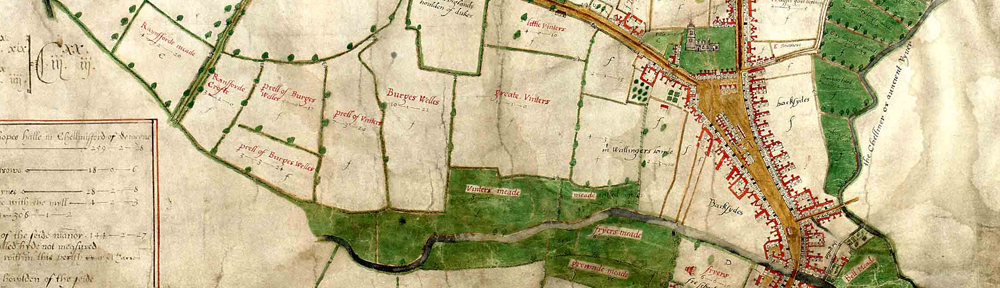
Here at the Essex Record Office our Archive Assistant (and events wrangler) Neil Wiffen has been looking at things again, specifically the 1777 Chapman and André map of Essex. Here he explains all:
Extract from the Walker Map of Chelmsford 1591 (D/DM P1).
Hopefully you are all aware of the wonderful Chapman and André map of Essex. If not, you can view it in incredible detail on Tim Fransen’s excellent website (I dare you not to be amazed and to lose hours of your life by exploring the late eighteenth century landscape of Essex: you have been warned!)
So, I was preparing an event listing for our 2027 season of talks, where we will be discussing the (spoiler alert!) witchcraft statutes of 1563 and 1604. To accompany the text there is always a need to have an illustration or two and, thinking outside the box, I thought that showing the Chelmsford gallows, as shown on John Walker’s 1591 map (above) would be a suitable image, albeit well known. There are not many images of gallows and the couple of other instances I could think of where those depicted by Chapman and André.
Chapman and André sheet 21. Showing the gallows/gibbets along the river Thames between Barking Level and Dagenham Marsh.
The first was of one of the sites along the river Thames and either shows gallows or a gibbet (could they be both?) and the other was those just to the north-east of Romford on the common, what we now know as Gallows Corner.
Chapman and André sheet 17. The gallows/gibbets on Romford Common.
As interesting as these are, I thought I would check out the site of the Chelmsford gallows to see what Chapman and André show. Well, you could knock me down with a feather! There, it was in a semi-circular enclosure – what a view it must have been to the surrounding properties. I had never ‘looked’ before and it was hiding in plain sight, albeit at quite a small scale!
Chapman and André sheet 12. Chelmsford gallows.
This might not be news to any of you out there, it might just be me not looking! Do let me know though if this is news to you and, do let me know what else you have found surprising/delightful on the Chapman and André map. And the funny little field of ampersands opposite the gallows – well I’m fairly sure they are hops. Take a look at the big field in Castle Hedingham!
Neil
If you would like to discover more about witchcraft in Essex, come to our talk and book launch for “Witchland” with Marion Gibson on the 29th September, we are running it twice! Once in the morning at 10:40 and once in the afternoon at 18:40.
In a recent internet deep-dive in search of social media inspiration, we came across a recurring statement declaring Agnes Waterhouse, a local Essex woman, as the first person executed for witchcraft in England in 1566. Marion Gibson, currently a professor at Exeter University, has kindly written this blog post for us, to tell us a little bit more about Agnes and why these claims about her are actually fake news.
Agnes Waterhouse was a widow from the village of Hatfield Peverel who was tried in Chelmsford for witchcraft in the summer of 1566. It’s as a witchcraft suspect that her name appears on a list of accused felons held by the Essex Record Office, among the Quarter Sessions rolls.
Q/SR 19/5 – Quarter Session Roll from 1566 which lists Agnes Waterhouse, Joan Waterhouse, and Elizabeth Frances as felons suspected of witchcraft from Hatfield Peverel
A “felony” was a serious crime, punishable by death, and the group of suspected felons who included Agnes passed through the lower court of Quarter Sessions in 1566 on their way to the higher court of the Assizes. There they would be tried and sentenced.
Agnes was going to the Midsummer Assizes, held in the hot
months when England’s top judges got out of London and had time to sit in
judgement over suspected provincial criminals. In Chelmsford the Assizes were
held in the Market Cross House, which stood just in front of the present-day
Shire Hall. The Essex historian Hilda Grieve describes it as:
‘an open-sided building, with eight oak columns supporting upper galleries and a tiled roof. The galleries, which overlooked the open “piazza” below, were lit by three dormer windows in the roof… the magistrates and justices sat in open court, which measured only 26 feet by 24 feet, with the officers of the law, counsel and clerks, plaintiffs and defendants, jurors, sureties, witnesses and prisoners, before and around them, while spectators, hangers-on, and those awaiting their turn, crowded into the galleries above or thronged the street outside.’
The
Market Cross House was an unsatisfactory courtroom – packed, noisy and horribly
public – but it was Agnes’ destination in summer 1566 after she had been
accused as a witch.
Witchcraft was a crime that came to Assize courts regularly, but only after a new Witchcraft Act had been passed by Parliament in 1563. The new Act stated that witches who were convicted of lesser offences – like making farm animals sick – would be punished with one year in prison. Witches who were convicted of killing a person, however, were to be hanged.
Agnes was accused of murder by witchcraft, for which she would be executed if she was found guilty. She was said to have killed her neighbour William Fynee. When questioned, she also admitted harming pigs, cows and geese in her village. Eventually she said she had murdered her own husband in 1557 because they lived “somewhat unquietly” together; it is possible that this confession was drawn out, in part, by some guilt she may have felt over relief at his death and the relative freedom that widowhood granted her.
Agnes also confessed to owning a demonic spirit in the form of a pet cat called Sathan, given to her by her sister Elizabeth Fraunces, and this cat had killed her husband and done all the harm of which Agnes stood accused.
Elizabeth Fraunces and also Agnes’ daughter Joan were accused of witchcraft alongside her. Joan was just eighteen years old. She was accused of bewitching another teenager, the Waterhouse’s neighbour Agnes Browne. Joan and her mother, twelve year old Agnes Browne told the court, had sent a black dog to torment her. It brought her the key to the Browne family’s dairy and stole or damaged some of their butter. More seriously, the dog tempted Agnes Browne to suicide by bringing her a knife. He told her this was “his sweet dame’s knife” and when he was asked who this was, Agnes Browne said “he wagged his head to your house, mother Waterhouse”. As well as being a talking dog, this demonic tempter had a monkey’s face and a whistle hung around his neck: a strange beast to see trotting around Hatfield Peverel!
Agnes Waterhouse told Agnes Browne that she was making this story up: “thou liest” she told the girl stoutly. She added that she didn’t even own a dagger. It sounds as though Agnes Waterhouse was in court facing down Agnes Browne – and this account of the trial may be true. But Agnes Waterhouse didn’t need to confront Agnes Browne. She had in fact already pleaded guilty to witchcraft. Most accused felons fought for their lives by pleading “not guilty” but Agnes Waterhouse didn’t. Why did Agnes plead guilty, and why was she still fighting on in the courtroom after she had confessed? The answer is probably Joan. By pleading guilty and then standing beside her daughter to take the blame perhaps Agnes hoped to save Joan from execution.
A woodcutting, supposedly of Agnes Waterhouse, from a 1566 pamphlet of the trial.
The case made what we would now think of as “headlines”.
Someone gave the statements of the accused witches to a London publisher, who
added an eyewitness account of the courtroom scenes, a couple of very bad poems
and a description of Agnes’ execution. Yes, that was her fate, and 29th
July is the anniversary of her death. Agnes Waterhouse was executed with the
other felons convicted at the Assizes, hanged in front of a crowd gathered at
the gallows in Chelmsford. The site of her death lies on the road leading
towards Writtle.
It was a sad end to Agnes’ life, but it was a golden opportunity for journalists. The publisher rushed out a booklet about the case and even added a portrait of Agnes to his story, a woodcut print labelled in blackletter font and showing a woman looking oddly pious, with her hand upraised in blessing. There’s a good reason for this mismatch between story and woodcut.
The picture isn’t actually of Agnes at all. It was just a woodcut from the publisher’s stockroom, with space in the label to insert metal blocks of type. In this way the publisher could give any name to the woman depicted. Witches were usually women, this was a picture of a woman: that would do.
This bit of fake news isn’t the only myth to get stuck to Agnes over the course of the last four hundred and fifty years, however. She’s routinely described as the first witch to be executed for witchcraft in England. In fact, witches had been being executed in England and the wider British Isles for centuries, often because they were judged under laws concerning treason or heresy. Examples include Petronilla de Meath from County Meath, who was executed in 1324 and Margery Jourdemayne from Eye in Suffolk, who was executed in 1441. Both women were burned at the stake. But it is true that Agnes is the first media superstar of the age when witch-hunting got serious in England. She’s a “first witch” because she’s the first witch we know about from a printed news story. In the sixteenth century, that was extraordinary fame.
We should remember Agnes on the anniversary of her execution. She died surrounded by her enemies, likely jeering and jostling for a better view, but she died knowing that her daughter Joan had been acquitted, just as Agnes had hoped.
——————————————————————————————————————–
All the details of the case are taken from the news pamphlet ‘The Examination and Confession of Certaine Wytches at Chensforde in the Countie of Essex (1566)’.
You can read more about Agnes, including the whole text of this pamphlet, in Marion Gibson, ‘Early Modern Witches’ (London: Routledge, 2000)
In the meantime, St Andrews Church in Hatfield Peverel is probably the closest glimpse we can get of the Hatfield Peverel that Agnes knew.
Much of the building dates to the 19th century restoration, but the nave and central tower arch from the original 12th century priory still remain and Agnes would have looked on these features much as we do now, as an enduring memento of history. (Photo by Fred Spalding c.1940)
I’ve
recently been at the Essex Record Office looking for evidence that will help me
tell the story of the “St Osyth” witches of 1582 in a new book. I say “St
Osyth” in inverted commas because although the witchcraft accusations that
engulfed north-east Essex in 1582 started in St Osyth, in fact there is far
more evidence of their impact on surrounding communities than there is on the
village itself.
In
February 1582, a servant of Lord Darcy at St Osyth Priory complained that her small
son was being attacked by witchcraft. Once she had accused a neighbour, Ursley
Kemp, and Ursley had confessed to witchcraft then more people came forward to
make accusations. More villages in the manors and parishes controlled by the
Darcy family – Little Oakley, Beaumont, Moze, Thorpe and Walton le Soken, Little
Clacton and others – were drawn in. At least two people were executed and four
others died in prison, with multiple other imprisonments too. One woman was
released as late as 1588.
This
story has fascinated me since I read it as a student over 20 years ago. But
there are few surviving records from St Osyth. The Priory was attacked during
the Civil War and its estate and parish records were likely lost then – an epic
frustration for historians. But the records of the other witch-accusing communities
and authorities were more fortunate. Among these is today’s focus: a record of Elizabethan
visitations made by the Colchester ecclesiastical authorities to the parishes
around St Osyth.
St
Osyth itself answered to the Commissary Court of the Bishop of London and, guess
what, the Commissary’s early records are lost (you might almost think St
Osyth’s documents were cursed…!) but the ecclesiastical team from Colchester visited
most of the other witch-rich villages. In each place, they recorded the names
of the minister and Churchwardens. And today I found the names of some of the
accusers of the 1582 witches and learned that they were Churchwardens too.
Here’s
a nice clear link between parish authorities and witch accusations. It’s easy
to suppose that religious-reforming folk went after suspected witches but it’s
important not to stereotype accusers: they can’t be dismissed as just
“fanatical puritans” or “Anglican worthies”. But in this case there’s some documentary
evidence that they were the community’s religious leaders. It’s going to need
more thinking about as I carry on researching the book.
Essex
Record Office is one of the most impressive and friendliest archives in the UK,
and it’s come up with the goods once again. Has your village got a hidden
history of witchcraft? Were your ancestors accused? Or were they accusers? Are
there still stories of witches in your community? So much more to discover.
This Hallowe’en, experience history and horror with a screening of 1968 cult horror classic Witchfinder General at the Essex Record Office on Friday 26th October, 6.30pm-9.00pm. The screening will be accompanied by a talk about the real history of witchcraft in Essex by bestselling novelist Syd Moore (tickets available here).
The film is set in East Anglia in 1645, and stars Vincent Price as the notorious self-appointed ‘Witchfinder General’ Matthew Hopkins, who claimed to have been given the right by parliament to interrogate and execute witches. The plot is a fictionalised account of Hopkins’s bloody exploits, and follows him and his assistant John Stearne (Robert Russell) as they visit village after village, torturing and executing suspected witches.
Vincent Price as Matthew Hopkins in Witchfinder General. Price was 56 when he played Hopkins, even though Hopkins was only in his 20s when he sparked a major witch panic in the 1640s. Image: British Film Institute
Interior scenes were filmed in converted aircraft hangars near Bury St Edmunds, and exterior scenes were filmed on locations including the Dunwich coast, Lavenham, Kentwell Hall, and Orford Castle.
The film is best known for its violence, despite being extensively cut by the British Board of Film Censors. It has divided audiences and critics alike, with some deploring its violent scenes, while others have championed it as an important part of British film history.
While Hopkins did exist and did indeed hunt suspected witches, the film departs from real history in several ways. Hopkins was the son of a Suffolk minister. Almost nothing is known of his early life, but by the winter of 1644-5 he was living in Manningtree in Essex. He came to believe that there were 7 or 8 witches living in the town; these and others were arrested and questioned, with Hopkins giving evidence against them. This sparked a trail of accusations, and eventualy 36 Essex women were tried for witchcraft at the Essex assizes in July 1645. Nineteen of them were executed. 9 died in prison, and 6 were still locked up in 1648. What Hopkins had started in Essex spread to Suffolk, Norfolk and Cambridgeshire, with at least 250 people tried as witches, and at least 100 executed.
Hopkins did not meet the violent end that he does in the film, but according to a contemporary account died slowly of consumption (tuberculosis) at his home in Essex in 1647. Price was 56 at the time that he played Hopkins, but in reality Hopkins was only in his 20s when he instigated the East Anglian witch hunts. The film’s biggest departure from reality, however, is its omission of court cases; in the film, Hopkins and Stearne subject their victims to summary executions, but in reality suspected witches were arrested and tried.
Burial record of Matthew Hopkins in the Manningtree and Mistley parish register, recording his death in August 1647, two years after he began pursuing witches (Essex Record Office). The text reads: Mathew Hopkins sone of Mr James Hopkins Minister of Wenha[m] was buryed at Mistley August 12th 1647
Here are all the details if you want to join us for horror and history this Hallowe’en:
Date and time: Friday 26 October, 6.30pm-9.00pm
Location: Essex Record Office, Wharf Road, Chelmsford, CM2 6YT
Film length: 86m
Rating: The film is rated 18 as it contains strong violence and execution scenes. If you are lucky enough to look under 18 we will ask to see proof of your age on the door