St George and the dragon

To mark St George’s Day, Archivist Katharine Schofield takes a look at a very rare pen and ink decoration of George slaying the dragon on a manorial court roll from Great Waltham, dating from 1541.

D/DHh M151

Extract from D/DHh M151, a manorial court roll of 1541 from Great Waltham, showing St George slaying the dragon

D/DHh M151

George and the dragon sit in the initial letter of the document. The words ‘Waltham Magna’ appear just beneath the decoration

Among the hundreds of manorial court rolls deposited in the Essex Record Office, a very small number have pen and ink decorations.  These include a court roll for the manor of Great Waltham alias Waltham Bury (D/DHh M151) where the court for Easter 1541 has a drawing showing St. George slaying the dragon in the letter V (for visus or view, the view of frankpledge carried out twice a year in the court leet).  The original is approximately 3.5 cm high and 7.5 cm across.  The rolls were the working records of the court and not intended to be decorated so a ‘doodle’ as elaborate as this is a rarity.

Court rolls form the majority of the manorial records held in the Essex Record Office, which are held by Act of Parliament of 1924 under the authorisation of the Master of the Rolls.  The Manorial Documents Register (MDR) was established two years later to record the location of the documents to ensure that they could be traced if they were required for legal evidence.  The National Archives is in the process of computerising the Manorial Documents Register county by county and the work completed so far can be seen on the National Archives’ website here.

After more than two years of work the Essex contribution to the MDR is complete; you can find out more about the project and how you can use these fascinating documents at Essex through the ages on Saturday 12 July 2014.

Manorial titles are not part of the MDR and records such as the letters patent of 1467, although relating to the rights of the lord of the manor, do not form part of the register.  However, a search of Seax will locate this and many other ‘ancillary’ manorial documents, including deeds of sale of manors and also of copyhold premises.

By the later 15th century St. George’s Day was a well-established feast day in England.  In June 1467 Edward IV granted Henry Bourchier, Earl of Essex (his uncle by marriage), lord of the manor of Stansted in Halstead, the right to hold two three day fairs in the town, one of which was to take place on St. George’s Day and the two days either side (D/DVz 3).  The other fair was to be held on the feast day of St. Edward the Confessor and the two adjoining days, 12-14 October.  After the Reformation St. George’s Day was one of the saints’ days that continued to be celebrated in the Church of England and today churches throughout England will fly the flag of St. George on the feast day.

St. George was a soldier in the Roman army who became a Christian martyr.  He came from a Greek Christian family and became one of the foremost military saints, venerated in the Catholic, Anglican and Orthodox churches.  The flag of St. George is also used as the basis of the national flag of Georgia.

The adoption of St. George as the patron saint of England was a phenomenon of the Middle Ages.  In 1222 the Synod of Oxford declared St. George’s Day (23 April) a feast day.  At that date the most venerated saints in England were St. Edmund King and Martyr, whose shrine was at Bury St. Edmunds and St. [King] Edward the Confessor.  This changed after 1348 when Edward III founded the Order of the Garter and associated St. George with the country’s highest order of chivalry.  The chronicler Froissart recorded that English soldiers used St. George as a battle-cry at the Battle of Poitiers in 1356 and throughout the Hundred Years War of the 14th and 15th centuries.  Famously Shakespeare copied this in Henry V with Cry God for Harry, England and St. George!

On this day: opening of the M25

The M25, hate it or love it, celebrates an Essex birthday today. After being first proposed in the 1960s, the section which runs from Potters Bar to the Dartford tunnel (The Queen Elizabeth II Bridge not opening until the early 1990s) was finally opened on 22 April 1983 by David Howell, the then Transport minister, and a bevy of special guests, VIPs and celebrities. As part of the opening many of the invited guests were able to take their first ride on the new three lane motorway courtesy of The Eastern National Omnibus Company.

Thanks to that Company we have a small collection of photographs celebrating the event, prominently featuring many of their green liveried buses. The M25 was opened in sections between 1973 and 1986, and work on alterations and improvements has continued ever since.

D/F 271/12/50 -1

D/F 271/12/50

D/F 271/12/50 -2

D/F 271/12/50

D/F 271/12/50 -3

D/F 271/12/50

Document of the Month April 2014: Papers relating to repatriation and reburial of remains of Captain Fryatt, 1919 (D/P 174/1/83)

Each month in the Searchroom a new Document of the Month goes on display. The DoTM for April 2014 is a set of four papers relating to the repatriation and reburial of Captain Fryatt in 1919 (D/P 174/1/83).

Charles Algernon Fryatt was born in Southampton in 1871, but while still a child moved to Harwich. On leaving school he followed his father’s example and became a merchant seaman and in 1892 joined the Great Eastern Railway Company as a seaman on the SS Ipswich. He rose through the ranks and at the outbreak of the First World War was a master mariner engaged in the G. E. R. continental service between Harwich and Rotterdam. He continued to make regular voyages on this route despite the German blockade.

On 28 March 1915, while in command of the SS Brussels he was ordered to stop by a German U-Boat when near the Maas lightvessel. Seeing that the U-Boat had surfaced to torpedo his ship, he attempted to ram it and forced it to crash-dive.

Thereafter he seems to have become a ‘marked man’ and on the 25 June 1916 the Brussels and her crew were waylaid and captured by five German destroyers soon after leaving Holland for the return journey to Harwich. Captain Fryatt was charged with attempting to destroy a German submarine and was tried by Court Martial at Bruges Town Hall in Belgium on 27 July 1916. He was found guilty and executed on the same day. The execution provoked international outrage and was widely regarded as murder.

In July 1919 Captain Fryatt’s body was exhumed from its resting place in a small cemetery outside Bruges and returned to the United Kingdom for reburial. After a funeral service in St. Paul’s Cathedral on 8 July 1919, his coffin was taken by train to Dovercourt and interred in All Saints’ churchyard. He was posthumously awarded the Belgian Order of Leopold and the Belgian Maritime War Cross.

He was survived by his widow Ethel and seven children.

The papers will be on display in the Searchroom throughout April 2014.

Papers relating to the repatriation of the remains of Capt. Charles Fryatt from Bruges to Dovercourt (D/P 174/1/83)

Papers relating to the repatriation of the remains of Capt. Charles Fryatt from Bruges to Dovercourt (D/P 174/1/83)

Recording of the Month March 2014: The Essex Youth Orchestra

The next monthly highlight from our Sound Archivist Martin Astell…

Essex Youth Orchestra – Wand of Youth (SA 10/1/1/1/1)

For March we have some music. Our choice this month is, we believe, the earliest recording of the Essex Youth Orchestra. The orchestra was formed in 1957 as part of the County Youth Service of Essex County Council and by the time this recording was made, in 1960, they had already made successful tours of West Berlin and Essex and been invited to tour Holland.  In subsequent years the orchestra visited Denmark, Sweden, Norway, Czechoslovakia, Italy, the USA and Canada, and has performed at the Royal Albert Hall, the Royal Festival Hall, Snape Maltings, and at the Bath Festival both accompanied by and conducted by Yehudi Menuhin.

Youth Service Volume 8 Number 4 April 1968

New works have been written for or dedicated to the Essex Youth Orchestra by composers such as Alan Rawsthorne, Elizabeth Maconchy and Bernard Stevens, and former members have gone on to perform with any number of major symphony orchestras. Membership of the orchestra was open to any young person aged under 21 who was resident in Essex or attended an Essex school or college.

The Essex Youth Orchestra continues to the present day along much the same lines. You can find more details here.

The four recordings with our reference SA 10/1/1/1/1 were made on April 19th 1960 by Pike Films on both sides of two 7″ 45rpm lacquer ‘instantaneous’ discs. The discs have pre-printed labels bearing the Pike Films logo with the details of the recordings being hand-written in ink. The first two sides contain recordings of The Impressario by Mozart and part of Dvorak’s Symphony No.4. However, we have chosen to feature the third side which contains the first section of Elgar’s Wand of Youth (Suite 1), which seems appropriate for a youth orchestra. The fourth side has parts 2 and 3 of Wand of Youth.

Media Types 004 - Lacquer disc close-up

We are told that Elgar, when in his fifties, decided to develop into full orchestral works a number of compositions he had made at the tender age of eleven to accompany a childhood play staged by him and his siblings. These resulted in two suites to which he gave the name Wand of Youth and he chose to give them the opus number 1 to indicate that they were, in fact, his earliest work.

The Essex Sound and Video Archive holds a series of recordings of the Essex Youth Orchestra as well as others from Colchester Youth Chamber Orchestra, Witham Choral Society and others. We also hold recordings of compositions by Essex-based composers from William Byrd to Alan Bullard. Details of all the recordings held in the Essex Sound and Video Archive can be found on the Essex Record Office online catalogue Seax.

Medieval Mercenary: Sir John Hawkwood

There’s not long to wait now until the forthcoming ERO Conference, The Fighting Essex Soldier: Recruitment, War and Remembrance in the Fourteenth Century.

While there will be talks on the participation of Essex men in the running of the county, the king’s wars in Scotland, France and Ireland, along with on the seas and mention of the Peasants’ Revolt, we just do not have the time to talk about those men who fought on after peace was declared.

Many of the soldiers who had fought for Edward III, perhaps over the course of many years in successive campaigns, did not necessarily find the idea of going home an attractive proposition. Skills honed on the battlefields and in the garrisons of the first part of the Hundred Years War might not be welcomed back home in Essex, while the opportunities for rape and plunder at home were much more limited than on the continent.

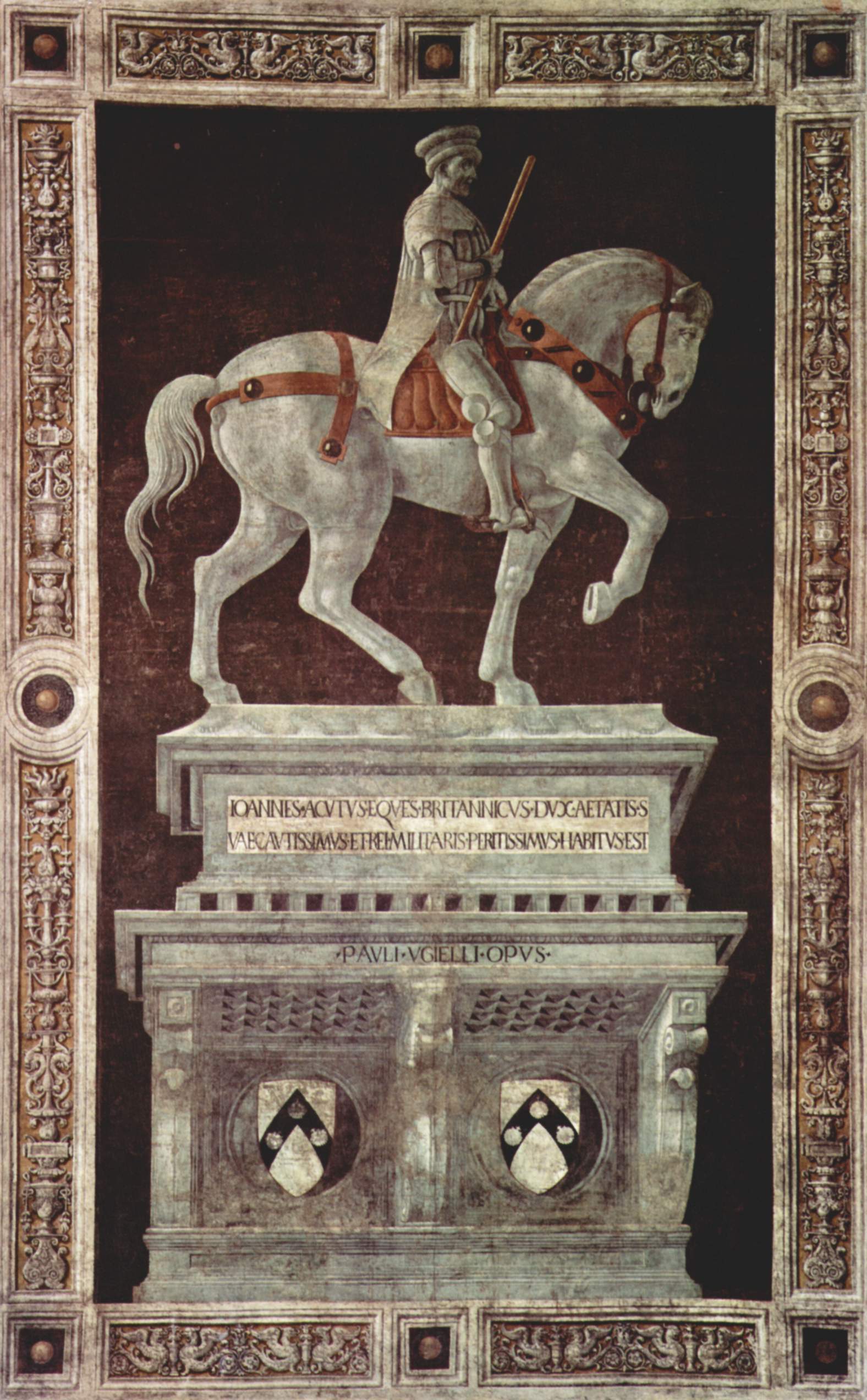
For those willing to take a chance and stay on in Europe there were openings for continuing to fight on in various countries, not least France and Italy. One of these men – and perhaps the most famous of them – was Sir John Hawkwood (d. 1394) of Sible Hedingham. He almost certainly took part in the wars of Edward III up to 1360 but in what capacity is unclear. Possibly he may have fought at Crécy (1346) and Poitiers (1356) but he came to prominence later as the most famous condottiere (a professional military leader or captain) in Italy of his day. Sir John is even commemorated by a fresco in Florence Cathedral.

Funerary Monument to Sir John Hawkwood by Paolo Uccello (1436)

While we do not have time for a paper on him during our day, the ERO has published a book by Dr Christopher Starr about him. This richly illustrated book places Hawkwood in an Essex context, showing his descent from villain ancestors, his network of gentry and aristocratic connections and the eventual dispersal of his accumulated estates. The intriguing history of Hawkwood’s mysterious tomb at Sible Hedingham is also uncovered for the first time.


Medieval Mercenary-1

Available in person from the ERO Searchroom for £9.99, or remotely for £13.49 (including p&p within the UK cheques made payable to ‘Essex County Council’ or by credit/debit card over the phone – 01245 244644), this is a wonderful introduction to a remarkable Essex character. Why not treat yourself to a copy?


The Fighting Essex Soldier: War Recruitment and Remembrance in the Fourteenth Century

Saturday 8 March 2014, 9.30am-4.15pm

More details here

One of our speakers, Dr Jennifer Ward, has also curated a display of fourteenth-century documents from our collections to accompany the conference which will be in the Searchroom from January-March.

Men Behaving Badly: Sir Hugh de Badewe

Ahead of The Fighting Essex Soldier: War Recruitment and Remembrance in the Fourteenth Century on 8 March 2014, we take a sneak preview at another of our speaker’s subjects – Gloria Harris’s research on medieval Essex knight Sir Hugh de Badewe.

Sir Hugh de Badewe (c.1315 – c.1380), of Great Baddow near Chelmsford, was a prominent Essex knight of the mid-fourteenth century. He took part in military expeditions to the Low Countries at the beginning of the Hundred Years War (1337-1453) in the retinue of William de Bohun, 1st Earl of Northampton, and may have fought at the naval Battle of Sluys in 1340. In a military capacity he is next heard of on August 8th 1347 at Calais. It was here that he was rewarded by Edward III with an exemption for life from serving on assizes, juries and from appointments as mayor or sheriff for ‘good service in parts on this side of the sea’. The Siege of Calais, following on from the English victory at Crecy, had lasted for nearly a year and took a major effort on the part of the English Crown to succeed. Possibly Sir Hugh was being rewarded for having taken either crucial supplies or reinforcements of troops from Essex over to France; perhaps he even fought in the siege lines himself.

The Battle of Crecy, from a 15th-century illuminated manuscript of Jean Froissart’s Chronicles

So, a near contemporary of the successful Edward III and a participant in the chivalric deeds of the times, living up to our modern-day image of the medieval knight. However, Sir Hugh was certainly not ‘a verray, parfit, gentil knight’, but, as with many other knights of the time, he was also involved in a certain amount of law breaking, or to be more precise, gang warfare. Gang warfare, in which Sir Hugh seems to have participated wholeheartedly, took place in the wider, later-medieval context of criminal activity generally and of criminal bands in particular. Lawlessness on this scale was not new and it was not confined to Essex. Organised crime was perhaps the biggest danger to public order during the later medieval period. Criminal bands could number from two or three members to two or three hundred, depending on the type of offence. In many cases the criminals themselves were often assisted by local men and women, called receivers, who were not involved directly in the attacks but helped the gangs in other ways such as providing food and shelter or perhaps valuable information based on local knowledge.

Mostly criminal gangs were drawn from members of the gentry, men like Hugh who were knights, and esquires. Although the gentry were certainly most prominent in the criminal bands, other members might be engaged in a variety of occupations. Of the three attacks in which Hugh is known to have taken part, it is the first in 1340 that is, arguably, the most interesting in terms of the numbers involved and in the social composition of the criminal band. Upwards of thirty four men were involved when they mounted the attack on John de Segrave’s property in Great Chesterford. Heading the list of offenders was the magnate John, earl of Oxford. Second on the list was John Fitz Walter, a young Essex land owner who was to gain much notoriety as an Essex criminal in future years and third was Bartholomew Berghersh, whose father was Lord Chamberlain to Edward III.

While some gangs may well have had their origins in the halls of the nobility, the links between Hugh and the gang members involved the 1340 attack appear to have had more to do with their military connections than adherence to a particular magnate household, although it is often difficult to make a distinction. While Hugh’s maiden expedition to France, at the very beginning of the Hundred Years War in 1337, may well have been his first introduction to particular noblemen and knights of the military community, some of these men were already acquainted with each other following their shared experience of active service in the war against Scotland.

Sir Hugh de Badewe is not an extraordinary case, but is all the more interesting for it, since his story is a typical one of the time. To find out more about the life and crimes Sir Hugh de Badewe, join us for Gloria’s talk at The Fighting Essex Soldier on Saturday 8 March.

The Fighting Essex Soldier: War Recruitment and Remembrance in the Fourteenth Century

Saturday 8 March 2014, 9.30am-4.15pm

More details here

One of our speakers, Dr Jennifer Ward, has also curated a display of fourteenth-century documents from our collections to accompany the conference which will be in the Searchroom from January-March.

Recording of the Month, February 2014: Courtship and romance in the Second World War

The next monthly highlight from our Sound Archivist Martin Astell…

Courtship and romance in the Second World War (Mrs Duddy), Acc. SA673

Valentine’s Day provides the excuse for our February recording to focus on love and courtship. This month’s recording is an extract from an interview recorded in 1988 with Mrs Audrey Duddy (née Carver) who was born 1924 in Tottenham and died in 1991. During the Second World War she was evacuated, along with other pupils from Tottenham High School, to Saffron Walden. She later joined the Women’s Land Army and after the war went on to become a teacher, finishing her career as Head of Department at Saffron Walden County High School.

The extract we have selected for you to listen to below is the part of the interview where Mrs Duddy talks about going to dances as a young woman with a group of her Land Army colleagues, the interesting ways in which they negotiated their dealings with young men, and how this led to her meeting her husband.

The Essex Sound and Video Archive holds a wealth of recordings relating to the Second World War, particularly reminiscences of experiences on the Home Front. We have a Sources List which will help you to identify some good examples of recordings covering subjects such as evacuation, rationing, air raids, the Home Guard (and other Civil Defence work), the Women’s Land Army, Dunkirk, war work, the Royal Navy and other military service, the US Air Force and American troops, prisoners of war in Essex, airfields, health care, D-Day, VE Day and VJ Day, the Auxiliary Territorial Service, Women’s Voluntary Service and Women’s Auxiliary Police Service. Click on the following link to download the source list: ESVA Second World War sources


New Accession: Poor rate assessment for Brentwood, 1694

Dr Stacey Harmer, Archivist at Brentwood School, blogs for us about an exciting discovery made at the school recently that has been deposited at ERO to benefit from our climate-controlled storage and to allow public access…

An exciting discovery has been made in the archives of Brentwood School, which are being catalogued in preparation for the opening of the new Learning Resources Centre in the summer of 2015. It is a parchment roll, protected by a cardboard cover, entitled ‘A Rate made the Tenth day of Aprill Anno Dom’ 1694 for the Reliefe of the Poore of the Towne of Brentwood’. It lists 146 heads of households (including a number of widows) and seven pensioners of the town. The person who was taxed the highest was a Mr Lambert, who was to pay 7s 6d. This may be the Francis Lambert who, in 1689, was summoned to court to answer for his contempt in refusing to serve as a petty constable even though he had been elected by the parishioners [ERO Q/SR 461/55].  A few were not affluent enough to pay any rate but were still included in the list (assessed as 0s 0d).

IMG_2200

Dr Stacey Harmer (right) depositing the poor rate assessment with Archivist Ruth Costello at ERO

IMG_2202

The first name on the list is ‘Mr Barnard’: almost certainly Daniel Barnard, the schoolmaster of Brentwood School. Barnard had been appointed to the school in 1655 at the age of 24, already an ordained priest. A year later he married the daughter of the vicar of South Weald. According to R. R. Lewis, author of The History of Brentwood School (1981), Barnard was “one of the most successful schoolmasters of his time”. His pupils included the sons of Sir William Scroggs (Lord Chief Justice of England) and Erasmus Smith (English merchant and philanthropist).

1694 is a crucial date in the history of the parish of Brentwood. Brentwood chapel, dedicated to St Thomas Becket, was built in 1221 but was subsidiary to the parish of South Weald. The parish vestry controlled matters such as the care of the poor, the collection of poor rates, and apprenticeship of pauper children.

1694 is the year in which the first records of the chapel of St Thomas Becket begin, showing an important move towards autonomy. At Essex Record Office there is a record book of the Brentwood chapel starting in 1694 which includes vestry minutes, orders for relief, overseers’ accounts and nominations of officers [ERO D/P 362/8/1]. The battle for independence from the parish of South Weald was to take nearly two centuries: Brentwood did not become a separate parish until 1873, but it is clear that 1694 was an important step in this journey.


Great British Railway Journeys: Ipswich to Chelmsford

As episode 17 of series 5 of Great British Railway Journeys airs on BBC2 and Michael Portillo takes in some of the sights of our great county, we thought we would share some items from our collection to accompany his experience of oyster dredging on Mersea Island, and his visits to a model farm at Tiptree and to the world’s first purpose-built radio factory, Marconi’s in Chelmsford.


Oyster dredging on Mersea Island

Mersea Island lies 9 miles south-east of Colchester, in the estuary of the Blackwater and Colne rivers. It is joined to the mainland by a causeway, and there is evidence of human habitation stretching back to pre-Roman times. Oysters have been gathered and consumed on Mersea for centuries, with oyster shells being found next to the remains of Celtic salt workings. The gathering of uncultured oysters gradually gave way to cultivation, and Mersea oysters were exported by the barrel load to Billingsgate Fish Market in London, and further afield to the continent.

Competition amongst oyster gatherers in Essex has sometimes led to outbreaks of violence; during the reign of Edward III for example, a disagreement between men from Brightlingsea, Alresford, Wivenhoe, Fingringhoe, Mease, Salcott and Tollesbury over fishing rights resulted in the drowning of three men.

Mersea’s history of oyster fishing is evident in records held in our collection. Our will collection shows how prevalent the oyster trade was amongst Mersea inhabitants, such as this one of Frances Brand, an oyster dredger of West Mersea, dated 1763 (D/ABW 101/1/38). The will includes arrangements for Brand’s two oyster smacks: ‘I give and bequeath all those my two smacks or dredging vessles with the boats dredges and other the appurtances to them and every of them belonging unto my son William Brand upon condition that he my said son … shall therewith carry on the dredging business for the support and maintenance of himself, my wife and my other three children untill he my said son William shall attain … one and twenty years hereby earnestly requiring him so to do.’

Will of Francis Brand, oyster dredger of West Mersea, 1763 (D/ABW 101/1/38)

Will of Francis Brand, oyster dredger of West Mersea, 1763 (D/ABW 101/1/38)

West Mersea postcard 18

Postcard showing marshland and boats on West Mersea

Mersea Museum’s website has several great historic photographs of the Mersea oyster trade, such as this one, of members of the Tollesbury and Mersea Oyster Company men outside the Packing Shed circa 1908.


Model farm at Tiptree

Before broadcast, we are making an educated guess that the ‘model farming establishment in Tiptree’ is the farm set up by John Joseph Mechi (1802-1880) in the 1840s. Mechi, having made a fortune as a razor-strop manufacturer, decided to turn his attention to farming and apply his talents to the improvement of agriculture.

In 1841 he bought 130 acres of poor, wet heathland in Tiptree, in one of the least productive districts in Essex, and proceeded to improve it by such means as deep drainage, removing hedges and trees, redesigning buildings and the use of steam-powered machinery. He persevered until his model farm turned a handsome profit. Mechi was exceptional amongst agricultural improvers for publishing details of his experiments in books, pamphlets and newspaper articles. He even published annual statements of his farm’s income and expenditure, explaining his failures as well as justifying his successes. His well-known publication How to Farm Profitably (1857) had, in various forms, a circulation of thousands of copies. Sadly, his career ended in disappointment, as the failure of his banking interests deprived him of the funds needed for his style of farming, and this, together with the effects of several bad seasons at Tiptree Hall Farm, led to the liquidation of his affairs shortly before his death.

John Joseph Mechi (I/Pb 13/3/1)

John Joseph Mechi (I/Pb 13/3/1)


Tiptree Hall Farm one year after Mechi designed it. The main buildings are on the north and east sides, giving shelter from the coldest winds. The barn contained a horse-powered threshing machine. When not driving the threshing machine, the horse gear could be used to drive a chaff-cutter or corn mill. Within a year Mechi had decided to exchange horse power for steam power.

Tiptree Hall Farm one year after Mechi designed it. The main buildings are on the north and east sides, giving shelter from the coldest winds. The barn contained a horse-powered threshing machine. When not driving the threshing machine, the horse gear could be used to drive a chaff-cutter or corn mill. Within a year Mechi had decided to exchange horse power for steam power.


Marconi’s – the world’s first purpose-built radio factory

Guglielmo Marconi established the world’s first wireless factory in a former silk mill in Hall Street in Chelmsford in 1898, when he was aged just 23. Chelmsford was chosen because Marconi needed electrical power, and in the 1890s Chelmsford was the place to be for electricity, thanks to the pioneering work of R.E.B. Crompton and Frank Christy.

In June 1912, a replacement 70,000 square foot purpose-built factory was opened in New Street. The factory was completed in an astonishing 17 weeks by a workforce of over 500 people. The factory provided employment for thousands of men and women; although the machine shop remained the preserve of men, women were employed for the more delicate aspects of the production of wireless transmitters.

Women at work in Marconi's New Street factory in Chelmsford

Women at work in Marconi’s New Street factory in Chelmsford

Marconi wireless equipment was used by ships and coastal stations to communicate with one another in Morse code. During the First World War, operators at New Street intercepted German radio transmissions for the British government, and Marconi engineers also developed the technology for ground-to-air communication with aeroplanes. During the Second World War, Marconi’s played a crucial role in the development of radar.

After the First World War, engineers at New Street began to experiment with wireless voice transmissions. The first publicised entertainment broadcast in Britain took place at the factory in June 1920, when Dame Nellie Melba performed. Her singing could have been picked up anywhere across Europe by someone with receiving equipment. By 1931 there was one wireless licence for every three homes in the country.

Shortly after the New Street factory opened, local photographer Fred Spalding took a series of photographs of the new facility. Click here to view more of the photographs from a previous blog post.


Check back here tomorrow for more to accompany Michael’s visit to Tilbury.

Recording of the Month, January 2014: “These New-Fangled Ways” (A Ballad of Protest)

Our  Sound Archivist Martin Astell begins a series for us of monthly highlights from the Essex Sound and Video Archive…

“These New-Fangled Ways” (A Ballad of Protest), SA 24/222/1

To begin this series and to be our first ‘Recording of the Month’ I have chosen one of the oldest recordings held in the Essex Sound and Video Archive. The exact date the recording was made is not known, but it is thought to be around 1905 or 1906. It is taken from one side of a double-sided 78rpm shellac disc on the “Jumbo” label, and consists of a poem written, and in this case spoken, by Charles E. Benham.

These New-Fangled Ways crop white

The poem is subtitled A Ballad of Protest as it satirises the curmudgeonly views of an old country fellow who cannot see the benefits of change and such modern contrivances as parish councils and board schools. Although it relates particularly to the late nineteenth century – which was, indeed, a time of great change – nevertheless, the theme can be seen as more or less universal, reminding us that we all may have a tendency to regard new developments as dangerous, retrograde or, at the very least, unnecessary.

Charles E. Benham published his Essex Ballads and Other Poems in 1895. He took a keen interest in the Essex dialect and the thirteen Essex ballads were written in this manner ‘to perpetuate many archaic and interesting forms of folk speech.’ It was later that he was asked to make sound recordings of a number of these poems, as he explains in the Transactions of the Yorkshire Dialect Society (Part XIX, Volume III, December 1917, p.22):

“Some time before the war a student from Berlin named Theodor Albrecht, came to me in order that I should correct his vocal interpretation of my Essex Ballads. Friends warned me to have nothing to do with him, as even then it was suspected that he was trying to acquire the east coast dialect for sinister purposes. Be that as it may, the country was not endangered by his visit, for the accent with which he solemnly read the book was such that he never could have made himself understood in Essex, much less have passed himself off as a native. However, he appeared satisfied, and he wrote and published an extensive thesis or “inaugural dissertation” on the Essex Ballads which gained him the degree of Doctor at the University, and the University itself commissioned me to have phonograph records made of four of the ballads to be deposited in Berlin.”

You may have to listen to the recording a few times before you are able to discern every word but if you want to cheat, the poem is transcribed on its SoundCloud page. However, you may notice that the author recites some of the verses in a slightly different order than in the published version. And by the way, the word ‘tares’ which appears in the poem is given as “rough grass, weeds” in Edward Gepp’s A Contribution to an Essex Dialect Dictionary (London, 1920) but is defined in James Britten’s Old Country and Farming Words: Gleaned from Agricultural Books (London, 1880) rather more specifically as Vicia Sativa, or the common vetch, which is grown as livestock fodder or as a soil-fertilising plant.

Many more examples of Essex dialect and accents can be heard in recordings held in the Essex Sound and Video Archive, and the ERO library contains dialect dictionaries, plays and novels written in dialect, and numerous papers discussing the subject (particularly in the Essex Review). The Essex Sound and Video Archive has a source list (ESVA Sources on dialect) which will help you to identify some good examples of recordings, or you could purchase a copy of our CD called How to Speak Essex: 20th Century Voices from the Essex Sound and Video Archive; please e-mail ero.enquiry@essex.gov.uk or telephone 01245 244644 for more information.

Written examples of dialect speech are a valuable resource for the academic, but nothing can be better than hearing the real thing. As Charles Benham says:

“But to preserve for future generations the distinctive intonation, accent, and inflection, there is still needed the gramophone record, and this important aid should not be overlooked by the devout dialect-philologist.”

(‘The Essex Dialect’ by Charles E. Benham, The Essex Review, Volume XXIX, 1920, p.159)

And perhaps he should have added that there is still needed an accessible sound archive in which these treasures can be preserved, and that should not be overlooked either.