Where there’s a will: the Dutch in Essex

Following the recent upload of images of an additional 22,500 wills to Essex Ancestors, Archivist Katharine Schofield takes a look at some of the wills of the Dutch population of Essex…

Among the wills recently added to Essex Ancestors are a number of wills from the Dutch population of Essex, almost all of which are from testators in Colchester.

From the 1560s onwards Flemish and Dutch Protestants, fearing religious persecution, came to England.  Flemish weavers had first settled in Colchester in the 14th century, and many of the new refugees chose to settle in the town.  They brought with them the techniques of bay and say weaving which revitalised the town’s cloth industry and brought prosperity to Colchester for the next 150 years.

The Dutch wills can be found on Essex Ancestors by using the search term ‘Dutch will’. They are either written in Flemish or record testators with Flemish names.  These wills often have a distinctive style, clearly differentiating them from others of the same date.

The will of Andries de Haene dated 19 May 1587 (D/ACW 2/254) is typical of these wills.  It was proved in the archdeaconry of Colchester, and although no parish is recorded for the testator, it is very likely that he was resident in Colchester.  There are two versions of the will, one in English and one in Flemish.

The English version of ... will (D/ACW 2/254)

The English version of Andries de Haene’s will (D/ACW 2/254)

D-ACW 2-254b

The Dutch version of Andries de Haene’s will (D/ACW 2/254)

It begins:

‘for because that wee have nothinge more surer then death and that the houre of death is most uncertein’.


Similar phrases to this often appear in the Dutch wills in contrast to English wills of the same date. The first bequest is of 10s. ‘for Love and brotherlye charitys sake to the poore of oure duytch congregation’. Charitable bequests were quite common at this date and the Dutch wills usually include bequests to the Dutch congregation in Colchester.

The next bequest is to his wife who was unnamed but described as his ‘lovinge bedfellowe’.  He left her ‘all her clothes Lynen and Wollen apartayninge to her body and also the best bedde wyth all thinges longing to the same’, together with £10.

Bequests to wives of their clothes and a bed appear to be a Flemish custom, in the will of Nicolas de Hane of 1584 (D/ABW 12/181) he specified that if his widow were to remarry she would retain the bed and appurtenances ‘According to the custome of the towne of Helle’ [Halle, Belgium].

Andries de Haene continued by dividing the remainder of his goods into two parts, one part for his wife and the other for his children.  In most such cases the wife was given custody of any children and to keep their inheritance safe for them until they married when they would inherit.

Theodorus van den Berghe (the second minister of the Dutch church in Colchester) in his will of 1598 (D/ACW 3/166) specified that children should be given their inheritance on their wedding day ‘or when they come to yeares off great discretion’. William Casier, son of Malius, who was born in Meenen in Flanders [Menen, Belgium] specifically stated in his will of 1588 (D/ABW 9/259) that this was the ‘use of … Meenen’.  He also required that if his wife had to leave the country while still a widow, then any unmarried children should ‘helpe to beare the chardges of the voyage’.

It would seem that his widow Katherine did not have to leave and did not remarry as her will of 1590, when she was resident in the parish of Holy Trinity, Colchester also survives (D/ABW 9/287).  She left all her possessions to their four children Walter, Maliard, Josentge and Annanais (the executor).

Over the course of the 150 years, many of the Dutch names became anglicised many married into English families. Almost a century after the Dutch arrived Abigail Hedgethorne, a widow of St. Martin’s parish in Colchester (in the heart of the present-day Dutch Quarter of the town) left a will in 1666 (D/ACW 17/185).  As well as the English copy there is a version in Dutch where the family name was given as Hagedorn.

You can access Essex Ancestors from home as a subscriber, or for free in the Searchroom at the ERO in Chelmsford or at our Archive Access Points in Saffron Walden and Harlow.  It will shortly be provided at Waltham Forest Archives.  Opening hours vary, so please check before you visit.

Before you subscribe please check that the documents you need exist and have been digitised at http://seax.essexcc.gov.uk/

You can view a handy video guide to using Essex Ancestors here.

Where there’s a will: Richard Leget of Hornchuch

We have just uploaded digital images of a further 22,500 wills to our Essex Ancestors online subscription service (more on this here), and to mark the occasion here we take a look at one of our earliest wills…

Most medieval Essex wills relate to the nobility and major landowners.  These were proved at the courts of the Bishop of London and the Archbishop of Canterbury and are not deposited in the Essex Record Office.

However, during the 15th century, making a will became more common and a small number of 15th century wills survive among the records of the archdeaconry of Essex (D/AEW).

Among these is the will of Richard Leget of Hornchurch, dated 10 September 1484 (D/AEW 1/212).  The will itself is in Latin and Leget begins by leaving his soul to God, the Blessed [Virgin] Mary and all the saints and his body to buried in the parish church of St. Andrew.  He made a bequest of 8d. to the ‘Lord Abbot’ there [at Hornchurch] (there had been a priory in the parish until it was dissolved and granted to New College, Oxford in 1391).  He left to John Hubbart a mattress, two blankets, two linen sheets and a coverlet, requested that all his debts be paid and left everything else to his wife Alice.

D-AEW 1-212-1 watermarked

The first page of the will of Richard Leget, 1484 (D/AEW 1/212)

On the reverse of the will is a list of his debts, giving names and amounts.  There are two further lists in English stitched to the will.  The first of these is a list of money spent on the burial by Thomas Herde, one of the executors.  A total of 12s. 9d. was spent and amounts included 16d. for a ‘wyndyng cloth’, 14d. to the priest and clerk for the ‘deyrge’ [dirge] and mass, 4d. for ‘lyth’ [light], 8d. for the knell and priest, 8d. for bread and 12d. for ale, 21d. for ‘month mynde’ paid to the priest and clerk and 12d. to the sexton for the grave.

D-AEW 1-212-4 watermarked

Part of the inventory of Richard Legets possessions which is included with his will of 1484 (D/AEW 1/212)

There is also an inventory of his goods, beginning with his clothes – a gown of murray worth 5s. 4d., a blue gown worth 3s., a doublet worth 8d., a pair of hose worth 12d., an ‘olde cloke of blak’ valued at 8d..  It continues with household goods including a kettle valued at 2s. 4d., a brass pot, 2s., a ‘fryyng panne’ 8d., and also includes a brass posset (8d.), 31lbs. of pewter (5s. 2d.), three candlesticks (6d.), a ‘lanterne’ (3d.), a mattock (8d.) and a cart (2s. 8d.).

The recent upload of 22,500 wills to Essex Ancestors means that images of all our wills before c.1720 are now available online. You can access Essex Ancestors from home as a subscriber, or for free in the Searchroom at the ERO in Chelmsford or at our Archive Access Points in Saffron Walden and Harlow.  It will shortly be provided at Waltham Forest Archives.  Opening hours vary, so please check before you visit.

Before you subscribe please check that the documents you need exist and have been digitised at http://seax.essexcc.gov.uk/

You can view a handy video guide to using Essex Ancestors here.

Where there’s a will: major update to Essex Ancestors

We love wills here at ERO. These fascinating and incredibly useful documents can tell us all sorts of things about the lives of people in the past, and are a brilliant resource for genealogists and social and economic historians alike.

The majority of the population did not leave a will, but where these documents exist, they can be of great help in establishing family connections (particularly before census returns begin in 1841) and for researching the amount of personal property people owned.

It can be surprising to see what testators valued; in 1641 Elizabeth Fuller of Chigwell left her eldest son Henry my longe carte and dunge carte, my ponderinge crose my furnace, my mault quarne. We think the crose must be for religious contemplation and the quarne for grinding grain but it seems an odd mix of bequests. Her second son Robert received my best chest and my best brace [brass] pot which to modern eyes would seem to be the better bequest (D/AEW 21/71).

It can be surprising to see what testators valued; in 1641 Elizabeth Fuller of Chigwell left her eldest son Henry ‘my longe carte and dunge carte, my ponderinge crose my furnace, my mault quarne’. We think the crose must be for religious contemplation and the quarne for grinding grain but it seems an odd mix of bequests. Her second son Robert received ‘my best chest and my best brace [brass] pot’ which to modern eyes might seem to be the better bequest (D/AEW 21/71).

Our collections include about 70,000 wills which date from the 1400s to 1858. Digital images of about 20,000 of these wills have been available on our online subscription service Essex Ancestors for some time, and we have just uploaded a further 22,500.

This is a project we have been working on for many months, with our digitisers spending about 375 hours photographing the wills, our conservators spending about 44 hours conserving them, and our archivists spending about 752 hours checking all the images against their catalogue entries to get ready for the upload.

It can be surprising to see what testators valued; in 1641 Elizabeth Fuller of Chigwell left her eldest son Henry my longe carte and dunge carte, my ponderinge crose my furnace, my mault quarne.  We think the crose must be for religious contemplation and the quarne for grinding grain but it seems an odd mix of bequests.  Her second son Robert received my best chest and my best brace [brass] pot which to modern eyes would seem to be the better bequest (D/AEW 21/71).

A portion of our wills collection in storage

This upload will mean that digital images of all of our wills dating to c.1720 will be available on Essex Ancestors. We will now press on with working on the rest of the wills, which date from c.1720-1858, for upload in the next few months.

To celebrate the upload, our archivists will be choosing some of their favourite wills to share on the blog over the next few days and weeks.

You can access Essex Ancestors from home as a subscriber, or for free in the Searchroom at the ERO in Chelmsford or at our Archive Access Points in Saffron Walden and Harlow.  It will shortly be provided at Waltham Forest Archives.  Opening hours vary, so please check before you visit.

Before you subscribe please check that the documents you need exist and have been digitised at http://seax.essexcc.gov.uk/

You can view a handy video guide to using Essex Ancestors here.

Essex at War on film

We were lucky enough to have Chris Church of Wire Frame Media film at Essex at War, 1914-1918 at Hylands House on Sunday 14 September, who has produced this fabulous short film capturing a flavour of the day. Have a watch for a snapshot of what went on, and if you came along see if you can spot yourself!

If you came along and would like to tell us what you thought of the day, do please fill in our short survey here.

Secrets from the Asylum

Tonight on ITV the inimitable pub landlord, Al Murray, amongst others, will be discovering the secrets of their ancestors’ lives. One of Murray’s ancestors was committed to an asylum and the show will follow his discovery of what that meant for her and the other asylum “inmates”.

1st Edn OS Map 25" showing the County Lunatic Asylum in 1975

1st Edn OS Map 25″ showing the County Lunatic Asylum in 1875

After The Asylum Act of 1845 it became a requirement for each county to have its own asylum. The Justices of the Peace in Essex opened their County Asylum at Warley near Brentwood in 1853 at a building cost of some £66,000. It was then designed to hold 450 inmates. The institution finally closed its doors in 2001 and much of the site has now been re-developed into luxury flats. To get a flavour of what the asylum was like at the end of its life this website has a number of very good pictures.

A/H 10/2/5/18 - A page from one of the female case books. The words used to describe her illnes are somewhat different to how we would describe them today. "Acute melancholia, morbidly despondant..."

A/H 10/2/5/18 – A page from one of the female case books. The words used to describe her illness are somewhat different to how we would describe them today. “Acute melancholia, morbidly despondent…”

Those documents which had survived the passing of time and the closing of Warley Hospital have now been passed to us at the Essex Record Office. These include Managers’ Minutes, Reception Orders, Case Books and Patient Indexes. We also have a range of Burial Registers which were kept by the Justices of the Peace. The majority of these documents fall under our A/H 10 reference and many of these can be searched in the Record Office, though it is worth bearing in mind that most records less than 100 years old are closed to the public and will have to be searched by one of our archivists (the exception to that being the Burial Registers which are held under references Q/ALc 12/1 to Q/ALc 12/5 and these are currently available to view on our catalogue Seax).

Q/ALc 12/1 - This is the first of 5 burial registers for the graveyard at Warley Hospital. They run from 1856 to 1935. Some burials of patients from Warley are also recorded in the parish graveyard of St Peters, South Weald.

Q/ALc 12/1 – This is the first of 5 burial registers kept by the Justices of the Peace for the graveyard at Warley Hospital. They run from 1856 to 1935. Some burials of patients from Warley are also recorded in the parish graveyard of St Peter’s, South Weald

Q/ALc 12/1

Extract from Q/ALc 12/1

If you are interested in what you discover with Al Murray tonight and want to find out more about life in the asylum or if you think you may have a relative who may have been in the County Asylum, please feel free to visit us or get in touch to discover the secrets that our records might hold.

First World War memorials – who was included where?

Andy Begent has created a website recording biographical details of 460 men connected with Chelmsford who lost their lives as a result of the First World War, including photographs of them where possible. In this blog he writes of one of the unexpected tasks that he has dealt with in that ongoing project.

Recently someone asked me what had been the biggest challenges which I had faced during the creation of the Chelmsford War Memorial website.

Chelmsford war memorials homepageI think they expected me to respond by talking of the difficulty in researching the lives of the fallen so long after they died. Though that research can be time consuming, laborious, occasionally frustrating, yet often rewarding, I have found the biggest challenge has been the apparently simple task of determining whether a person should or should not be included on the website.

Early on in my research I was faced with a choice: should the website only commemorate those named on the Chelmsford Civic Centre war memorial, or should it include others that I had identified as having strong Chelmsford connections but who been omitted from that memorial?

I soon discovered that the process to select the names for the memorial had been imperfect. The draft list of names was issued as late as July 1923 to the public for comment upon, with the finalised list later determined by the Mayor and Town Clerk. That delay of almost five years after the end of the war meant that there was every chance that relatives or friends of some of those who could have been included on the memorial were no longer in a position to suggest their names.

Leading Seaman Samuel Allen Barnard, killed aged 26 when H.M.S. Vanguard blew up in 1917. Read his story here

My initial analysis also revealed that some of those named on the memorial had left Chelmsford several years before the war – some to settle in other parts of the country, and others who emigrated abroad, to Canada and Australia. They appeared not to have set foot in the town for some time, if at all, since their departure, yet their names were included on the memorial.

Having identified those potential shortcomings I decided I would include on the website all those mentioned on the war memorial plus those with a strong Chelmsford connection who had been omitted from the war memorial. I then just needed to determine what ’strong Chelmsford connection’ meant.

I looked to the past for clues.

Almost a century ago those erecting war memorials after the First World War had to determine their own inclusion/exclusion criteria, with the criteria varying from memorial to memorial. The Chelmsford approach seemed to be inconsistent, but maybe if I looked at other memorials I could identify best practice.

I soon established that war memorials that commemorated the war dead who attended a particular school, or church, or club, or place of work would have been fairly straightforward to compile names for – either the individual had attended or they had not.

Leading Mechanic Arthur Evan Thomas, R.A.F. Read his story here.

Other types of memorial would have been more challenging. Those that commemorated war dead of towns (and villages, parishes etc.) often used residency as the primary criteria for inclusion. Usually a person was included on such a memorial if they had been resident in the town at the time they began military service. They may also have been included if they died in the town as a consequence of their military service. Some war memorials broadened the residency scope wider than the individual; they may have included an individual on a town’s war memorial even if the individual did not reside in the town when they joined up or died, but their parents, spouse or next-of-kin siblings did, either at the time of them joining up or of their death. This broadening of scope means that some individuals’ names appeared on more than one war memorial – some of Chelmsford’s also appear on town and village war memorials in other parts the UK and further afield.

Even the boundary of a town can be difficult to determine. Chelmsford’s Civic Centre war memorial generally uses the Borough Boundary of 1923 but also includes residents from beyond. The 1923 Borough did not include parts of Widford which were added to the Borough in the 1930s. Great Baddow, Broomfield and Writtle were not absorbed in to the Borough until 1974.

Other criteria, beyond residency, may be considered when selecting names for a war memorial, including date of death, cause of death, and whether the individual was serving or had served in the military.

Corporal John William Hooker, 7th (Service) Battalion, Duke of Cornwall’s Light Infantry, killed in action in 1918. His brother, George Alexander Hooker, was also killed in the war. Read his story here.

Some war memorials restrict their commemorations to those that died or were killed between the war’s outbreak on 4th August 1914 and the Armistice of 11th November 1918. Others stretch that to the Treaty of Versailles of 28th June 1919 when peace with Germany officially started. For the First World War the Commonwealth War Graves Commission (CWGC) commemorates deaths from 4th August 1914 up to 31st August 1921. Others go beyond, recognising that the war led to wounds and illness that led to the deaths of servicemen for decades after the war. The last of those to die who is commemorated by Chelmsford’s Civic Centre war memorial is Douglas Havelock Newman, a former prisoner of war, who died on 7th May 1922, well past the CWGC cut-off date.

Some war memorials include only those who were killed in action or died of wounds. Others expand on that to include those that died of illness, accident or even suicide. The CWGC makes no distinction around causes of death when determining if a person should be commemorated. Chelmsford’s Civic Centre war memorial includes all of those except suicide, although two soldiers who committed suicide are buried in the town.

Some war memorials include only those who died whilst serving in the military. Others go beyond that to include ex-servicemen and civilians. The CWGC commemorates anyone who was still in military service or members of certain civilian organisation (such as the Red Cross) at the time of death, but also includes those who had left the military and died up to 31st August 1921 as a result of an injury or illness caused by or exacerbated by their service up to that date. The Chelmsford Civic Centre war memorial includes a member of the Red Cross, but it does not, and neither does the CWGC, include a civilian from Chelmsford, John Thomas Bannister, killed in a German air raid on London during the First World War.

Having pondered those factors I have ultimately come up with the following criteria which I employ to determine whether someone should be included on the website. You will see is not simple and certainly not as simple as I would have liked.

An individual will be recorded on the website where:

  • They are mentioned on Chelmsford’s Civic Centre war memorial or the Moulsham, Springfield or Widford war memorials, or
  • They or their assumed next of kin were resident in the Borough of Chelmsford of 1923 or parishes of Widford and Springfield at the time they began military service or at the time they were killed or died, or
  • They died or were buried within those same areas, and;
  • Their death is commemorated by the CWGC or their death is proven to have been as a result of an injury or illness caused by or exacerbated by their military service or enemy action.

Determining to what extent these criteria apply so long after an individual’s death is not always easy. We do not have comprehensive records of all those who served in the military nor of those who lived in Chelmsford. The 1914-15 and 1918 registers of electors provide some evidence which can be used, as do contemporary newspaper reports, cemetery and church records. Perhaps the greatest untapped source of information is the stories passed down through families and I hope that the war’s centenary will bring many of the latter to the fore.

If you would like to view the Chelmsford War Memorial website follow this link: http://www.chelmsfordwarmemorial.co.uk/Chelmsford_War_Memorial/Home.html

Andy will be giving a talk on some of the stories he has come across during his research at Essex at War: 1914-18 at Hylands House on Sunday 14 September. Click here for details.

Greetings from Bangkok

In this guest blog post, Denwood Holmes writes for us from Bangkok about his research in the Essex archives…

Greetings from Bangkok, where I hope I have the distinction of being among the ERO’s more far-flung correspondents.

As an Ottoman art historian-turned-PR consultant, genealogy has been a means to maintain my interest in archival research while languishing in the private sector. Tracing my American patrilineal ancestry started out easy: most colonial New England descents are fairly well documented, and armed with the name of a great-great grandfather, two articles on the descendants of John Holmes, gentleman, Messenger of the Plymouth Colony Court by distinguished genealogist (and cousin) Eugene Stratton quickly took me back twelve generations. The original Mr. Holmes was by all accounts something of a rogue, frequently cited for drunkenness, and the executioner of Thomas Granger, the first person hanged in the Massachusetts Bay Colony, for unlawful congress with animals.

After that the going got tougher. American genealogists have historically been content to end their research with arrival in the New World (why ever would we go further?), but to do with my teenage years spent in the UK, and inspired partly by David Hackett Fischer’s book Albion’s Seed, I became determined to the trace the Great Leap across the pond.

It wasn’t entirely tabula rasa: George Mackenzie, in his Colonial Families (1925) cites a Thomas Holmes of Colchester as John’s father, but without further reference. Thomas’ will, dated 1637, is preserved in ERO (D/ACW 12/225): gentleman alias maltster alias gaoler of Colchester Castle, he leaves “five pounds, my corslet, my pike, and all my armour” to his son John.

IMG_3777 compressed

Will of Thomas Holmes of Colchester, 1637 (D/ACW 12/225)


IMG_3768 compressed

Thomas left corslet, pike and armour to his son John (D/ACW 12/225)

The will also mentions a daughter, Susan Mor(e)ton, the widow of Tobias Moreton, gent., of Little Moreton Hall, a half-timbered manor house which still stands in Cheshire. Susan’s will, unearthed by chance in the Prerogative Court of Canterbury, confirms Mackenzie’s assertion: she mentions her nephews (John’s sons) Thomas (who remained in Colchester), John, and Nathaniel, my great x8 grandfather.

IMG_3775 compressed

Extract from Thomas Holmes’s will mentioning his daughter, Susan Morton (D/ACW 12/225)

Along with a number of noted Colchester Puritans, the will is witnessed by George Gilberd, esquire, brother of William Gilberd/t, physician to Elizabeth I.

IMG_3771 compressed

Signatures of witnesses to Thomas Holmes’s will (D/ACW 12/225)

IMG_3769 compressed

Thomas Holmes’s signature at the end of his will (D/ACW 12/225)

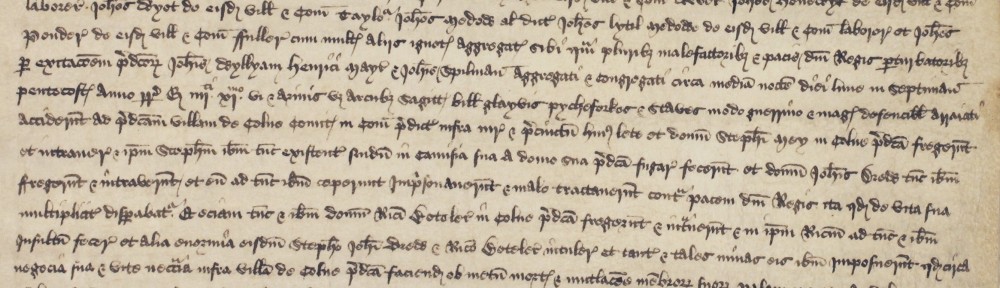
The Holmes family – clearly middling Puritan parish gentry – were not native to Colchester: according to the Red Parchment Book of Colchester, Thomas’ grandfather Thomas, draper, was sworn a burgess in 1543, and is described as being of Ramsden Bellhouse. There the trail dwindles. The ERO will of Thomas Holme of Ramsden Bellhouse of 1514 mentions a brother, John, a tailor, but little more. Finally, in the Feet of Fines for Essex, we find the last signpost to date:

“Hilary and Easter, 14 Henry VII (1499); William Holme, Humphrey Tyrell, esquire, Thomas Intilsham, “gentilman”, William Howard, clerk, William Bekshyll and William Rede, plaintiffs. John Choppyn and Joan his wife, daughter and one of the heirs of John Dawe, deceased, defendants. A third part of a moiety of 1 messuage, 60 acres of land, 10 acres of meadow, 30 acres of pasture and 10 acres of wood in Ramesdon Belhous, Dounham, Wykford, Ronwell, and Suthhanyfeld. Defendant quitclaimed to plaintiffs and the heirs of William Holme. Consideration 40 marks.”

Certain prosopographical observations can be made here. Humphrey Tyrell of Warley was a younger son of the Tyrells of Heron, probably a nephew of the Sir James executed for the murder of the Princes in the Tower. Howard was his clerk. Hintlesham was an MP for Maldon, and Rede was probably the nephew and heir of Sir Bartholomew Rede, Mayor of London. All were in the circle of John de Vere, 13th Earl of Oxford. The identity of William Holme remains a mystery; there are two or three of the name active in London at around the same time, all probably in the cloth trade. Here the trail ends, for the time being: any thoughts or suggestions on the part of the ERO community as to how to proceed are much appreciated; I can be reached at Denwood_Holmes@yahoo.com.

I conclude with a special thanks to Allyson Lewis, Katharine Schofield, and all of the staff at ERO for their help and support which regularly goes above and beyond the call of duty, extending unto providing me with pencil-rubbings of seals by mail here in Bangkok; having worked in archives from London to Damascus I say unequivocally that ERO is lucky to have you.

Discover: Workhouse records

Researchers often discover from documents such as census returns or death certificates that an ancestor spent time in a workhouse.

The minutes of the Boards of Guardians who oversaw the running of Essex workhouses after 1834 have been deposited at ERO, and these can give an idea of what life was like for inmates.  However, a picture – or in this case an Ordnance Survey map – can sometimes be far more effective.  This extract is taken from the 120 inch: 1 mile map series and shows the ground floor of the newly built Maldon workhouse (now St. Peter’s Hospital) with a typical layout of rooms.

Ordnance Survey map showing Maldon Union Workhouse, 1873

Ordnance Survey map showing Maldon Union Workhouse, 1873 (click for a larger version)

On admission to the workhouse, males and females were separated and this plan shows further segregation: for example, aged females, bedridden females, able bodied females and girls all had different day rooms.  When allowed outside for fresh air, they would all be in different airing yards or play grounds.  Plans of the workhouse (D/F 8/611B) show that this separation continues on other floors, with different dormitories and even different staircases.

If you would like to find out more about using workhouse records, join us for Discover: Workhouse Records (from 1834) on Thursday 26 June 2014, 2.30pm-4.30pm. This session will look at why and how workhouses came into existence, what life was like as an inmate and will consider surviving Essex workhouse records. Tickets are £10.00, please book in advance on 01245 244644.

What is a manor and what are manorial records?

Ahead of Essex through the ages: tracing the past using manorial records on Saturday 12 July, we begin a manorial mini-series exploring what these fascinating documents can tell us about Essex in the past. In this first post Archivist Katharine Schofield writes for us about what a manor actually was…

A manor was essentially a unit of land.  Manors were at the heart of the post-Norman Conquest feudal system whereby all land was owned by the King.  He rewarded his followers (or tenants-in-chief) by giving them land which they held in return for military service to the King.  They in turn rewarded their followers (or tenants) on the same basis.  At the bottom of the structure was the knight’s fee, the amount of land considered sufficient to finance the service of one knight.  Domesday Book, produced in 1086, shows the beginnings of this system and is arranged by manors rather than towns or villages.  It is for this reason that a number of places appear in it more than once.

Manors and parishes rarely coincided.  Domesday Book, for example, records three manors in the parish of Takeley, owned by Eudo Dapifer [the steward], Robert Gernon and the Priory of St. Valéry in Picardy.  By the time that the Revd. Philip Morant wrote The History and Antiquities of the County of Essex in 1768 there were four manors in the parish – Waltham Hall, Colchester Hall, St. Valerys or Warish Hall and Bassingborns which could trace their ownership back to the three Domesday manors.  Manors could also have land in a number of different parishes; for example, records of the manor of Berechurch or West Donyland in Colchester included property in Old Heath and on East Hill and St. John’s Green, all in other parishes.

The lord of the manor owned everything in and of the manor – the crops, animals, mineral, hunting and fishing rights and also the tenants, who could be bought and sold and who owed days of labour and items of produce to the lord.  The lord would either keep the land and farm it using the labour of his tenants or he would rent the land, retaining jurisdiction over it.

Among the earliest deeds in the Essex Record Office are a small number of early 13th century grants where named individuals, with their belongings and descendants, or chattels and issue [catallis et sequela – underlined in red below]), are sold or exchanged for land.

Grant by Thoby Priory of William le Beggere to Barking Abbey, c.1202-1201 (D/DP T1/1582). William had originally been purchased by the Priory from Robert de Saincler. In return for this grant, the abbey gave the priory land in Mountnessing.


As tenants were considered part of the property, the lord was also entitled to customary dues which would be paid as compensation for the loss of income that the tenant or members of his family would bring.  These included payments which were required when a son was sent to school or entered holy orders, as well as ‘merchet’ which was paid when a daughter married and ‘chevage’ paid to live the outside the manor.

The territorial rights of the lord over the tenants and their lands were enforced in the manorial court – the court baron.  Some, but not all, manorial lords also had jurisdiction over minor criminal matters in the court leet.

The rights of manorial lords did not change significantly over the centuries, but the nature of the manor did.  Some rights ceased to be exercised and others became more important.  It is estimated that the Black Death of 1348-1349 killed around a third of the national population and possibly as much as half of the population of East Anglia.  This ultimately led to lords being unable to find tenants willing to work the land as they had done previously, and the labour dues of tenants being commuted to rents or quit rents.  This, in turn, meant that records which commonly appeared in the early Middle Ages disappeared to be replaced with rentals.  Similarly by the 18th century the business of the manorial courts was mostly taken up with the admission and surrender of land by copyhold tenants.

IMG_2893 watermarked

Manorial survey of Castle Hedingham by Israel Amyce, 1592. This survey book includes written descriptions of pieces of land illustrated with maps. (D/DMh M1)

The Manorial Documents Register (MDR) was established in 1926, the year after manorial landholding (copyhold) was abolished, to record the location of documents and ensure that they could be traced if they were required for legal purposes.  The two main types of manorial records listed by the MDR are:

  • Court records – court rolls, later books, estreat and suit rolls, stewards’ papers, admissions and surrenders
  • Assessment of land and financial records – surveys, extents, custumals, accounts (or compoti), rentals, and quit rents

As well as the records listed by the MDR, the Essex Record Office holds many deeds of copyhold properties and of the manors themselves.  Manorial titles remain and still retain some rights, including the extraction of minerals and fishing and any remaining rights must have been registered with the Land Registry before October 2013 if a lord intends to continue enforcing them.

Over the last few years, the ERO has been contributing to a major update to the Manorial Documents Register, improving the catalogue and getting information online to make these useful and fascinating documents more available to researchers. Even if you don’t want to attempt reading the earlier Latin documents, from 1733 they were kept in English, so there may well be information contained within them of interest to your research in family history, house history, or local history. Essex through the ages on 12 July marks the completion of our contribution to the project, and celebrates the improved accessibility of these records for researchers.

Whether you are interested in using manorial records in your own research, or just want to enjoy hearing experts talk about them, join us for Essex through the ages: tracing the past using manorial records on Saturday 12 July 2014 to find out how you can discover centuries of Essex life using these fascinating documents. There are more details, including how to book, here.

New Accession: photograph of farm labourers

New accessions arrive at ERO all the time, in all shapes and sizes.

One recent arrival is this photograph of farm labourers in Good Easter (D/DU 2905/1), taken in c.1905, a time when farming was still in recovery from the effects of the agricultural depression which had begun in the mid-1870s.

gg

D/DU 2905/1

It was very kindly donated to us by Geof Garwood, whose grandfather George Pavitt is the young man fifth from the left.

All too often historic photographs come to us today without any information about where or when they were taken, or who the people pictured are, so we are lucky in this case that the photograph was donated by a descendant who could give us some more details.

Shortly after leaving the photograph with us, Geof also came across his grandfather’s Long Service Certificate presented by the Essex Agricultural Society in 1948, for 50 years’ service at Falconers Hall in Good Easter, suggesting that this is where the photograph was most likely taken. There is some more information about George in the catalogue entry for the photograph here.

Geof has now donated the long service certificate to be kept with the photograph, and while he was here we also looked at some maps of Good Easter, and found his grandfather’s baptism and his grandparents’ marriage in the Good Easter parish registers. The photograph and certificate help to add personal colour and depth to these existing records in our collection.

IMG_2760

Geof Garwood (right) and ERO archivist Chris Lambert examine Geof’s grandfather George Pavitt’s Long Service Certificate, presented to him by the Essex Agricultural Society in 1948.

IMG_2765

Looking up the location of the farm on which George Pavitt worked in Good Easter

IMG_2773

Looking up Geof’s grandparents in the Good Easter parish registers

Depositing your records at ERO (either as gifts or as long-term loans) achieves two things; firstly, the records benefit from our specialist storage facilities and are cared for by experts; and secondly they are made available to researchers, not only in Essex but around the world through our online catalogue Seax.

If you have something that relates to the history of Essex places or people that you would like to deposit with us, do get in touch to discuss it, either on ero.enquiry@essex.gov.uk or 01245 244644.

And if you recognize any of George Pavitt’s fellow workers in Good Easter, we would be delighted to know.