Registered wills – filling in the gaps

Wills can tell us all sorts of things about the lives of people in the past, and are a brilliant resource for genealogists and social and economic historians alike.

As we have mentioned before, our collections include some 70,000 original wills made by people in Essex between 1400 and 1858. These wills have all been catalogued and digitised, and can be searched for by name and viewed on our online subscription service Essex Ancestors.

We have now begun work on an additional set of records which can help to fill in any gaps in our series of original wills, which will ultimately result in about 10,000 more wills being added to Essex Ancestors.

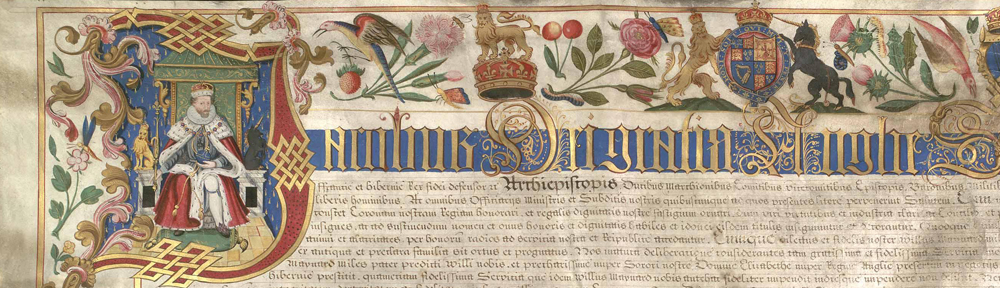
Decorative I

A decorative initial ‘I’ from a book of registered wills dating from 1500-1515 (D/ACR 1)

Before 1858 when somebody died leaving a will, their executor would take the original will to the relevant court so that probate could be granted. The original wills would be kept by the court and filed; it is these wills proved in the ecclesiastical courts in Essex which have been digitised and are available via Essex Ancestors.

Clerks at the courts would also usually write out a copy of the will into large volumes called will registers (references beginning D/ABR, D/ACR, D/AER and D/AMR). There are approximately thirty 16th and 17th century registers for the courts in Essex where there are no original wills surviving.

Registered wills 1500-1515

The will registers are books into which clerks copied wills being proved at the ecclesiastical courts. Sometimes a will might survive in the book when the original copy of it has been lost, providing a useful second chance for researchers.

The wills in the registers are listed in the three volumes of Wills at Chelmsford, but do not currently appear on Seax. To make these records easier to find, we have started a project to add the details of individual wills in the registers to Seax, so they will be searchable by name. To begin with, only a written catalogue description will be available, but in the long term we plan to add digital images too. In the meantime, registered wills are viewable on microfiche in the Searchroom, or copies can be ordered through our reprographics service.

The first register for which details have been added to Seax is that for the archdeaconry of Colchester (D/ACR 1) which covers the north of the county for the years 1500-1515. 

Some of the wills in the volume are in Latin and as it dates from before the Reformation, the testators would all have been Roman Catholic, evidenced by the use of Catholic phraseology such as ‘I bequeath my soule to almyghte god and to our blessed lady saynt mary and to the holy all hallowes’, which appears in the will of Roger Burgon of Colchester below. Following the English Reformation and the invention of the Church of England references to Mary and the saints all but disappeared.

Roger Burgon’s will is dated 16 December 1507 (D/ACR 1/127/1).  After bequeathing his soul to God he went on to request that his body be buried in the Church of St. Francis within the Convent of the Friars Minor [Greyfriars] in Colchester.

Roger Burgon will

The beginning of the will of Roger Burgon, 1507 (D/ACR 1/127/1)

The majority of the wills are for men, but a number of women do appear, such as this one for Agnes Tomson of the parish of St Leonard in Colchester, dated 8th December 1502 (D/ACR 1/50/5).

Agnes Tomson will

The beginning of the will of Agnes Tomson, 1502 (D/ACR 1/50/5). The heading to the will reads ‘Testm Agness Tomson de High’ – Testament of Agnes Tomson of the High, then a new area of Colchester

Agnes’s bequests included a ‘blake gowne’ (black dress), a ‘petycote’, a ‘greene gowne’, a ‘russet gowne’ a ‘floke bed’ (flock bed), pots, plates and a kettle, a ‘blankett’, a ‘bolster’, and a ‘long knyff’ (knife), all of which helps us build up a picture of Agnes’s life.

Agnes Tomson will

The section of Agnes’s will leaving a ‘blake gowne’ (black dress)

Examples of English HandwritingIf you would like any further advice on using wills in your research, please ask a member of staff in the Searchroom or contact us on ero.enquiry@essex.gov.uk. If you would like any help with reading old handwriting, our publication Examples of English Handwriting 1150-1750 by Hilda Grieve is a very useful guide. It can be purchased for £6 (+P&P) from the Searchroom or by phoning 033301 32500.

If you get really stuck, our Search Service can transcribe wills for you – please contact ero.searchroom@essex.gov.uk for details.

Unknown Warriors: Sister Kate Luard’s letters, autumn-winter 1915-16

One of the stories we have been following over the course of the First World War centenary commemorations is that of Sister Kate Luard (read all our posts about her here). Kate was born in Aveley in 1872 and grew up in Birch near Colchester. On the outbreak of the war she volunteered to nurse on the Western Front, and remained there for the duration of the war.

During this time she wrote numerous letters, the majority of which are cared for at ERO. Her great niece, Caroline Stevens, has put together the following extracts from her letters written home at this time 100 years ago, when Kate was posted to No.6 Casualty Clearing Station.

Kate Luard letters

A few of the letters in the Kate Luard collection deposited at ERO

During the Great War of 1914-1918, Kate Luard served principally on ambulance trains, casualty clearing stations and a field ambulance, but was also posted at times to Stationary and General Hospitals in the base areas.

On 17 October 1915 she was sent up the line to take charge of No.6 Casualty Clearing Station at Lillers in France following four months at a base hospital, No.16 General Hospital. Her second book, Unknown Warriors, commences on this date and in this her letters home are a record of her times in various casualty clearing stations. This included time as Head Sister at No.32 CCS which became one of the most dangerous when the unit was relocated in late July 1917 to serve the push that was to become the Battle of Passchendaele, and where she had a staff of forty nurses and nearly 100 orderlies.

Tented nurse's quarters at a Casualty Clearing Station  (Courtesy of Sue Light)

Tented nurse’s quarters at a Casualty Clearing Station
(Courtesy of Sue Light)

A casualty clearing station was part of the evacuation chain of the wounded from the battle front starting with the regimental aid post just behind the front line, then an advanced dressing station and on to a field ambulance before transfer to a casualty clearing station. CCS’s were normally located near railway lines and waterways so that the wounded could be evacuated easily to the base hospitals. A CCS often had to move at short notice as the front line changed. Although some were located in temporary buildings, many consisted of large areas of tents and marquees and often several were near each other to enable flexibility.

The following are extracts from Unknown Warriors, which was republished in 2014 by the History Press. For more information about Kate Luard and her family see www.kateluard.co.uk


October18th

The sister has been showing me round and handing over her books and keys of office. The poor lads in their brown blankets and stretchers looked only too familiar. When there is a rush, the theatre Sister and I stay up at night as well. The CO [Commanding Officer], the Padre and myself are the only people allowed to do the censoring. I do it for the Sisters. I shall have to be very careful myself, not to mention names, numbers passing through, regiments, plans, or anything interesting.


Thursday, October 28th

The weather is beyond description vile, and the little cobbled streets are a Slough of Despond and a quagmire. The King has been about here yesterday and today, and was to have held a very sodden and damp Review a mile away, only he had an accident riding and had to be carried away instead: no one knows if it was much or not.


Saturday, October 30th

A boy came in at 6 p.m. with his right arm blown clean off in its sleeve at 2.p.m. He was very collapsed when he came in, but revived a little later. ‘Mustn’t make a fuss about trifles,’ he explained.


Sunday, October 31st

This afternoon we took a lot of lovely flowers to the Cemetery for our graves for All Saints’ Day. It took all afternoon doing them up with Union Jack ribbon, and finding the graves. There are hundreds. It was a swamp of sticky mud, and pouring with rain.


All Saints’ Day 1915, November 1st

A Scotch RAMC (Royal Army Medical Corps) officer, who was with his Regiment all through, was talking about the early morning of the 14th, after we had tried to take the Hohenzollern Redoubt on the 13th. Our dead and wounded were lying so thick on the ground, that he had to pick his way among them with a box of morphia tabloids, and give them to anyone who was alive: tie up what broken limbs he could with rifles for splints, and leave them there: there were no stretchers.


Wednesday, November 3rd

A lad had to have his leg off this morning for gas gangrene. He says he ‘feels all right’ and hasn’t had to have had any morphia all day. You’d think he’d merely had his boot taken off. Some of them are such infants to be fighting for their country. One has a bullet through his liver and tried to say through his tears ‘there’s some much worse than what I am.’


Friday, December 3rd

Captain D. is a scrap better to-day, able to emerge from bromides, and talk a little. He told me that when they were holding the Hohenzollern trenches in that worst weather, when they stood up waist-high in liquid mud, two of his men slipped under it when they were asleep and their bodies were dug out next day.


Sunday, January 16th

D.F. the boy with the head wound, has been peacefully dying all day; his hand closes less tightly over mine to-day, but his beautiful brown eyes look less inscrutable as he gets further from this crooked world.

_________________________________________________________________________

Unknown Warriors coverUnknown Warriors is available in the ERO library, or you can find out more about the book and Kate herself here.

Art in the archives: portrait of the Barrett-Lennard family by Pompeo Batoni

As well as looking after the archives for Essex, the ERO is also the Corporate Custodian of Art for Essex County Council (ECC). Besides commissioning portraits of its chairmen ECC has never actively collected art, but has received a number of donations and bequests over the decades. Some of this art is displayed in ECC buildings, while other pieces are in storage at ERO.

Many pieces are viewable on the BBC Your Paintings website, and if there is something in storage that a member of the public would like to see you can make a request for it to be made available – please contact us on ero.enquiry@essex.gov.uk

The largest single collection of artwork was donated by the Barrett-Lennard family. It includes this family portrait by the Italian artist Pompeo Batoni painted in Rome in 1749/50.

Batoni portrait of Barrett-Lennard family

Portrait of Thomas and Anna Marie Barrett-Lennard with their daughter Barbara Anne by Pompeo Batoni, 1749/50

The painting has a very sad story behind it. It shows Thomas and Anna Marie Barrett-Lennard with their daughter, Barbara Anne, who had died of tuberculosis the previous year. The artist painted her likeness from a miniature by Thomas Hudson which the couple brought with them on their travels.

Barbara Anne was the couple’s only child, although Thomas had two illegitimate children with a mistress who were brought up by the couple as their own. The eldest, Thomas Fitzthomas, inherited the estate, and in 1786 he was granted the right to adopt his father’s surname and titles, becoming Thomas Barrett-Lennard (more on that here). A portrait of Thomas Jr by John Opie hangs in the ERO Searchroom.

The Barrett-Lennard family lived at the mansion of Belhus in Aveley, which they built up into one of the largest estates in Essex. During Thomas’s tenure, he remodelled the house in the gothic style and employed Capability Brown to landscape the park and gardens.

The painting was loaned for The Family in British Art, a touring exhibition that visited Norwich Castle Museum and Art Gallery, the Millennium Gallery in Sheffield, and the Laing Art Gallery in Newcastle in 2011-12. The tour was part of the Great British Art Debate partnered with Tate Britain. It is currently stored at ERO, and is brought out for special occasions for public view. A high quality digital image is available, and anyone wishing to view the original can request for it to be brought out of storage.

Essex at Agincourt

Following Essex at Agincourt on Saturday 31 October 2015, archivist Katharine Schofield has written a summary of the involvement of Essex noblemen in this famous battle.

The Battle of Agincourt was fought on St. Crispin’s Day, 25 October 1415.  It was perhaps the most famous battle of the Hundred Years’ War, when the outnumbered English forces defeated the French, with the English longbow archers making a decisive contribution defeating the French cavalry.  The battle was immortalised in the 16th century by William Shakespeare in the play Henry V (written c.1599) and by Michael Drayton in his poem Fair stood the wind for France (c.1605).

As Prince of Wales Henry V had fought the Welsh and it was not long after he succeeded his father Henry IV I in 1413 that he sought to raise an army against the French and renew the claims of his great-grandfather Edward III to the French crown.  In December 1414 Parliament granted him a tax for war against the French.  Henry V and his army landed in northern France on 13 August 1415.

The campaign started with the siege of Harfleur.  The town did not surrender until 22 September, by which time the summer, and the best conditions for military campaigns, was nearly over.  The English had also suffered casualties during the siege, notably to dysentery and other diseases.

The siege of Harfleur

The siege of Harfleur (BritishBattles.com)

Among those who died at Harfleur was Michael de la Pole, 2nd Earl of Suffolk and lord of the manors of Langham and Nether Hall in Gestingthorpe.  His son Michael, 3rd earl, was to die a month later at Agincourt.

Another man with Essex connections, Lewis John, was among those invalided home from Harfleur; he went on to serve as sheriff of Essex, 1416-1417 and 1420-1422.  He originated from Wales and had come to London, presumably to make his fortune.  By the time he died in 1442 Sir Lewis John owned land in a number of counties, including West Thurrock and East and West Horndon in Essex.

Having gained only one town for all the money spent raising an army, Henry V was reluctant to return to England and so set off to march to the English garrison at Calais, reasserting his hereditary claim to lands in northern France.  The French army that had been unable to save Harfleur was now ready to face the English.  Henry’s forces had been weakened by illness, had inadequate supplies of food and had marched 260 miles in two and a half weeks, but did not want to delay battle in case the French were able to bring up more reinforcements.

The two sides faced each other; as the French cavalry advanced they were trapped in muddy ground and caught in the deadly fire of the English archers and were unable to advance on the English forces.  Among the French casualties were the constable and admiral of France, the master of the royal household, and the Dukes of Brabant, Alençon and Bar.  Around 1500 noblemen were taken to England as prisoners, including Charles, Duke of Orleans, the Duke of Bourbon, Jean Le Maingre, Marshal of France and the Count of Eu.

The battle itself achieved very little immediately.  Henry continued his march on Calais and then returned in triumph to England.  However, the defeat and death or capture of so many of the French nobility meant that when Henry returned in 1417 he was able to capture towns and castles across northern France.

Catherine of Valois

Catherine of Valois

In 1420 the Treaty of Troyes was signed.  Henry married Katherine, daughter of Charles VI of France and was declared the regent and heir of the king.  Henry’s triumph was short-lived.  He died in 1422 leaving his nine month old son Henry VI as king.  He was crowned king of England in 1429 and king of France at Notre Dame Cathedral in Paris in 1431.  However, Charles VI’s son Charles VII was able to regain French territory, and by 1453 English possessions in France were reduced to Calais.  Henry VI was ultimately to lose his throne to Edward IV in the Wars of the Roses.

A number of Essex lords had raised men from their lands to form part of the king’s army.  It is likely that not only the lords, but some of the men in their retinues would have come from the county.  One of the great lords present was Richard Beauchamp, Earl of Warwick depicted in the battle by Drayton as ‘Warwick in blood did wade’.  Although his lands were mostly elsewhere, he was lord of the manor of Walthamstow. 

Richard de Vere, 11th Earl of Oxford was almost the same age as the king, and they had both served Richard II as pages.  His grandfather John, the 7th earl, had fought at Crécy and Poitiers in the reign of Edward III.  He supplied 39 men-at-arms and 60 archers to the campaign.  He commanded the rear of the army as it marched from Harfleur, and took a prominent role in the battle, capturing Jean, Sire de Ligne.  Drayton wrote that ‘Oxford … cruel slaughter made’.  He was rewarded for his role in the battle by becoming a knight of the Garter in May 1416, in place of Edward, Duke of York, one of the notable English casualties of the day.  Oxford died in 1417 and was buried at Earls Colne.

Richard de Vere effigy

Effigy of Richard de Vere, 11th Earl of Oxford, 1385-1417, at Earls Colne

The Bourchier family originated from Halstead and Sible Hedingham and served against the French at various times during the Hundred Years’ War.  Sir William Bourchier, a justice of the peace in Essex, fought at Agincourt and also on the 1417 expedition.  He had inherited lands at Little Easton, Broxted and Aythorpe Roding from his mother Eleanor de Lovayne and was also lord of the manor of Wix.  In 1419 Henry V rewarded him with the title Count of Eu for his service in France.

Humphrey, 6th Lord FitzWalter died aged only 16 while on campaign.  His younger brother and successor William, baptised at Woodham Walter, also served on the campaign and was present at Agincourt.  He went on to campaign in France in later years and drowned returning to England in 1431.  He was buried in Little Dunmow.

As well as the great lords present at Agincourt, a number of Essex gentry also fought in the battle.  Sir Thomas Erpingham was in charge of the archers who had such a devastating effect on the course of the battle.  He is said to have launched the archers’ attack by throwing his baton into the air as a signal to fire and shouted ‘Now Strike’.  His lands were in Norfolk, although he did hold four Essex manors through his wife, including Little Oakley.  His retinue of 20 men at arms and 60 mounted archers included Sir Walter Goldyngham who was present at the battle.  The Goldynghams had first been granted a manor in Bulmer by Robert Malet, one of the tenants-in-chief listed in Domesday Book.  This manor came to be known as Goldingham Hall.

Sir Nicholas Thorley, lord of the manor of Bobbingworth fought in the retinue of Henry’s brother, Humphrey, Duke of Gloucester.  He survived the battle and went on to serve as sheriff of Essex 1431-1432 and later married the earl of Oxford’s widow Alice without royal permission.  For this omission Thorley was imprisoned in the Tower for three years and his wife had to pay a fine of one year’s value of all her lands.

Other Essex gentry present at the battle were Sir John Tyrell of Heron Hall in East Horndon who was also part of the Duke of Gloucester’s retinue.  Having survived the battle he went on to serve as sheriff of Essex and Hertfordshire in 1423, speaker of the House of Commons and was treasurer to Henry VI’s household.  He married Alice de Coggeshall, daughter and co-heiress of Sir William de Coggeshall of Little Coggeshall. 

The Waldegrave family acquired the manor of Navestock in the 16th century.  Sir Richard Waldegrave, present at Agincourt, held the manor of Wormingford by service of 10d. ward penny (a sum paid for watching a castle) per annum. Others who served included Robert Helyon of Helions Bumpstead with six esquires and three mounted archers and Sir William Mountneney of Mountnessing. Sir John Hevenyngham, lord of the manors of Little Totham, Eastwood, Fleet Hall in Sutton and Goldhanger fought in the retinue of the Earl of Norfolk. 

Seals of Richard de Waldegrave

Seals attached to D/DAy T1/13, from left to right: monogram, RW; an ermin’s tail in a crescent moon: legend, Solu[m] deo honor [et] gloria; arms and crest of Waldegrave: legend, S’ Ricardi de Waldegrave

We hope you have enjoyed our mini series on the connections between Essex and the Hundred Years’ War and the Battle of Agincourt – a small display of documents dating from 1415 will remain in the Searchroom until Christmas.

The essentials of archery

Today’s post from our medieval specialist Katharine Schofield is all about the importance of archery in medieval England. Join us to find out more with the English Warbow Society at Essex at Agincourt on Saturday 31 October 2015. This is a joint event with the Essex branch of the Historical Association, and all the details can be found here.

The use of longbows by the English archers was perhaps one of the most significant developments of the Hundred Years’ War and indeed of medieval warfare.  The longbow had a decisive and devastating effect in the English victories at the Battles of Sluys in 1340, Crécy in 1346, Poitiers in 1356 and Agincourt in 1415.

Ian Coote English Warbow Society

Ian Coote of the English Warbow Society using a traditional English warbow. See replicas of period bows and arrows and hear more about how significant their role was in the Hundred Years’ War at Essex at Agincourt
Photo: Chris Morris

The longbow originated in Wales and was used against the English in the 12th and 13th century invasions.  A 12th century chronicler Gerald of Wales described how an Englishman was struck by a Welsh archer:

It went right through his thigh, high up, where it was protected inside and outside the leg by his iron cuirasses and then through the seat of his leather tunic; next it penetrated … the saddle … seat; and finally it lodged in his horse, driving so deep that it killed the animal.

The deadly effect of the longbow meant that it was soon incorporated into English forces.  Longbows ranged in size from 5 to 7 feet [1.5 – 2.1 metres] and were usually made from yew, but wood from ash, elm and other trees could also be used.  An archer could shoot over half a mile and could knock a knight off his horse.  Archers could fire up to 12 arrows a minute, but would usually average about six arrows.  The arrows were around 3 feet long with a tip designed to break through chain mail.

Archery was a necessary skill for all Englishmen from the 13th to the 16th century, when it was gradually superseded by more modern weapons of war.  In 1181 the Assize of Arms did not mention bows and arrows, although a law of Henry I (1100-1135) stated that if a man was accidentally killed by an archer at practice then the archer could not be prosecuted for murder or manslaughter.

Archery practice remained a source of potential danger.  The Essex Assizes held in August 1579 recorded the indictment of John Pollyn of Little Oakley who on 28 June with other young men at the butts in the parish had shot Thomas Downes, aged 16, in the left eye leaving him with a wound 3 inches deep of which he died the following day.  In 1581 an inquest at Barking on Henry Fawcett, aged 19 recorded that a fisherman John Redforde accidentally shot Fawcett on the right side of his head to the depth of an inch while he was standing near the butts.  Fawcett died from the wound a week later.  The cause of death was recorded as ‘By misfortune’ [misadventure].

In 1252 another Assize of Arms was issued and this required every able-bodied man aged 15-60 to equip themselves with bows and arrows.  This was not formally repealed until 1623/4.  A declaration of 1363 acknowledged the successes that the longbow had brought:

Whereas the people of our realm, rich and poor alike, were accustomed formerly in their games to practise archery – whence by God’s help, it is well known that high honour and profit came to our realm, and no small advantage to ourselves in our warlike enterprises … that every man in the same country, if he be able-bodied, shall, upon holidays, make use, in his games, of bows and arrows … and so learn and practise archery.

In 1388 an Act required that all servants and labourers were to have bows and practice on Sundays and holidays.

By the 15th century archery was still considered to be of such importance that legislation was introduced to ensure that the equipment was readily available.  An Act of 1472 required every merchant importing goods to bring in four bowstaves for every ton; in 1483-1484 ten ‘good’ bowstaves had to be imported for every butt of wine.  Customs duty was removed from bow staves longer than 6 feet in 1503.  Maximum prices for bows made of yew were fixed at 3s. 4d. in 1482/3.

In 1542 an Act of Parliament laid down rules for regular practice.  It established a minimum distance of 220 yards (more than 200 metres) that men over 24 should be able to hit the target.  It also prohibited houses for ‘unlawful games’ which prevented practice and the Quarter Sessions rolls for Essex record many prosecutions.

In 1574 the records of Colchester Borough contain a copy of an order to the bailiffs by Thomas Worrell, fletcher, and John Gamage, bowyer, who had been appointed as deputies by the Essex Commissioners.  Lists were required of every householder, children and manservant aged 7-60 and they were required to muster before Worrell and Gamage on 5 May 1574 ‘with such bows and arrows as they ought to use’.  Colchester’s records notes the letter ‘was not received until 10 p.m. on 3 May and therefore the muster was not carried out’ (D/B 5 R7 f.183r. – 184r.].

Mark Stretton of the English Warbow Society making arrow heads

Mark Stretton of the English Warbow Society making arrow heads

Every town and village would have had archery butts for practice.  Butt Lane in Colchester is said to take its name from the fact that it led to the town’s butts.  In Chelmsford the butts were located in Butt Field off Duke Street in the area covered today by Townfield Street and the railway station.  As late as 1622 the chamberlains’ accounts for Maldon record the expenses in making new butts for the borough in Butt Lane (D/B 3/3/292).

Extract from John Walker's 1591 map of Chelmsford showing Butt Field (D/DM P1)

Extract from John Walker’s 1591 map of Chelmsford showing Butt Field (D/DM P1)

Extract from John Walker's map of Moulsham, 1591, showing Moulsham Butt Field (D/DM P2)

Extract from John Walker’s map of Moulsham, 1591, showing Moulsham Butt Field (D/DM P2)

Maldon chamberlains' accounts D/B 3/3/292

Extract from chamberlains’ accounts for Maldon recording the expenses of making new butts for the borough in Butt Lane, 1622 (D/B 3/3/292)

The records of Quarter Sessions for Essex have many examples in the 1560s, 1570s and 1580s of parishes throughout the county being reported for the butts being out of repair.  Widford was reported at the Michaelmas 1572, Easter 1574, Epiphany and Midsummer 1575 and Easter 1584 Sessions, on the last occasion they had until Midsummer to repair them or pay a 5s. fine.  Little Waltham was reported in 1572 and 1577 and Willingale Spain in 1574, 1575 and 1580.  The lord of the manor and tenants of Grays Thurrock were presented in 1580 for ‘lack of butts in a convenient place’.

It was quite common for parishes to be given until the next Sessions (three months) to repair the butts or face a fine.  Aveley faced a fine of 13s. 4d. in 1566, North Ockendon a fine of 6s. 8d. in 1576 and Little Canfield 12d. in 1580.  In Danbury in 1574 it was reported that the butts were in decay and that Ambrose Madson had taken down one for his gaming there.  While failure to maintain and repair the butts was commonly the issue, it was reported to the Michaelmas Sessions of 1568 by the jury for the Hinckford Hundred in the north of Essex that ‘our buttes be in good reprassyons’ (Q/SR 27/16)

Given the requirements of the law, it is not surprising that there are a number of wills with bequests of bows and arrows.  In 1529 John Archare of Maldon, currier bequeathed his best, second and third bows (D/ABW 1/5); and in 1588, the year of the Spanish Armada, George Ardlye of Weeley, husbandman left his bow and arrows to his son Robert.  As late as 1612 Richard Crowe, a miller of Springfield left his bow and arrows to John Gibbs of Great Baddow.

Will of George Ardlye of Weeley (D/ABW 2/75)

Extract from will of George Ardlye of Weeley, leaving his bow and arrows to his son Robert, 1588 (D/ABW 2/75)

By the end of the 16th century, although Quarter Sessions records have many examples of parishes and manors being prosecuted for their failure to maintain their butts, the longbow was gradually being replaced with firearms.

To find out more about medieval archery from the English Warbow Society, join us on 31 October 2015 for Essex at Agincourt; all the details of the day are here.

Fighting the Hundred Years’ War: war indentures

In this next installment in our mini series marking the 600th anniversary of the Battle of Agincourt, Katharine Schofield investigates some of the documents we hold which show medieval kings raised their armies to fight the Hundred Years’ War. Find out more about Agincourt and the Essex gentry who took part at Essex at Agincourt, a one-day conference on Saturday 31 October 2015. This is a joint event with the Essex branch of the Historical Association, and all the details can be found here.

After the Norman Conquest society and most importantly land-holding was arranged on a feudal basis.  William the Conqueror divided the English lands between his supporters, the tenants-in-chief named in the Domesday Book.  They held their lands directly from the king in return for military service, generally considered to be a maximum of 40 days a year.  In turn they rewarded their military supporters with land.  This process called subinfeudation continued down through the landholding classes to the knight at the bottom.  A knight’s fee was sufficient land to support a single knight.  This would include the knight, his family and servants, as well as providing him with the means to provide horses and armour to perform his military service.

When a knight died without a male heir his lands could be divided between heiresses (and their husbands).  The knight’s fee would be split into parts called moieties which owed fractions of a knight’s service.  Since it is difficult to provide a fraction of a knight (at least before a battle), it gradually became customary for payment of scutage (literally shield money) to be made in place of military service.  In some cases a payment would be made because the land was too divided, in others the landowner might be too old or too young to fight.  The money would then be used to hire mercenaries to fight in wars.

Scutage roll from Layer-de-la-Haye, 1240-1360 (D/DR M25)

Scutage roll from Layer-de-la-Haye, 1240-1360 (D/DR M25)

By the early 14th century the feudal system had been replaced by contracts between the king and an individual lord.  These contracts or indentures of war were agreements whereby the king agreed to pay the lord a sum and in return the lord was bound to supply a fixed number of men.

The agreement was written out twice on one piece of parchment and then divided with a wavy or indented line (hence the name) so that in the event of a dispute the two parts could be proved to have once been together.  The king’s copies are held at the National Archives in the records of the Exchequer.

Two of the indentures which would have been given to the lord survive in the Essex Record Office.  They are both written in Anglo-Norman French.  In the medieval period Latin was the language of record, used in the courts and official and legal documents.  However, French was the language of the king and his court until the 15th century and some documents including correspondence and agreements were written in French rather than Latin.

The earlier document dates from 1384 and is an agreement made between Richard II and his half-brother Thomas Holland, Earl of Kent (D/DRg 1/62).  The earl was the governor of the castle and town of Cherbourg and was given £4,000 to provide a sufficient garrison and artillery to defend it.  The earl’s seal shows a hind or white hart.  Richard II also used the white hart as his personal badge.  It is thought that it may have derived from the arms of Joan ‘The Fair Maid of Kent’, the mother of both Richard II and Thomas Holland.

D/DRg 1/62

Seal of Richard II

Seal of Thomas Holland, Earl of Kent

The second (D/DL F15) is dated 8 February 1417 and is an agreement for Henry V’s second campaign in France, following the siege of Harfleur and the Battle of Agincourt in 1415.  This campaign was one of successful conquest resulting in the Treaty of Troyes which made Henry V heir to the French throne, and arranged his marriage to Catherine de Valois, daughter of Charles VI of France.  It is an agreement made between the king and Sir Roger Fienes of Herstmonceux in Sussex.  Sir Roger was to supply 10 men-at-arms and 30 archers, 20 of whom had to be mounted.  The online medieval soldier database www.medievalsoldier.org lists the names of the men-at-arms archers in Sir Roger’s retinue.

D/DL F15

‘War Charter’ between King Henry V and Sir Roger Fynes concerning an excursion into France, 1417. Includes detailed instructions regarding Sir Roger’s liabilities while on active service. It was this second campaign of Henry V which ended with the Treaty of Troyes in 1420. (D/DL F15)

The indenture specifies all the terms and conditions, including the daily wages to be paid – 2s. for Sir Roger, 12d. for the men-at-arms and 6d. for the archers.  It also agreed further payment, depending on the length of the campaign, the division of prisoners (the ransoms would bring reward) and other prizes that might be gained from the campaign.  Sir Roger was bound ‘to be with his said retinue well mounted armed and arrayed according to their estate at the port of the town of Southampton’ on 1 May 1417.  It is likely that a knight such as Sir Roger would have had at least six different types of horses, including a war-horse for battle as well as pack-horses to carry his equipment, the men-at-arms four and the mounted archers one.  They would then be shipped overseas at the expense of the king.

Waging war in this way was an expensive business.  The need to finance the campaigns of the Hundred Years’ War meant that Edward III and his successors had to summon Parliament more frequently to grant taxes to pay for the war.  The tax usually levied was called a fifteenth and tenth and was first introduced by King John and continued to the 17th century.  This was levied on movable goods and was at the rate of one fifteenth for rural areas and one tenth for urban areas and royal land.  In the 47th year of Edward III’s reign (1373-1374), William Reyne, one of the bailiffs of the borough of Colchester proposed a means by which the burden of the tax on the burgesses could be reduced.  All men, both burgesses and ‘foreigners’ [forinceci] (from outside the town) would pay the tenth.  In addition all ‘foreigners’ outside the borough who traded within the town would also be assessed to pay the tenth, instead of the rural rate of the fifteenth.  This forced people of fairly modest means such as farmers, dealers and fishermen to pay at a higher rate than they might otherwise have expected.  It was obviously successful as they chose to use the same method the following year.

In addition the king also had the right of purveyance, which derived from feudalism.  This was the right to requisition goods and services for royal use, and was particularly used to feed and supply armies and garrisons.  It was a system that was open to abuse by the royal officers and was unpopular.  Both Edward III and Henry V used purveyance to equip their armies for France.  Despite these taxes, the kings had to turn to moneylenders, including Italian bankers, for extra finance.  In 1338 wool was shipped from Harwich to pay the Bardi (Florentine) financiers who had lent the king money.

To find out more about the Battle of Agincourt from expert speakers, join us on 31 October 2015 for Essex at Agincourt; all the details of the day are here.

Poaching, fraud and trespass: October 1415 in Essex

And gentlemen in England now a-bed

Shall think themselves accursed they were not here

Henry V, Act IV, Scene 3 

These lines from Shakespeare’s Henry V suggest that every Englishman had wished he could have taken part in the Battle of Agincourt, 600 years ago on 25 October 1415. But just what was on the minds of those ‘gentlemen in England now a-bed’? Documents such as this one can give us some clues.

This court roll from the manor of Earls Colne records the proceedings of the court which met on Friday 4 October 1415 (D/DPr 67). (You can find out more about manorial courts and the records they produced here.)

Earls Colne manorial court record 1415

The manor of Earls Colne (in this document referred to as Colne Comitis – Comitis being Latin for ‘count’, the continental version of the Anglo-Saxon ‘earl’) was part of the lands of the Earl of Oxford.  Richard de Vere, the 11th earl, played a prominent part in the Battle of Agincourt, having supplied 39 men-at-arms and 60 archers to the campaign.  He was rewarded for his part by being made Knight of the Garter in May 1416. He died the following year and was buried at Colne Priory.

Manorial court roll, Earls Colne, 1415

In the top left corner of the document are the words ‘Colne Comts’ – an abbreviation for ‘Colne Comitis’, the Latin version of Earl’s Colne (‘comitis’ being the Latin for ‘count’, the continental equivalent of the Anglo-Saxon title ‘earl’

Effigy of Richard de Vere

The effigy of Richard de Vere, 11th Earl of Oxford, at Earls Colne

This court, held only three weeks before the Battle of Agincourt, records the usual business of a manor court.  Entries include Richard Hosyer fined 6d. for being a common poacher [venator] within the lord’s warren and fishgarth.   Nine women were fined a total of 23d. for breaking the assize of ale and Christina and Rose Mason were fined 3d. each for breaking the assize of white bread.  The assize regulated the price, weight and quality what was produced.  Ralph Preston was fined 2s. 4d. for trespass and cutting down two oaks and an ash tree on Heyhous, the lord’s land.

Land transactions were an important part of manorial business and those recorded include the surrender by John Turner of land called Berecroft (later Windmill Field) and the admission of Thomas Kelet, Robert Sebryght, John Bonjoon and Alice his wife on payment of a fine of 12d.  John Dunstale was granted (for a fine of 6d.) the rent of a croft called Litelreycroft (later Rycroft) opposite the Hallegardyn for ten years at an annual rent of 7s.  Robert Mathew was fined 68s. 6d. and lost his cattle for having claimed lands that did not belong to him by right of a false charter or deed of the Earl of Oxford.  This was continued from the previous court held on 4 June where it was found that the deed dated from the reign of Edward III but the red wax seal was less than one year old (we feel this one needs some further investigation…).

The roll will be on display in the Searchroom alongside two other Essex documents dating from 1415 as we prepare for Essex at Agincourt on Saturday 31 October 2015. Join us for talks from experts on one of the most famous battles in British history – all the details of the day are here.

Document of the Month, October 2015: Photograph of West Indies Cricket Team, 1939

The West Indies cricket team played Essex at Chelmsford during the Essex Cricket Festival on 31 May – 2 June 1939. The West Indies won by 2 wickets.

West Indies cricket team 1939

Back row: C. B. Clarke, G. Gomez, [? E.A.V. Williams,? J.E.Q. Sealy], A. V. Avery
Middle row: [? J.B. Stollmeyer], R.M. Taylor, Ray Smith, B. K. Castor, [? H.P. Bayley], T. Wade, [unknown], Peter Smith
Front row: G. Headley, J. Dennis, [? I. Barrow], J. O’Connor, [? R.S. Grant], J.W.A. Stephenson, [? J.H. Cameron, M. Nichols, L. Constantine, L. Eastman, [? E.A. Martindale]
[Identified by Ray Illingworth and Peter Edwards of Essex County Cricket Club, October 1998]

This photograph was taken by the famous Chelmsford photographer Fred Spalding, himself a keen cricketer. He rarely included the names of players in teams but in this case the players have been identified as far as possible.  They include George Headley (far left on front row) and Learie (later Sir Learie) Constantine  (3rd from right on front row).

Headley scored 116 against Essex and went on to score two more centuries against England during the 1939 season.

During Essex’ first innings Constantine took 7 wickets for 49 runs in 10 overs and during their second innings, 6 wickets for 42 runs. Constantine had toured England with the West Indies cricket team in 1928 (their first ever tour), scoring 130 runs in 90 minutes against Essex.  He continued his career as a cricketer playing for both the West Indies and for teams in Lancashire.  He later became a barrister and Trinidad’s High Commissioner to the United Kingdom, and was influential in the passing of the Race Relations Act.

The photograph will be on display in the ERO Searchroom throughout October 2015.

Researching vintage and classic vehicles

Do you own a historic vehicle and are curious about its past? The Essex Record Office holds the first registration details for over 750,000 cars, motorbikes, tractors, trucks and other vehicles registered in Essex between 1904 and 1974 and Southend between 1914 and 1961. The first Essex entry is for registration F1, on 1 January 1904, for a 15 horse power ‘Panhard Levassor’ registered to Essex County Council, and the last entries are from 1974 when responsibility for the registration of vehicles passed to the DVLA.

C-DF-12-7

F1, the first vehicle to be registered in Essex in 1904 (C/DF 12/7)

One notable purchaser of a vehicle in Essex was Frank Winfield Woolworth, the American retail tycoon, who registered a brown 35 horse power Double Phaeton Panhard on the 26 July 1910. His first shop was opened in Liverpool the previous year – perhaps he was touring the country?

D-F-269-1-1514

Woolworth’s opened a branch in Chelmsford in 1929. The company’s American owner, Frank Woolworth, purchased a car in Essex in 1910 (D/F 269/1/1514)

If you think that your historic vehicle might be included in our records, our Search Service can investigate for you and produce a certified abstract recording the vehicle details from the original register. The entry for each registration number includes the date of registration, some details of the first owner and some details about the vehicle, but entries do vary according to the date when the vehicle was registered.

Chassis numbers for Essex registered vehicles are usually recorded but please be aware that this is not always the case. For those recorded in the Southend area the chassis number was never recorded in the records that we hold. The certified abstract, if it contains a chassis number, should be acceptable to the DVLA as supporting evidence to accompany a V765 form (Application to register a vehicle under its original registration number).

How to know if your vehicle was registered in Essex or Southend

The earliest vehicles registered in Essex (1904-c.1920) all have registrations beginning with the letter F. After that, there are several combinations of letters that indicate a vehicle was registered in Essex. This might be the only two letters on the registration, or the last two of a group of three letters:

EV, HK, NO, OO, PU, TW, VW, VX and WC

Similarly the two letter combinations and dates for Southend are:

HJ and JN

Get in touch

If you would like to speak to us about using the Search Service to find details of an historic vehicle registration, please get in touch on 033301 32500 or ero.searchroom@essex.gov.uk

Transatlantic letters: from Boston to Romford

This letter from Robert C Anderson, a researcher looking at the social connections between the earliest settlers in New England, tells of an exciting discovery in the archives at Essex Record Office.

At the end of September I was following in the footsteps of an earlier historian in his work on Rev Stephen Marshall of Wethersfield and Finchingfield.  One of the citations he gave was D/DMs C2.

When I submitted my order for this item it brought forth a bundle of about a dozen letters written to various members of the Mildmay family.  Once I had studied the letter relating to Marshall I looked through the remaining items in the bundle.

To my surprise two of the letters [D/DMs C4/5 and D/DMs C4/7] were written by Michael Powell of Boston, Massachusetts to Carew Mildmay of Romford, Essex, one in 1649 and one in 1651.  To the best of my knowledge these letters have never been published nor even mentioned in the literature.  This was an exciting discovery and one which I am keen to bring to a wider audience in America through my ongoing work on the migration from England to New England in the 1620s and 1630s and the associated website of my project, www.greatmigration.org.

Michael Powell to Carew Mildmay

One of the letters from Michael Powell in Boston to Carew Mildmay in Romford (D/DMs C4/7)

Michael Powell was born in England about 1605 and married Abigail Bedle of Wolverston, Suffolk.  They emigrated to New England in 1639 and settled in Dedham, Massachusetts, possibly following Rev Timothy Dalton who had been minister at Wolverston until leaving for the New World in 1636.  Powell and his family initially lived in Dedham but in 1648 they moved to Boston where Powell was a lay preacher in the Second (Old North) Church.  He was ruling elder there until his death in 1673.  His widow Abigail died in 1677 and left bequests to their 4 daughters, Abigail, Elizabeth, Dorothy and Margaret.

Michael Powell signature

Michael Powell’s signature on one of the letters (D/DMs C4/7)

In both of these letters, Michael Powell reminded Carew Mildmay of their past close associations and commiserated with Mildmay regarding the difficulties he was experiencing in the Civil War. In the 1649 letter Powell noted that he had had a report that “the lord hath preserved you & yours in these dangers when Essex was visited with the Cavileirs [sic],” referring apparently to an assault on Mildmay’s residence at Romford.

Powell to Mildmay

Powell writes to Mildmay as ‘an old freind of oures’ [sic] Michael Powell signature

Powell also informed Mildmay of events in New England, including the recent death of Governor John Winthrop, Mildmay’s cousin. Powell stated that “I live now at Boston & follow my trade. We have 2 sons & 6 daughters.” Although the identity of Powell’s wife has long been known, the residence of the family in England just prior to migrating to New England was not. Based on the obvious prior friendship between Powell and Mildmay, a search of the Romford parish register revealed baptisms for two Powell children there, a son John in 1637 and a daughter Abigail in early 1639, only a few months before the family sailed to New England.

It was a real thrill to find two previously unknown pieces of correspondence from Michael Powell which will add another piece of the jigsaw to the details of his life and connections to the early settlers in New England.

_________________________________________________________________________

The Great Migration Directory, by Robert Charles Anderson, lists all those families and unattached individuals, about 5600, who came to New England between 1620 and 1640 as part of the Great Migration. Each entry provides data on English origin (if known), year of migration, residences in New England, and the best treatment of that immigrant in the published secondary literature. The book may be ordered through the New England Historic Genealogical Society here. A copy is also available in the ERO Library.